“Reports say that Communities Secretary Ruth Kelly, who is charged with fighting discrimination and who is a devout Catholic, is considering resigning over the issue.”
That’s a result, then. (BTW, I think “devout Catholic” is understating things somewhat.)
very nice! “That is so Gay” lol
For the first time reading these great cartoons I disagree. The Catholic Church has beliefs (I disagree with them) and if they are running an adoption service they should not be forced to compromise those beliefs. To my mind the Government should not be making laws about this anymore than it should about things like smoking in public. It is a matter of individual freedom of association (or disassociation).
Come on, Nick. So if it’s my firmly held belief, religious or otherwise, that black children should never be adopted by white families, then that’s OK? Oh… hang on… that IS the case??
OK, I’ve got a better one. If it’s my firmly held belief that aryan-looking children should only be adopted by aryan couples, then that’s OK? Or if it’s my firmly-held religious belief that I’m going to refuse employment to black women?
Kidding aside, you may agree or disagree with the gay-discrimination law, but we *have* to stop making special arrangements and exemptions for people *just* because they happen to believe in the supernatural. Or worse still, a particular flavour of the supernatural.
Nick, the Catholic Church receives Public Money through local govt to provide the adoption services. It is absolutely NOT OK for my tax money to be spent supporting institutionalised homophobia.
Ruth Kelly is a member of Opus Dei. An organisation practising a kind of Catholic Dominion Theology. It attempts to get members into positions of authority with the aim of influencing policy. It is a dangerous cult.
nick, the smoking in public argument is faulty too.
if one wants to smoke in one’s house, great. if one wants to smoke in public, one is making the decision for all within breathing distance that they are going to suffer the effects of second-hand smoke. the effects and dangers are documented and it isn’t ok for someone to increase another’s chances of long term health issues. one’s liberty ends where it infringes on another’s.
plus, in countries where health services are paid for by public funds, smokers are taxing non-smokers for their decision to endanger their health. that gets into murkier waters (b/c all sorts of health endangering practices might be ruled against.), which deserves attention.
with either outlook, libertarianism or socialized health care, arguments against public smoking or smoking in general, respectively, are stronger.
Nick,
As T&Z says, they recieve public funding. They place children of any religion or none with adopters of any religion or none. It isn’t their core business, it’s a charity supposed to be done out of the goodness of their hearts. They apparently do it well and the government is glad to have the support, but that doesn’t mean they get to decide on who is unworthy of the service on the grounds that they feel a bit squeamish about it.
Now, if they came out and said ‘Homosexuals will burn in Hell and any children in their charge are likely to so too’ that would at least be a coherent position. But it would rather tip their hand, so they give a lot of flannel about valuing equality and whine about their consciences. Which apparently over-ride the welfare of the 120 or so vulnerable kids they place per year.
Nick, someone’s religious beliefs cannot preclude human rights. If I run an orphanage and believe, based upon scripture, that it is okay to kill the children who are disobedient, would you say that I have a right to do so?
T&Z, are you sure that Roman Catholic Church (RCC) which operates orphanage in, say, Chad, receives your tax money?
Can we put a bit different spin on this? Let’s assume that alcoholism is a life style choice, and that we all may be latent alcoholics. If we don’t state publicly that we are alcoholics, nobody would prevent us from adopting children. However, I am sure that there would be lots of people objecting for openly-alcoholic couple adopting a baby, so I do not think that any adoption agency would facilitate such an adoption. Would you consider this to be a wrong thing? And why would be ok for a government of the day to make a call on what is right and what is wrong on the matter of… well – moral. If you think that RCC is morally bankrupt, I’d say you’re probably right. But why do you think that government is more qualified to make a call on any moral issue. Oh, I know – it can FORCE YOU!!! So… Opus Dei is a dangerous cult? Can they force you to do anything?
VanDerVal, your alcoholics example suggests pretty openly that there is something inherently destructive about homosexual parenting. This has been pretty well proven not to be the case. Alcoholic parents, on the other hand…
I hope the church does close its adoption agencies. Such services should be administered by the government, which is obliged to do so in a fair and just manner (unlike religious organizations, which are apparently just as interested in judging and discriminating as they are in looking after the welfare of children).
And if Opus Dei isn’t able to force anyone to do anything, this is merely because they have not yet achieved their goals. In this way they are like many other aggressive religions intent on imposing “morality” on society.
Jonathan, why are you (continuously) reading things that I did not write? I am certainly not suggesting that there is anything “inherently destructive about homosexual parentingâ€Â. I suppose that you’re making this conclusion because you think that there is something destructive about alcoholic parenting. At any rate, being a gay does not make you a bad parent. It doesn’t make you a good parent either. Who is to say that you cannot be a gay and an alcoholic? So what would matter more than: the fact that you are alcoholic, or the fact that you’re gay? Somehow, I believe that politically correct minds would consider sexual preference first, and then human qualities. When we deal with moral issues, *we* are making decisions for ourselves and assume responsibility. When we act according to the law, we do what we’re told, and delegate responsibility to something inherently irresponsible – government.
Bottom line, by discussing how bad the church is, we are missing on opportunity to discuss how good or bad the law is.
As for Opus Dei achieving their goals – dude, could there be a more dangerous set of governments than one we have now?
IMHO, Opus Dei is a joke. And I thought that RCC did not have a sense of humor.
“if they are running an adoption service they should not be forced to compromise those beliefs.”
The fux shouldn’t be running adoption agencies in the first place.
“Opus Dei is a joke”.
Opus Dei is no joke. They are the Wahabist Taliban of the RCC. For example they teach that it’s OK for a OD member to deny that they are a member. Check out Wikipedia and http://www.odan.org/
What’s an asshat? Is that something you can only find in the UK, like Ribena and barely water? Do Englishmen wear hats on their asses?
BTW – what’s the world coming to when bigots can’t make sure innocent children are brought up bigoted? Boyoboyoboy.
VanDerVal, the Church does receive UK tax money to operate Adoption Services (amongst other FBI’s, so to speak) in the UK. Secular organizations, better reflecting the values of the society they operate in, would be moraly better positioned to operate Social Services. So lets hope the RCC closes its services.
I don’t necessarily think that government is more qualified… etc. I think I agree with where you are coming from there, as a Libertarian. But the subject of Author’s satyre was the Church, not the State.
Carolita, an asshat is someone who wears their butt as a hat. That is, they have their head firmly inserted up it. The perfect epithet in this case.
Hi guys. Well thanks for the (mostly) polite and intelligent response, but you know, most of you are missing the point.
The government should not be legislating what we can or cannot do or think. That is tyranny. Being politically coreect is tyranny. Freedom of speech and association should mean exactly that. The RCC choose not to approve of gay people.
I am an atheist and I believe wholeheartedly in ‘live and let live’. I think the RCC is wrong to believe that gay couples should not be parents but I defend their right to think and say it.
This is the issue and it is the same for smoking. If I owned a pub I should have the right to decide whether it is a smoking pub or not. Those customers, and potential employees, who choose not to enter that environment can choose to go to a non-smoking pub. The government should not be telling us what to do. And, by the way, I am also a non-smoker.
I think that’s a bit strong, Nick.
The government can not and should not legislate what we are allowed to think, but can and will and *must* legislate what we are allowed do. We’re not allowed to kill people or steal from them, for example! You miss the point that the government is not telling the Church what to think. It’s telling it what it is allowed to do in today’s society.
One of the things we’re not allowed to do is discriminate against people on the basis of gender, colour or religion. Why should sexuality be any different? Would you support the right of someone to decide whether or not black people could enter their pub?
Back in the day Christians used their religion to justify slavery, but that’s now a notion thankfully confined to the past. Any opposition to same-sex adoption is just naked bigotry masquerading as ‘conscience’. You may believe in live and let live, but unfortunately the RCC does not.
Nick, there is a contradiction in your position that you are missing. It may be, for argument’s sake, fair enough to say beliefs, bigotted or otherwise, are a private matter. But the UK State FUNDS the RCC’s imposition of bigotted thinking on other humans. It’s NOT a Private matter at all. Especially when we are talking about placing a human child into the hands of an organisation that practices the very kind of thought control that you (I think rightly) express disapproval of.
As a resident of a heavily Catholic part of Massachusetts, I sincerely apologize on behalf of the Catholic Church.
I console myself that while the church hierarchy is nasty, it’s only the hierarchy, and a few fundamentalists. Fewer than there seem to be in the south.
And Catholic Charities had no objection to placing with homosexuals.
The Catholic Church, however forbade Catholic Charities to obey the state, and told them that if the state insisted, the Charities would have to end the program.
Despite the hype, it’s not the freedom of the charity which is being infringed on by the state, it’s the freedom of the Church’s members which are being infringed on by the hierarchy.
I’ve never met an intolerant Catholic layman, nor one who believes in papal infallibility or the teachings on homosexuality and women in the church. However these same people are generally trapped, because of the guilt that their parents or tios or whatnot may lay on them.
Some members of all too many Catholic families get very upset when members leave the Church, or even when friends do not join (my paternal grandparents were Protestants forced by their “friends” to join the Catholic Church while they were in a majority Catholic town. They reverted to Protestantism quickly when they moved out).
My mother, an apostate Catholic, doesn’t see her uncle, a priest, all that often. I get the impression that it has something to do with her conversion to Unitarianism and refusal to marry within the Church.
Catholic fundamentalists (a small minority) make noises that the other Catholics are not really Catholics. I wish the Church would go ahead and enforce its idiot teachings through excommunication.
It won’t though, since it would lose the majority of its members were it to do so. In Latin America, I’ve heard that even many priests disregard the teachings on birth control.
Well, I suppose that they’re not Pentacostals or Scientologists.
Pentacostalism is Catholicism’s main rival in Latin America. I think I prefer the Church to the Pentacostal preachers, and even Pentacostals to the lawsuit-happy Scientologists.
VanDerVal, you wrote: “Jonathan, why are you (continuously) reading things that I did not write? I am certainly not suggesting that there is anything “inherently destructive about homosexual parentingâ€Â. I suppose that you’re making this conclusion because you think that there is something destructive about alcoholic parenting.”
Yes, you are exactly right, I believe there is something inherently destructive about alcoholic parenting. And so when you make a direct comparison and just happen to select an obviously (for me) destructive example, please forgive me for seeing a corresponding connotation. When in both cases the concern is the welfare of the children, I would suggest you choose a more neutral example next time in order to avoid such misunderstandings.
In any case, I’m not sure why you take pains to argue that homosexuality has no influence on the quality of parenting while failing to comment on alcoholism, which is quite clearly at least potentially detrimental.
I believe that by discussing the law (designed to be anti-discriminatory) we are missing a chance to talk about how bad the church is. I am generally suspicious of charities so deeply influenced by bigoted ideology. I’d like to see any state funding withdrawn and placed in the hands of an organization committed to upholding anti-discrimination laws. If people want to be bigots, I believe that is their right. However, they should legally be prevented from making life difficult for the targets of their bigotry. And of course tax exemption should be out of the question for any organization that discriminates. Otherwise the state is subsidizing discrimination.
Nick Timms Says:
“If I owned a pub I should have the right to decide whether it is a smoking pub or not. Those customers, and potential employees, who choose not to enter that environment can choose to go to a non-smoking pub. The government should not be telling us what to do. And, by the way, I am also a non-smoker.”
As I understand it the ban only applies to the owner’s premises which are licenced to sell fermented and spirituous liquors. If the owner seriously wished to allow access to the premises for the purposes of taking tobacco then he could relinquish that licence.
The holders of such licences are members of an oligopoly. As such society which has granted them the licence has the right to regulate the activities of the oligopolists if that is perceived to be of benefit to the society. It is not compulsory for anyone to hold such a licence unless they wish to participate in the liquor trade.
In our polity it the right of anyone to campaign the repeal of the laws which restrict the sale of liquor and those which restrict the use of tobacco in licenced premises.
“In our polity it the right of anyone to campaign the repeal of the laws which restrict the sale of liquor and those which restrict the use of tobacco in licenced premises.”
In my experience among the first to object to any proposal for relaxation of the restrictions on the sale of liquor in unlicenced premises are existing members of the oligopoly.
I’m also a libertarian, and it’s my belief that there is a certain point where one person’s freedom infringes on another’s, and it stops being freedom then and becomes anarchy. This is a difficult line to see, and is the true meddle test of any society. To ensure the maximum freedom possible with the least regulation. Most western nations are losing their momentum and about to stagnate because of this.
IMHO, of course.
Ruth Kelly might resign over this? That sounds like a great reason to keep pushing. We already have the Roman church too involved in the lawmaking process – so ridding the government of Kelly would be more than welcome at this point.
LQ you said that most Catholic laymen disagree with the Catholic teaching on homosexuality, but I don’t think that you or the other Catholic laymen understand the Catholic teaching on homosexuality
Fortunately, it’s not necessary to understand the Catholic teaching on homosexuality. As a myth-based teaching, it carries no weight.
I disagree. Catholics believe that homosexuals are perfectly normal and fine but acting on homosexual desires is wrong. The Catholic church holds a life of celibacy in high esteem so homosexuals are called to something greater than the rest of us.
Of course, it is your right to disagree, but until you can show those of us who require evidence and sound reasoning that the basis of this Catholic teaching is anything more than a myth, we will have no basis to give it any weight.
I could but I wouldn’t know where to start. If you are Christian then it will be easy, but if you aren’t then it will be more difficult. I can give you plenty of sound reasoning without involving religion.
I’ll warn you that I’ve heard many, many (unsuccessful) arguments, but you are welcome to try to convince me. Incidentally, as you may have suspected, I am not a Christian. And I suspect your “more difficult” is a bit of an understatement.
If you are not a Christian then I’m assuming you believe in the theory of evolution (I do too but it is slightly different and most Christians don’t). We live in a world where the highest evolved animals (next to humans) have no consciousness or very little, no deep emotions such as love, hate, etc…, and are incapable of creating a complex society that isn’t just on an instinctual level. Human beings are extremely odd. There are no creatures like us. We are personal beings, capable of deep emotions, and are capable of rational thought and using it to overcome our animal emotions. My question is that why would an earth so opposite human nature evolve creatures such as us? We are so contrary to anything else in this world. If this is just evolution then we are fish out of water. If an effect can’t be greater than its cause, and we (the effect) are personal beings then logically the cause must be a personal being. This sounds a lot like God to me.
There is a Christian (maybe just Catholic) alternative to intelligent design that, logically, makes plenty of sense. What if human beings were monkeys physically and had evolved, strictly on a physical level, to having human like characteristics. Then God, in one instant, not over time, gave humans a soul, reason, and intelligence. This does not contradict any scientific fact that I know of and it goes along with the Bible. The Bible says six day, but I have heard that the original Hebrew had no phrase for a period of time so it did not mean a literal day. It also says that man was formed from the slime of the earth, not mud. Couldn’t slime mean anything relatively insignificant. It could be monkey with human like features. This theory seems to fit well. It allows for God and the scientific facts that point to evolution. This gives life meaning and calls us to something higher as well and it helps to know that we aren’t just freak accidents of evolution.
I get a lot of this from an excellent book. I highly recommend it because for a while I was questioning the existence of God myself. I noticed that the burden of disproof does not lie on the agnostic, so I had to prove that God existed and this book put this into context and explained things very well.
I forgot to put the name if you were interested. It is called “Letters from a Skeptic”. It is a compilation a letters from an agnostic father to a Christian son. Though, I disagree with some of his views on God’s knowledge of our future choices he makes some excellent points about the existence of God and the validity of the Bible. It is at most Barnes and Nobles and Borders.
Richie, regarding your first point about humans being far beyond (other) animals, I am afraid I don’t agree. There is a great deal of evidence pointing to the presence of the characteristics you list and others that at least some other animals share with humans, though perhaps in lesser degree. It is true that humans have surpassed other animals in terms of technology, but we are still very much animals. I see no reason to assume that our species does not merely comprise animals that have managed to climb to the top of the food chain. And everything humans are today can be traced back down the evolutionary ladder. Rather than ask myself “how can this be?”, I ask myself how it could be any other way.
I would also argue that our so-called “animal emotions” are in fact simply our emotions. I don’t believe that we are contrary to other life forms on our planet at all.
My problem with anything religious is the fact that it is not based on scientific method, the only reliable way humans have managed to come up with for gaining knowledge about the world. A basic assumption is that we should believe nothing that is not verifiable through evidence. This principle shoots down all religious arguments because these are based on religious texts and ideas, which are never based on evidence or logic. Sometimes a religious assumption is followed by a logical chain, but this just means that the argument is invalid from the very start. Starting with the bible and looking for things that may coincide with science is not scientific. Science and religion are in my view completely incompatible, primarily for this reason. A theory that “allows for God” is in my view absolutely unscientific.
There is no burden of disproof. There is only burden of proof, and religion, lacking such proof, can be dismissed out of hand by anyone who views things scientifically.
Regarding agnostics, you may have heard of the Flying Spaghetti Monster (there is a Wikipedia entry). An agnostic, whose claim it is not to know whether gods exist because he cannot disprove them, also cannot disprove the existence of the Flying Spaghetti Monster and must, logically, consider him (the FSM) to be equal in probability to any other gods. I find the idea of agnosticism exactly as absurd as the possibility of the existence of the FSM.
I’ll remain an atheist until verifiable evidence proving the existence of god (s) turns up. But based on what I’ve learned so far, such evidence would be absurdly improbable as it would contradict all of the things we have proven using scientific method. Additionally, I personally am happy with life the way it is and would not want to be subject to any sort of god. I’ve never believed in any god and have never understood some people’s need to believe. This probably explains my lack of interest in the bible. Religion interests me primarily because I don’t get it myself at all, but for many people it is a good enough reason to blow themselves up, even taking others with them. I must admit I have not seen this behavior in other animals.
I completely agree that the burden of proof lies on the theist, but (if I understand you correctly) you are saying that you are not an agnostic. I tend to stay away from the term atheist because it literally means no gods. You can’t disprove God so you can’t be an atheist. I use the term agnostic because you can’t be 100% sure that God oesn’t exist. Now back to the matter at hand.
If you need physical evidence that there is a god then I can’t help you because there is no fossil record that points to God and you can’t find secular documents that show God’s existence with physical evidence. If you are open to arguments of logic then that’s how God is proven. Now about your point that people look for scientific facts that coincide with the bible. I agree that that is just moronic. Those people do not grasp the main point of the Bible. The Bible never claims any scientific in errancy . There is a certain part in the Bible that calls bats birds. We now know, through science, that bats are mammals. Does this mean that the Bible loses its credibility? No, the Bible never makes a claim to be a book of scientific facts. It only makes the claim that it is inerrant on matters of faith and morals. I see science and religion (pure theism, not any specific religion, just for this point) are not contradictions but paradoxes. Looking at the Bible strictly at its word, it says Jesus was fully God and fully man. The definition of God is not lack of man and the definition of man is not lack of God. This would be a paradox, not a contradiction.
I don’t think that any animals have the reasoning, intellectual, and loving capacities that humans do. Emotions, I believe, are not just instinct. There is an instinct in most animals to protect their young, but I don’t know of any animals, besides humans, that show mercy, compassion, and charity to their young and to others. Human beings tend to want to help those in need, but all of the animals that I have heard of either contribute to the herd or get kicked out. Compassion and charity seem out of place in this world.
I was just thinking about another thing as well. If we mirror our world, as you say, because we are not out of place then why was Hitler wrong? I don’t see any morals in other animals. Where do we draw our moral boundaries? Do we just happen to think that murder is wrong? Because most animals follow the law of kill or be killed. I am sure that you know that murder is wrong. Why? I think that we need a moral reference point to base our own actions off of. We don’t have to think about it, but it is in the human nature to want to help those who can’t help themselves and not to murder others. That must reflect something; it doesn’t reflect the world we live in so it must reflect a being greater than us which in turn must be a higher power of some kind.
Also humans are the only beings with such a highly evolved form of reason able to contradict instinct so blatantly (except for the instincts that we need to live). Why, if humans are such great creatures and the highest form of life, are there no other forms of life like us. I want to know your thoughts on what I wrote about the alternative to intelligent design that allows for both God and the physical part of evolution. It seems to make more sense to me than either of the two separately.
I made a mistake in my last paragraph. Humans can contradict the instinct for food, water, etc… I want to add something as well on the same note. If you starve a dog for a few days and put a steak in front of it then it will attack the steak and eat it. If a Nazi had captured a soldier and told him that he could eat if he told him the location of his squad, the soldier could refuse where any other animal would just eat.
Richie, I call myself an atheist because I assume there are no gods until convincing evidence for their existence is presented. Otherwise, I would be trapped in the situation of having to entertain the idea of the existence of literally everything for which there is no evidence, regardless of whether it contradicts that which science has already demonstrated. Such as the Flying Spaghetti Monster. This is the problem with agnosticism. It makes everything for which there is no evidence equal. And if Jesus, Mohammed, Zeus etc. are equal to the FSM, then I rest my case.
Since none of the supposedly holy books are based on good science, I would not bother bringing them into contact with science. Even if you can find things in them that don’t directly contradict science, that isn’t evidence of anything since you did not start with a scientific basis. Science piled on top of an unscientific assumption is not science. Personally, I have never had a need or interest in “allowing for God” in my science. Which is why I am not on the lookout for alternatives to “intelligent design” and other theories that do not have a scientific basis. I am instead quite fond of the scientific model.
I still think you are making too strict a division between humans and other animals. Yes, humans have some impressive differences, but, as I mentioned before, just about every characteristic humans have is present in some animals in greater or lesser measure.
And for the record, many animals do not live on a kill-or-be-killed principle. Animals also form societies, and many of the skills necessary for living in these societies must be learned, i.e. are not instinct. I’m sure you have seen films of animal parents teaching their offspring the skills necessary for life.
Of course, there are also humans who operate on a kill or be killed principle. Even religious humans. Just look at any of the wars going on today.
Perhaps where I disagree with you most strongly is your apparent claim that religion is the basis of morality. Treating others the way you would like to be treated is not a religious concept, it is a logical concept, and forms the basis of nearly every society. Many animals have learned that there is more to be gained from cooperation than killing, though they, like us, are often torn between principles.
The cooperation principle does compete with other principles, including kill or be killed, not just among other animals, but also among humans.
Regarding your Nazi example, there are emotions among both people and other animals that seem powerful enough to override the survival instinct. (And that’s not to mention something called conditioning.) Have you never seen examples of animal parents risking their own lives to save their offspring? Never seen pictures of a mother monkey that won’t let go of it’s dead baby? Never seen an animal mourn the loss of a mate? I think other animals are more like humans than you claim. And humans are more like other animals.
I think you misunderstood my point on the bible. I agreed with you and just stated objectively how it is supposed to be interpreted, as a book that is inerrant on faith and morals. I think that any scientific statements in the Bible, whether right or wrong, hold no bearing on the point that is trying to be gotten across.
Human beings are greater than other animals because of their innovation. Animals usually have some form of brute strength, claws, shell, or another defense mechanism. Humans have survived through invention and innovation. Humans have created weapons to fight with while apes have a vast amount of strength. Humans seem so weak compared to the other animals in the world. Why would humans have the capacity for innovation if it goes against every other animal on earth? It is just not how animals survive. Animals have always had a physical survival mechanism like a porcupine has spikes. It is just contrary to how animals have survived since the dawn of animal-like life. If you say that all of our human characteristics mirror something on earth then why doesn’t this. It is just contrary to everything.
I just came across this in an article I was reading. Great apes communicate information. They can speak about where the predator is. Is it on a level comparable to that of a human? I think you are drawing too vague a distinction between humans and animals. Humans can debate, hold opinions, try to change others’ opinions, and look at things and question why. Apes do not realize that any other apes have ideas, opinions, or desires different from their own. Yes humans share many other characteristics with animals, but the things that make us different from other animals is what also puts humans above those animals. Our differences are not just differences, but they are vast superiorities. No other animals contain the theory of mind like humans do. That is what does not reflect anything in this world. That is why I refuse to believe that there is no God because we are different from everything in this world and our differences make us superior. Our differences have to reflect something and they seem to reflect the Judeo-Christian idea of a loving and intellectual God.
Richie, my comments on “holy” books were designed not to argue that they do or do not contain much (or any) science (you have already acknowledged this); instead they were intended to show the futility of trying to integrate faith (generally based on such books) and science.
I think you might find it interesting to examine the more closely the societies of the higher apes. They not only share 98% of our DNA, they mirror us in many aspects of our emotions, behavior, communication etc. Though, of course, not quite at the level of humans. (And they don’t, apparently, have religion. But then, neither do I.)
By the way, I would be interested to hear your response to my discussion of agnosticism, and, as a follow up, how you would respond to the discovery (just for the sake of argument) of extra-terrestrials that are more advanced than humans. Logically speaking, more advanced extra-terrestrials are far more likely than gods. Would this not have an impact on your strict human/animal division? How would you deal with a genetically engineered human/ape hybrid? Such a thing is also not completely outside the realm of the possible.
I think our main difference is how close animals are to humans. I think humans have vastly surpassed animals, while you don’t. I think this is the root of our problems. I don’t think that we are going to agree.
I see your point on the agnosticism argument and it makes sense, but I think the FSM is a metaphor just to show, if you can’t prove God exists, how silly it is to say that God exists because you can’t prove he doesn’t. I see what you mean, but I don’t think that agnosticism, in all seriousness, goes beyond the belief in God. I think that technically agnosticism can be used to put all things that cannot be disproved on the same level. My original point on this matter was that, by the definition of the word atheist, it is impossible to be an atheist. It is impossible to conclusively say that God does not exist because you can’t disprove him. You just won’t accept that God exists until you are given conclusive evidence, but you can’t say for a fact that God doesn’t exist. That doesn’t mean he exists, but it means you can’t find evidence to support a claim that God doesn’t exist.
If extra-terrestrials that were far more advanced than humans were discovered, I think that I could no longer be Catholic. Catholics believe, if you were not aware, that Jesus died on the cross and the priest during mass is turning bread and wine into the body, blood, soul, and divinity of Christ by reliving that eternal moment. (But, before I entirely threw away my faith, I would question and try to find out why I should still be Catholic and understand Church teaching better). That would mean that this alien species had to have Jesus come and redeem them as well and the same sacrifice would not be eternal. This would not change my animal/human distinction. This distinction only applied to how humans reflect the natural surroundings according to your reasoning. I think this new alien species would only help my point because I think that everything alive reflects at least some tiny aspect of God and some just reflect God more perfectly than others. This would mean that some aspect (their intelligence presumable) reflects God’s intelligence more perfectly than ours does. The distinction I made was to show that God exists, but if God exists then humans don’t need to be the pinnacle, they just need to be part of God’s plan.
Your human/ape hybrid is an interesting question. I’m not sure what you are looking for. I would be against it because scientists are playing God. I believe that it would be successful. I believe that apes had physically evolved to having human-like physical characteristics and in one instant God imparted rational thought onto them. After that, it was genetics. The children of the first humans were humans because of genetically passed on traits. So I think a genetic experiment like that would be possible, but just because it can be done does it mean it should be done.
The bible does not try to integrate faith and science. People try to use scientific statements in the Bible to show that the Bible is scientifically accurate. Any scientific statement in the Bible is there merely as a sidenote, and if it wasn’t there, the story wouldn’t change at all.
Now in an earlier message you said that religion and science are contradictions. The Catholic tradition has been that faith and reason go together. Out of curiosity, what are some contradictions between religion and science?
Richie, the central fallacy upon which your whole argument is based is here:
it is in the human nature to want to help those who can’t help themselves and not to murder others. That must reflect something
You need to justify this bold assertiion. If you cannot, then your position is unjustifiable.
I assume you want me to justify the bold statement. We as human beings have two parts, physical and intellectual. The physical part needs food, water, etc. Either we live in a world that accommodates our needs or we don’t. We hunger, and we thirst. This world accommodates us physical; we hunger and behold there is food , we thirst and behold there is water. Our physical needs are not out of the capacity of this universe and it is reflected by the bounty of things that fit our needs. Therefore our intellectual side must reflect something. We are personal beings that have intellects and reason and compassion. This must reflect something as well because all of the human person must fit in with the cosmos in which we live, or our existence is out of the ordinary. My point in saying that was to point out that if our physical needs are reflected then we as personal beings also must have something that from which it is reflected. If we are personal beings with intellect then there must be an overarching mind of the cosmos that is just as personal as we are. Otherwise we are freaks of nature. Why would the cosmos evolve something whose needs and capacities are not met by the same cosmos that did evolve it. The cosmos seems to be impersonal so there must be something which most people refer to as God
Richie, I see your point about the word atheism, and it is possible to argue your point as it applies to those who state that there are no gods. It is possible, however, to use the term atheism to mean simply a non-theist.
Then there’s the pragmatic use of language. While it is technically impossible to disprove the existence of something, there are things that are so much in contradiction with everything we know through science that there is little objection to general statements about their non-existence. Would you have protested if I had said there is no Santa Claus? I can’t prove he doesn’t exist. Yet I say without embarrassment that there is no Santa Claus, no Flying Spaghetti Monster and there are no gods. All three collide with what we have learned about the world through science. So I persist in calling myself an atheist, both in the first and second sense. I find agnosticism is used far to often by people who deny the existence of Santa Claus, but still can’t say there are no gods, and I don’t want to be lumped in with them.
Regarding other animals, yes, I acknowledge we have vastly surpassed them in some ways, but I can also see how the differences developed slowly over time. It does not seem like much of a mystery to me how the differences came to be through natural processes (i.e. evolution).
My human/ape hybrid question was to find out how you would react to a being not clearly animal and not clearly human. Would such a being go to heaven or not? How would the Catholic God decide whether to give it a soul?
I found your reaction to the superior alien race question very interesting. However, I would suggest that superior intelligence would have nothing to do with religion; instead the aliens would have to have the characteristics generally attributed to the Catholic God in greater measure (mercy, love etc.). Intelligence would not necessarily be accompanied by these things. And if they did more perfectly reflect the Catholic God’s intelligence than we humans, would we perhaps be animals to them? This would also open the question of how close to the nature of a god can we get without being gods ourselves?
As for science and religion being at odds, the basic contradiction for me is that it is not scientific to come to the conclusion that the universe was created by an intelligent being. There is quite simply no basis for such an assumption, and it is thus unscientific. A house without a foundation cannot stand no matter how carefully the rest is constructed. It’s the same reason I consider the “intelligent design” theory to be illogical.
I think wombat has a point, too.
Well I see your point about us being animals to aliens. Human beings do not have to be the pinnacle like I said earlier, but humans still are above any other animals in philosophical thought. Animals cannot have philosophical thought so we wouldn’t be animals to them. If we were animals to them then you would be an animal to Einstein because he was smarter than you. Intelligence does not dictate being an animal to someone else, but self consciousness and realizing that other people hold different opinions than you is the main distinction (not the only) I make between animals and humans.
As for your comment about religion and science, let me use an analogy. In math you may be given an answer to a problem. Isn’t it possible to work backwards. This argument only works with this number but another equation with more advanced math would work too. Say you have the number 4 and someone asks you to find a way to get that number by multiplying (using whole numbers). There are two ways (4×1 and 2×2). No look at the Catholic Church, it never contradicts a scientific claim in this present day. If science makes a statement that one can realize through religion as well does it make it less correct if it was said first by a pope. If the Catholic Church agrees with scientific fact then why does the person who said it matter. By the way Pope John Paul II stated in an encyclical that evolution is more than a hypothesis and should be looked at and examined carefully by the faith (Catholic followers).
I disagree with the intelligent design theory as well if you are speaking strictly of the 6 days and God literally sculpted man theory. I think that evolution happened merely on a physical level and the human reasoning capabilities where given to us by God in one moment. My question in my last entry was targeted at specific discrepancies between religion and science and I am pretty sure that they can coexist peacefully.
Now about your argument that you have seen natural differences develop over time. If humans are at the top of the food chain then they are the peak of evolution. So the point of evolution ,of apes anyway, is to evolve them to the point of humanity, logically. Apes have been around longer than humans have and apes have not started to take on human-like features slowly since the dawn of man. I just don’t think that it is possible to make the leap from communicating just information to being able to debate and be self aware and to realize that others have different opinions. It has happened and it doesn’t seem to be happening.
Your question about how close to God can we get without being gods ourselves seems to me to be ridiculous. If the Catholic idea of God is infinite in every way then how could a finite being take on all of the qualities of God.
I don’t know about your ape/human hybrid. I would have to find out, and I will put the answer in my next entry. It is an interesting question, though.
And I just have one more thing to ask because I want to set up another argument. My question is: can an effect be greater than its cause?
Richie, the essential difference in opinion we have on humans/animals seems to be difference in degree (my argument) or difference in essence (your argument). I still say that evolution, both of humans and apes, can be traced back step by step, indicating a difference in degree. BTW, check the recent news for accounts of apes that have developed their own tools. Now word yet on whether they have developed religion or philosophy.
I am aware that the Catholic church no longer repudiates evolution. However, my complaint with religion and all apologies for it is that it quite simply is not scientific. Science does not start with the answer and work backwards to prove that it is true. Yet this is exactly how religion misuses science. An intelligent god is simply not the most plausible or most likely explanation for anything. Not to mention, of course, the fact that no one has every had any success proving the existence of a god, at least from a scientific standpoint.
Intelligent design is not the theory with the 6 days of creation, as far as I know. It argues instead that simple forms cannot become more complex, and that based on the complexity of what we see in the world around us, especially in humans, there must be a more complex form who created it. In any case, it is a theory without serious scientific support, probably because it bends any science it uses to support its forgone conclusion. Which is unscientific. Religion and true science cannot coexist peacefully, unless the religion side allows itself to be pushed so far back that the definition of god (s) becomes something so vague and undefined that it could be described as merely the forces of nature. The concept of god (s) becomes more plausible the further it gets from a bearded creator floating in the sky making bets with the devil (Job) and giving orders to humans. The problem is, the concept of gods never becomes really plausible. It was a concept developed by primitive people to explain the world, and was progressively adjusted over time to accommodate facts that could no longer be concealed or denied. Religion has in this sense been on the retreat since the very beginning, except among people who give it a higher value that reason itself (radical Christians and Muslims, to name just two). Compare concepts of religion in the Catholic church today to concepts of gods a couple of thousand years ago. There is a world of difference. It would be pretty difficult to argue that people were even worshiping the same thing. Don’t even get my started about turtles backs and the Greeks etc. I can’t quite imagine you defending these varieties of religion. Yet they existed and to some extent still exist today. Is this what these people are doing with the souls the Catholic God supposedly gave them?
Regarding your question about an effect being greater than its cause, I can’t say much until you give me more of a framework. For your reference, I am a strict determinist for the simple reason that I see no reason to assume that causal relationships ever break down. (The consequence being that everything is caused, even our own thoughts, and there is no such thing as chance in the universe.)
I was on vacation for a while so I didn’t get to write back. Sorry for the delay.
About the animal vs. human points, I think that the difference cannot be in degree alone. If it was difference in degree then not only would the intellectual degree have risen, but also the physical degree. As you go up the evolution chain, you find that natural defenses go up as well. Snails have a shell that, in proportion to their size, is an excellent barricade. Chimps are extremely agile and evasive. Larger apes are very strong and also agile. Humans, though, don’t have any natural defense mechanisms. They have no spikes, like porcupines, they are by no means strong in relation to the great apes, etc. The human intellect does not work in cooperation with human natural capabilities, as with apes (relaying of information to determine whether to fight or flee). The intellect of humans serves a different purpose than the intellect of other animals. The essence is completely different than that of other animals. The human intellect is arguably not even the same thing as the animal intellect.
Religion has no authority to make any scientific claim. Religion does not have any forgone conclusion, as you said. The Catholic Church had taught Intelligent Design for a long time because it was the only explanation at the time. Were the Greeks wrong for saying that winter was caused by the sadness of a goddess, yes, but should they be condemned for thinking that? I don’t think so because science was not keeping up with the questions of why things happened, and how, so religion stepped in to fill the hunger for knowledge.
The Catholic Church does not make a claim to be infallible on scientific facts. The Church has no authority (the Bible included) to make a scientific claim as fact. In the times of the early Church, the Church was the center of knowledge, power, and authority. It was a given for the Catholic Church to make a statement on every matter. There was no government and there were no scientific advances being made in the early middle ages. The Bible said intelligent design so the Church always said intelligent design, as did the Greeks. The point is that the Church’s forgone conclusion was a given; human beings exist. This was not one of faith or of the Bible. This was something seen in ordinary life everyday. The people of the time were illiterate, did not understand the purpose of the Church, and treated it like any other pagan religion. Pagan religions had a consistency of making the gods responsible for everything. The Church needed to do something so it said intelligent design.
This was not an infallible statement, though. The Church has no preconceived conclusion of a scientific fact. The Church doesn’t need to be scientific in any fashion because it doesn’t incorporate science. Gregor Mendel, the father of genetics, was a priest. He did not say that things get attributes from parents. He followed the scientific method. He ran experiments and controlled tests. The Church had no impact on this discovery. This was an individual scientist who had a question about genetics. The Catholic Church had no forgone conclusion on genetics because science and religion, though they coexist peacefully (meaning one will never refute the other), ultimately, have nothing to do with each other. The scientific community cannot create new doctrine, and The Catholic Church cannot make a scientific claim. My point is that your view of the relationship of religion and science is flawed.
About your point on the Greeks and now we are not even worshiping the same thing. You said ,”Is this what these people are doing with the souls the Catholic God supposedly gave them?” God has no direct hand in day to day matters. I would have no idea what to worship, had I not been instructed by my parents. The soul is not a flashing sign that says “worship this way”. It is the spiritual part of the human being. Most people in the world never question their beliefs, not because they have been instructed in every aspect of the faith and have no doubt of its correctness. It usually never occurs to people. That is why I enjoy dialogue with atheists, because they, for the most part, were brought up in some religion and questioned it. I personally believe that they went in the wrong direction, but atheists seem to be very intelligent as opposed to most religious people who accept things blindly. My point is that it nearly was against the law to question the gods. One of the few Greeks who questioned the gods was Socrates. He realized that the Olympian deities were illogical, and he began to believe in a monotheistic concept of an unchanging god. If you look at the purpose of God (to be more like Him) then you also realize that God must be constant because to be like Him, He must have a set nature. Nobody questions their beliefs, not because their souls tell them otherwise, but because it never occurs to them that they might be wrong.
My question in my last entry was very vague and I apologize. My point was that we are undoubtedly the effect of something because we (human beings as a race) did not cause ourselves. What, do you believe, is the cause of everything? Because an effect cannot be greater than its cause. With humans being the effect, the cause must be equal to or greater than us.
Richie, you did reply I see. Hope you enjoyed your vacation.
I’m not sure I follow your argument for parallel physical and intellectual development. I don’t see any connection there. All animals, including humans, have adapted to their environments with varying degrees of intellectual and physical development.
My beef with religion is not its pronouncements on science (and it has made them at different points in history; I’m sure the Catholic church’s attempts to coerce scientists at various points in history are known to you), it is the fact that it can’t scientifically justify its existence. There is no scientifically plausible reason for religion to exist today. From my point of view, religion in general has no justification for its existence except as the subject of historical study.
If religions were content to remain social clubs where people get together for interesting rituals I would have no problem with it. Unfortunately, my atheistic views are not readily accepted by religious people of many variants and most religious people want to structure society in such a way that it is in accordance with their beliefs. This makes it a threat to me and my way of life. I believe that a government should make all decisions based on reason, not the unscientific tenets of some religion.
As for Socrates, the concept of an unchanging single god is no more logical or plausible than the belief of some Hindus that there are gods in all things.
I agree that we did not cause ourselves. What the first thing to happen was after which all things followed is unknown to us. Actually, we can’t even say that there was a beginning. Perhaps the universe, or existence itself, have always existed. We just don’t have the information. But a being that we call a god is among the least plausible theories. Personally, if I don’t know something and I don’t have the means to find out, I am unwilling to tell myself that I know the answer. That would be the acme of intellectual dishonesty.
As for me, I am always asking myself if I might be wrong, and always throwing my views into forums such as this one to see if anyone can take a bite out of them. When they do, I adapt my views in accordance with the new info.
My point was that humans have virtually no physical defenses. Also the intellect and ingenuity serves as the defense. Human intellect serves a different purpose than that of other animals. It is different in degree but also different in essence.
My point about Socrates was that what you said about the soul was wrong.
There are two scientific reasons I think for religion. One is that it might just be right and if it is then that would be good enough for me. The second is that there are ways to prove God. For example, in religion you have a question and you know the answer, so you know which direction to go. You may call this unscientific because you have a preconceived answer, but think of it like this. You are in Venice and you know where Rome is, and you need to get to Rome. Is that unscientific, just because you know where you need to go and need to find a way there. Most people think evolution therefore there is no God, but what if it is evolution therefore I look to see if it is incompatible with religion. And you saying that there is no scientific reason for religion can be turned around, and I could say there is no religious reason for science. Just because you don’t need science to prove religion doesn’t make it wrong. You don’t need religion to prove science. I think ultimately you could survive without understanding scientific principles, but could you survive without religion if it was right?
Actually, humans (ones that are physically fit anyway) are by no means physically defenseless. While humans would generally run from a fight with a bear, rabbits have to watch out for us, as do many other animals. Again, I will argue that intellectual ability and physical ability are always combined in such a way that allows for survival in the animal’s environment. Granted humans, having developed the ability to change our environment to suit our needs, have perhaps to some extent transcended this system. But it didn’t happen all at once; we can follow the history back to ape-like beings with behaviors not all that different from that of apes.
I’m not quite sure what you mean about my being wrong about the soul. Actually, I don’t even believe there is a soul in the sense of something immaterial that dwells in the physical body. I think that what people call the soul is just the set of complex brain functions.
I’m afraid I must strenuously disagree with your claim that there are two scientific reasons for religion. “It just might be right” is certainly not scientific and is completely unsupported by any type of evidence. There just might be a Flying Spaghetti Monster. The total lack of evidence is the same as for the Catholic god (and any other gods for that matter).
The way you want to prove the existence of a god is also in my opinion completely unscientific. What you describe as “knowing” is something also completely unsupported by scientific evidence. You may believe that you know, your emotions may tell you that you know, but you cannot supply the evidence that would be necessary to convince someone (like me) who insists on scientific proof. It can be proven that there is a Rome. It cannot be proven that there is a god.
I also can’t accept your suggestion that you can turn science’s argument against religion around and challenge science from a religious perspective. Science is a system that must continually demonstrate that it works through logic, transparency, reproducibility etc. Religion has never succeeded in showing that it works at all and relies on its adherents’ insistence that they “know” there is a god even if they can’t demonstrate the truth of what they “know”. Religion and science really have nothing in common. Science can be demonstrated to work, religion can’t.
Humans can survive without scientific principles. Of course, they would live like other animals from hand to mouth, but in some environments they can indeed survive. Could I survive without religion if religion was right? Could you survive without the Flying Spaghetti Monster if he/she/it were the creator of the universe? Both of these questions are absurd without evidence. And there is no evidence. That, in a nutshell, is why I consider religion to be completely without truth or substance.
Humans were always adapting their environments. Making weapons and bowls and such. Humans have completely transcended the system from the beginning.
Earlier you mentioned something about the Greeks worshipping weird gods and asked if this is what they were doing with the soul that the Catholic God gave them and my point was that if the soul exists that is not its purpose.
I didn’t mean know as in you are sure of, but you assume as given. I don’t know that there is a Rome. I assume there is one because the person that gave me the map said that the closest city is Rome. My point is that knowing where you are going before you start isn’t unscientific; it just helps guide you.
What do you mean religion can’t be demonstrated to work? What is the purpose of religion?
Not from the beginning, and it didn’t happen all at once… Again, a gradual process that we can trace back quite a way.
To an atheist, all gods are more or less equally weird. And you will first have to show me (scientifically) that a soul exists, right before you show me (scientifically) what its purpose is before I can accept your statement about what the purpose of the soul is not.
By the way, do Buddhists etc. go to the Catholic heaven? What about well-meaning atheists? What about serial killers who repent and confess?
And I would still ask you why you would assume that “Rome” is not just some fantasy place out of a story. How do you know it wasn’t the Flying Spaghetti Monster who inspired the map? Or was it just some guy (or gal) with a quill and some parchment and a little imagination? Here I would have to say that to assume you know where you are going when you don’t even really know the place you are going to exists is pretty unscientific.
And by “can’t be demonstrated to work”, I mean just that. I hear many people describe many purposes of religion, but none of them can convince me that it actually does that which they claim any better than the absence of religion, which is what I have as a comparison. Did I mention that I grew up completely religion free? (Except in the sense that I was told many times as a child that I would go to hell if I didn’t get religion.)
Humans started out with nothing, but they realized more efficient ways. For example, I’m sure humans originally hunted by hand, but they saw that it was inefficient and made spears (or something). The point is that apes still hunt by hand, jaguars still hunt by hand. Humans have never seemed to like the status quo and have tried for bigger and better things.
Rome doesn’t seem to be the best example because everyone knows about it and that it exists and accepts its existence. Let me try another example. If you are traveling through America and you are in the Midwest. You need food and water. You stop at a gas station and ask for directions because you don’t have a map of your own. He says that the next town is some small town that you don’t know about. The man lives around there. Do you assume that the man is wrong because it is a stretch of the imagination to be traveling to town that you aren’t sure of and can’t prove, but can assume is there? I would take the man’s word and go in that direction.
The Catholic teaching is that there are two kinds of Baptism (actually three but the third is irrelevant here): Baptism of Water, traditional Baptism, and Baptism of Desire, which is when someone who, if they knew Christianity, they would have been Baptized or if they were going to be Baptized and couldn’t be (death). I believe most Buddhists are going to heaven, because they are peaceful and try to do good. As for atheists I believe that a lot of atheists are going to heaven. An early Church saint called Socrates a Christian because he spent his life seeking the truth and if Christ is the truth then him and a lot of atheists are going to heaven.
I don’t know what reasons for religion you have been given but I think the main reasons for religion are hope, salvation, and spirituality. Salvation and spirituality are not temporal which makes them nearly negligible unless you believe. I think hope for eternal love and life is what is given. Religion will always exist, right or wrong, because people need something to give them hope. Life is not enough for some people and the thought of this being it is almost inconceivable.
You said “Yet they existed and to some extent still exist today. Is this what these people are doing with the souls the Catholic God supposedly gave them?” My point was that if the soul exists then this is not its function.
So what do you say about apes and birds that use tools; apes, big cats, wolves etc. that communicate and cooperate during the hunt? None of the abilities that humans have appeared all that suddenly or completely.
Your example of the gas station is no different from the Rome example. You know that the man lives in the area, because he runs a business he has a motivation not to lie to people. And the next town is also plausible.
This is not comparable to following a path in the direction of something that is both implausible and 100% unproven. Your example seems to me the equivalent of walking aimlessly.
The picture you paint of who gets into heaven is somewhat more benevolent than the versions I normally heard as a child. My problem with this vision is not its mildness, but rather the fact that it is not based on any sort of evidence. Also, although it’s beside the point, I have no desire to exist without my personality, relationships and things. So if I can’t take them with me, I’d just as soon not exist.
I have no need of anything to give me hope and spirituality as I already have these, though perhaps is a more realistic version (realistic = not in conflict with science – I suspect you would deny my spirituality is really spirituality), and as mentioned above, I don’t see the point of salvation. But I’m sure you are familiar with many of the bizarre things people hope to get from religion.
My view of religion is that it was born of weakness among people who wanted an easy answer for all of the things about life they didn’t like or couldn’t understand. I can see how such a motivation could perpetuate religion, but I can’t help thinking that people who aren’t indoctrinated as children and who have the strength to face the facts of life are stronger and have a fuller understanding of life. I think it builds character to learn to face facts, such as death. It disturbs me that children should be taught to believe something of which they can’t in any way confirm the existence. How do they then learn to accept anything about life they don’t like? How do they then avoid living in an imaginary world where they just have to believe something to make it true?
And regarding the function of the soul, do you at this point expect me to accept the existence of the soul on the basis of your comments and also that you know what its purpose is? Being who I am, how could I believe such a thing? I think we need to address the issue of faith itself if we are to resolve this discussion, though it would not seem that one or the other will be convinced of anything. I think we need to address the issue of faith itself if we are to resolve this discussion, though it would not seem that either of us will be convinced of anything new.
And by the way, what drew you to a web site such as this one?
Oops, no edit function for my duplicate sentence. Choose whichever one you like.
You seem to be missing me on the soul issue. You don’t need to believe it. But if there is soul then it doesn’t do what you said it did.
My analogy about the road has nothing to do with wandering aimlessly. The old man who lives in the area represents the Catholic Church. It is close to God, if he exists, and knows the way to him. You can’t find the town (God) on your own. You need the guidance of the Church. Most atheists that have fallen away from faith seem to not have a complete understanding of the religion side, but they have a full understanding of the science side. I’m sure you don’t know everything that you do about science from trying to rationalize it. You have studied and read things, but you seem to make an assumption about God by rationalization and without understanding the teachings on God from the Church. Isn’t that being unfair and not being open fully to the possibility of God.
Animals that use tools make bowls or nests or something. They aren’t rational and don’t invent new tools because they aren’t satisfied with the efficiency of it. It was instinct. Their tools and our tools seem incomparable. And helping each other in the hunt is also negligible. Simply being able to relay facts takes no reasoning capabilities whatsoever.
My point on the soul issue is that you seem to be claiming knowledge of the purpose of the soul (if one exists). If a soul existed, I would not necessarily concede to you superior knowledge of its purpose without evidence.
I see the argument you are making about directions to the next town. My point was purely from an atheistic perspective. For one who considers the existence of god to be one of the least likely things in existence, you are moving in the direction of something that does not exist, hence “aimless”.
I don’t think I have to be a Scientologist to criticize Scientology. Assuming you do not believe in the Scientology tenets, would you refrain from criticizing because you are not completely familiar with it?
For me, religion has failed to in any way provide a justification for its taking up my time. I would require at least a tiny piece of scientifically verifiable evidence before I would devote any effort to learning more. This tiny piece of evidence is still missing for me. You may call my conclusions rationalization, but I consider them merely skeptical. Many people have tried to convert me, even with the threat of hell, but none have yet provided that tiny shred of evidence necessary to motivate me to learn more about what they are talking about. I assume they all used their best arguments.
In short, I don’t find it at all necessary to know anything about religion or the Church to criticize its lack of a rational basis.
You are correct that I am not open to the possibility of gods, but I don’t consider this to be at all unfair given the lack of evidence that such things exist and the improbability of their existence.
You are making assumptions about animals that seem to come from a religious point of view. Where I see the rudiments of human development, you write it off with a claim it is all instinct, or negligible. I am sure it was not negligible when humans first figured these things out. You seem to underestimate the complexity of other animals and overestimate the reasoning capability of early humans.
There is no point arguing the purpose of the soul if you don’t believe in it.
You don’t have to be a Scientologist to criticize it, but you need to know something about it. I was always taught that Scientology was weird, but I never made any true criticisms of it until I studied and learned about it. You can’t come up with an informed opinion about any scientific principle without looking at the evidence for and against it. It is not fair. Most people use the ” You’re going to hell” argument but a few people have an understanding of why God exists.
If humans evolved from animals that already had these simple capabilities. It was instinct for humans. Humans can reason, study philosophy, and the gap between humans and apes on the evolutionary chain has to be much larger than the gap between apes and the species lower than it.
Also, just out of curiosity, what are your thoughts on the Lord, Liar, Lunatic Argument
I’m not arguing that I know the purpose of the soul (which I don’t believe in). I suppose my point is that you are making a claim to knowing the purpose of the soul (or at least what its purpose is not). If a soul existed, I would not concede to you that you are in a better position to know its purpose. As long as the soul doesn’t exist, therefore, you can be as much of an authority on it as you like. But if it should happen to exist, then it belongs also to my realm, qualifying me to argue as to its purpose.
And while we are on the subject of the point of making arguments, there is no point in suggesting that you have a more accurate “understanding of why God exists” since it it is impossible to prove that there are gods anyway.
I need to know only one disqualifying thing about anything to reject it. Knowing about the absurd Xenu story in Scientology is sufficient for me to reject Scientology. If Scientologists integrate something so absurd into a system, I can reject it for that reason alone.
Similar disqualifiers exist for religion, the largest being the inclusion of the concept of the supernatural. The existence of a god would fly in the face of everything we know through science. This, coupled with the total lack of evidence to support it is a disqualifier. I don’t need to know more to reject it. How do you consider that to be unfair?
Back to the nature of animals again. I am not denying that humans are now by far the most advanced of animals in things intellectual. But again, human intellectual capability developed over a period of countless years. There are many plausible theories on the development of these capabilities, but none of the plausible ones argue that humans got this capacity suddenly. The argument that it happened suddenly seems to already contain the unprovable assertion that there was a god to give humans the capability suddenly. For this reason (among others) I can’t buy your argument.
The lord liar lunatic argument is another word game used by the religious to try to trick unwary non-believers with semantics. However, like all other semantic tricks, it is not effective against anyone who carefully examines its assumptions before replying. From what I have read, no one really knows much about the historical Jesus anyway, there is even some doubt as to whether he really existed. If he did exist, I suspect he was much like the many other supposed prophets at the time.
It may interest you to know, though you will likely find it absurd, that I consider my own wisdom to be at least equal if not superior to any supposed wisdom in the bible (though I am certainly not calling myself the wisest man on earth). I assume you disagree, but I challenge you to demonstrate that I am wrong.
What is your position on morals and atheism? Does morality come from religion in your view?
If you don’t believe in the soul then we can’t argue its purpose. It is like me saying you have to prove that God doesn’t exist. I am not going to argue if the soul exists so I can’t argue its purpose. I could but for now I am not going to.
I was once reading something that had an almost airtight argument. I couldn’t find any flaws in it. So I assumed that there were right. Then a day or two later I saw the opposition and it made sense and made the other argument seem extremely flimsy. This is essentially your argument. “I have heard my side of the argument so there is no need to look at anything that might discredit it.” You say that it seems absurd to believe in God because your argument seems airtight, but how can you say you are right without looking at it from someone who know might know how to defeat it.
There were various Jewish historians that not only talked about Jesus, but they also said that he said he was the Son of God. The Roman historian Tacitus said it as well. There is plenty of historical evidence to say that Jesus existed and he was not misquoted in the Bible. What do you mean caught up in semantics?
Humans were always above apes by nature of themselves. If they evolved from apes then what apes already knew was instinct for humans. Humans have always had more reasoning capabilities than other animals. Humans now just have more to work with. I am sure some of the smartest people in the world came thousands of years before us. The Ancient Greeks had just as much reasoning capabilities as you and I, but they couldn’t make an atomic bomb. Di this mean their reason was lower than yours or did it mean that they lived 2500 years before you?
What do you mean by saying that your intelligence is equal to that of the Bible?
I think, ultimately morals come from religion. There are things that we are taught from birth, about morals, that are just part of our culture. Western society has certain values that you understand by being immersed in the culture. These morals are things that we take for granted, but, when Western society was trying to form itself, there was Christianity, and Christianity played a key role in integrating its morals into culture. The roots of Western morals and values are deeply rooted in Christianity because Christianity help form those roots.
Regarding the purpose of the soul, that was not my point. See my previous post.
And you have my next argument exactly backwards. I am not talking about airtight arguments against religion; I am saying that an argument with a visible fatal flaw can be dismissed without further ado. (Does it contradict reason / science? Is there any evidence supporting it?)
There are few if any direct accounts of Jesus. Even biblical scholars acknowledge that almost none of the quotes attributed to Jesus in the bible can be confirmed by direct accounts. This, coupled with the fact that many impossible things were attributed to Jesus does not speak for the accuracy of the accounts of him. Personally, I think it is likely that there was a man named Jesus, but I find the likelihood of his being a miracle-working son of God to be nil.
My use of the word semantics was later, in my comments about the lord liar lunatic argument. In my experience, nearly all of the supposed proofs for the existence of god are semantic tricks. (Do you believe x? If you believe x then you must believe y, and if you believe y then God must be real. That kind of thing.) One thing they all have in common, however, is that they are unscientific.
And I am sorry if I am not able to accept your statements about humans and animals. “Humans have always had more reasoning capabilities than other animals” and the like have no scientific basis that I can detect and seem to stem from your prior conclusion that humans have their abilities because they are in some way connected to God. I don’t believe most anthropologists would accept your statements, either. The ancient Greeks were not that long ago in terms of the time it took to evolve. As Homo sapiens they were genetically virtually identical to us and therefore had virtually identical intellectual capacity. The rise of intellect as the most powerful survival characteristic came in slow steps. As we can see, intellect was so successful that humans now have time to devote to things not directly connected with survival. Such as philosophy, religion and television, the latter swallowing by far the most time for the average person.
I didn’t say that my intelligence was equal to that of the bible. I said I consider my wisdom to be at least a match for the wisdom set forth in the bible. This was a challenge to you, actually, to find something in the bible (a book I am not completely familiar with) that I don’t know from my own experience, and to defend the parts of the bible that I would attack as absurd. Personally, I think someone looking for good advice on how to live life is better off asking me than they are reading the bible, though I may not have *all* the answers. Indirectly, my point is: what do we need the bible for?
I am sure it will not surprise you to learn that I think the idea that morals come from religion is completely absurd. For me, the logic of morals is crystal clear. If the concept of morals had not existed previously, it would be discovered spontaneously because morals are a necessary foundation of every society. I can also perfectly understand why people do things considered to be immoral. After all, the system of moral behavior is not the only system that works, though it does have many advantages. The fact that most people in most societies have a moral code is simply a testament to the fact that moral behavior works efficiently.
I think that buddhist moral codes are more moral than the Christian ones, and they are also older. (By the way, buddhism started out as just a philosophy, not a religion.) Problems I see with western moral codes include inequality of the sexes, making sex taboo, condemnation of homosexual behavior, and the many bloody and immoral things in the old testament. (I’m very glad the old testament is not used as the basis of modern society!)
One thing that really frightens me is people who say they don’t kill only because it says so in the bible. I hope they don’t lose their religion!
Does religion really contradict reason and science? I would call them paradoxical.
Doesn’t it make more sense that their are only a few direct accounts of Jesus? He the son of a carpenter who lived in the far east of the Roman Empire. He was probably one of the most insignificant people in the known world. Anybody who was anybody lived in Rome. Why would anybody write about an individual in Judea, especially some carpenter. A few accounts of Jesus is proportional to a multitude of accounts of Augustine.
I don’t see how this is just semantics. If the premises make sense and a conclusion follows logically then I don’t see what the problem is. Here is a quote by a historian who wrote a history of the Jews.
“At that time lived Jesus, a wise man, if he may be called a man; for he performed many wonderful works. He was a teacher of such men as received the truth with pleasure. He drew over to him many Jews and Gentiles. This was the Christ. And when Pilate, at the instigation of the chief men among us, had condemned him to the cross, they who before had conceived an affection for him did not cease to adhere to him.”
This man was a Jew calling Jesus Christ and saying he performed many works. I think Jesus claimed to be God.
Western moral codes do not make the sexes unequal. In China, if a couple has a daughter then they will kill her because they think men are superior so they want a son. Tabooing sex outside of marriage makes sense even in a secular context. I am pro- gay marriage. There is no legal basis for homosexuals to not be allowed to marry. I disagree with homosexual acts, but so have all societies from the beginning. Christianity is not the basis of looking down on homosexuality. Societies have always functioned heterosexually. Homosexuality has always been looked down upon, and Christianity’s belief on homosexuality is less harsh than most beliefs. The problems you see with the Western moral code seem to be invalid.
What parts pf the Bible would you find as absurd? I think, looking through Christian eyes, all parts of the Bible can make sense.
If anything contradicts reason and science, it is religion. For me, paradoxical gives religion too much credit for making sense. When one considers religion’s premise, that there is a god/creator, it vigorously flies in the face of reason and science for reasons discussed several times above.
Yes, it would make sense that there are few (if any) direct accounts of Jesus. Of course, that also limits the amount of information on him and the chance to confirm any facts with different accounts. And a story can also be embellished, as stories of Jesus must certainly were, especially considering the gospels that were not selected for inclusion in the bible that, as I understand it, contradict other gospels. All in all, not much can be said for sure about Jesus.
Are you talking about the lord liar lunatic argument when you mention semantics? What premises are you referring to and what are the conclusions? What is the point of your quote?
Many western moral codes do make the sexes unequal. Until 100 years or so ago there was still a number of countries where women could not own property, or were considered the property of their husbands. Have we become more Christian since that time or just more logical/moral? Obviously, there are many moral codes in the western world, and many of them display the aspects that I have problems with mentioned in my last post. Furthermore, western morals do not come only from Christianity. That other moral codes are are more prejudiced than western ones is no argument, and your own views, while interesting, are not relevant to my argument. I fail to detect the invalidity of my point. Homosexuality was not always looked down on, incidentally. Check out the history of the ancient Greeks.
There are entire web sites devoted to the bizarre and immoral practices in the old testament. The new testament is also chock-full of ideas that were not so absurd at the time but are absurd now from a scientific perspective. (Noah’s ark, for example, was a genetic impossibility – one pair of any species does not possess enough genes to save the species – but they didn’t know that back then when the story was written. Adam’s rib? Garden of Eden? Believable back then, perhaps, but today?)
Can you really seriously claim that “because the bible says so” is a good reason for moral behavior? Would it not be better in many ways to understand the benefits of moral behavior and the pitfalls of immoral behavior? (keeping in mind that “moral” is quite subjective)
Sorry it has been so long but I’ve been busy.
My point wasn’t that stories of Jesus weren’t embellished which we are pretty sure they weren’t. My point was that if anyone chose to write about this poor carpenter from Judea then that seems to me to be the equivalent of hundreds writing about the emperor Augustus. Any writing of Jesus proves that he existed. The canonical gospels were written written before 68 A.D, thirty years after Jesus supposedly died. We are pretty sure of this because the Acts of the Apostles has no mention of the destruction of the temple and the diaspora. This would have effected the Apostles in such a drastic way that Luke (author of Acts) would have almost had to have mentioned it. So we know Acts was written before 70 A.D. We also know that the gospels were written before Acts, so this probably means that they were written around or before 68 A.D. All of the other gospels were written 100- 200 years after Jesus died. The further one gets from the actual event the more embellished the story becomes. People would have written anything that mentioned Jesus to get fame. The canonical gospels were the ones always used by the Christians. They were used before the canon was outlined, but when someone asked the question what about this book/gospel/epistle the canon had to be explicitly outlined. The excluded gospels were so far from the time of Jesus when Christianity was becoming popular that writing a new gospel would give them fame. It was always understood, before it was defined by the Catholic Church and these gospels were excluded that public revelation (Scripture) ended with the death of St. John the Evangelist. These gospels weren’t introduced when people accepted a general practice of excluding what wasn’t there already.
The point of the quote was that a Jewish historian writing 30 years or so after Jesus died claimed that he performed miracles and called him God. He was still a Jew when he wrote this. The Jews hated Jesus. 30 years is a short time when it comes to history and a writing that close to Jesus must have plenty of validity especially being by someone who was instructed to think that Jesus was wrong from birth. It says that he performed miracles. Why would anyone say something like this, especially when Christianity was condemned, unless it was true?
The lord, liar, lunatic argument basically states that Jesus was either the greatest liar on the face of the earth and deserved to die for his blasphemy, he was crazy, or he was actually God. The point is he couldn’t have just been a good man with good teachings because he actually spoke the greatest and most unholy blasphemy, claiming that he was God. He was a Jew and Jews were instructed from birth to treat the name of God with respect. No Jew in his right mind would ever make such a claim knowing he was under penalty of death. It just doesn’t seem worth it. Which leads to the next point. He was out of his mind psycho. This probably wasn’t the case either. If you look at his teachings, they seem to make sense. They are compassionate, logical, and sane. Treat others as yourself, turn the other cheek, try to treat your enemies with respect and not to just ostracize them. His teachings were revolutionary and drastically different from the common practice, but in the same way made perfect sense. Jesus knew what he was saying and was fully responsible for it. This means that Jesus must have been God because nothing else makes sense.
There are things in the old Testament that aren’t taken literally. There didn’t have to be a garden of Eden. Or even the rib thing. The point is man and wife and there was a first sin. There has been evidence that there could have been a flood in that Mediterranean/ Black Sea are which was the world to them. There could have been a worldwide flood within their little world. And there is a deeper point. Same with Job, Maccabees (if you are Catholic), etc. There is a point to the story and then the actual story can be translated as literally as reality would allow.
Men have always been seen as superior to women. Men are physically stronger so women were pushed down as simply the child bearers (except in Minoan society). My point was that the West has given women more freedom than they have ever had. The Catholic Church has always taught that women are equal to men, but not always acted upon it. I think people acted upon what they already knew by giving women equality. The reason I said that your point was invalid was because you said that Western moral codes had things in them that you said were fine, but that do have non religious reasons for being bad too. I was actually aware of the ancient Greek practice. I was hoping you wouldn’t know or bring it up. The point of Greek homosexuality was that the admiration of the male strength and beauty was raised from respect and admiration to lust. For society to continue the formula should be man+woman=child. Society cannot continue without this and it seems illogical to have it any other way.
In response to your last point the bible, interpreted with a Christian mindset always works as a good moral guide. You saying that morality is subjective is wrong. Morality is objective because it is part of absolute truth. Once you say that morality is subjective then you have become a relativist and illogical.
Hi again.
I can see the argument you are trying to make regarding accounts of Jesus. However, I don’t see how we can be at all sure that the stories weren’t embellished, or that they contained any fact at all, especially since the miracles claimed remain unconfirmed and implausible. And Jesus wouldn’t have been the only man around claiming to be a prophet, or claiming to have performed miracles. Accounts of a few people who thought Jesus claimed to be the son of God and that he performed miracles would be considered absurdly unreliable by any but Christians.
As for the lord liar lunatic scenario, this is indeed a semantic trap. The three possibilities are far too restrictive, and once one of them has been chosen, the trap closes. One scenario I consider likely: Jesus was a fanatic who was willing to risk or sacrifice his own life for his beliefs and/or his followers. This is not one of the possibilities given. Jesus had to be God because nothing else makes sense? Please.
Indeed, there are those like yourself who don’t need to literally believe every story in the bible. But even if these are only stories with a moral, it doesn’t save the bible from that fact that it is a mere book, relatively old, and no more wise than many other books with some moral content.
Once again, from a non-Christian perspective, the bible is just a book, and it is unwise, perhaps even dangerous, to take your moral code from just a book. Any thinking person will develop a moral code on his own. People who don’t kill only because it is forbidden by the bible frighten me. And morality is not an absolute truth except for absolutists. Relativism is not necessary illogical, in fact, it is normally quite logical.
Another thing that disturbs me about the church and its arbitrary and superstitious rules regarding things like homosexuality is that it sets down rules that all should follow. For homosexuals, it makes absolutely no sense to live an unfulfilled life just because a book is against homosexual behavior.
I disagree with what you describe as the point of Greek homosexuality. First, it is pretty well proven that homosexuality is not chosen out of, for example, “admiration of the male strength and beauty”. Rather, it seems to be genetic. It is true that it was not frowned upon, and I don’t believe that there were fewer homosexuals then than now. Homosexual behavior was probably more prominent because it was not taboo and anyone with an interest had no reason not to indulge. Homosexual behavior has always existed alongside heterosexual behavior. I do not see any danger of its driving out heterosexual behavior. There are many animals (including humans of course) that apparently are bisexual when it comes to their sexual behavior. But bisexuals can also reproduce. Even homosexuals can (and do) marry heterosexually and produce children.
I think in your two most recent posts you have relied on arguments that for the most part can only work on avowed Christians. Your earlier posts contained arguments that were, while for me unconvincing, at least based on reasoning not dependent on religion.
You may want to look back on your original intention to convince me that Catholic teachings (on homosexuality or otherwise) are not based on myth. You won’t make much progress with arguments that assume the truth of religion.
“I don’t think that any animals have the reasoning, intellectual, and loving capacities that humans do. ”
I once saw a crowd of cows standing on the highway around a cow that had been knocked dead by a truck. Most of the cows had streaks such as made by tears under their eyes. Just because animals dont have brocas convolution in their brains to allow them speech to express their emotions and thoughts dont assume that they dont have intellectual, reasoning and loving capacities.
[…] questo mi ha fatto subito tornare in mente questo (attenzione: il link conduce a un fumetto pubblicato online particolarmente discusso per la sua […]
In all situations, one must always ask the pertinent question:
“What would Hitler do?”
My, my – what a lot of piffle paffle………
What really stood out from all that is that Richie really doesn’t have any great understanding of animal behaviour, or evolution- which makes all arguments based on this poor understanding highly flawed.
Plenty of species show parental care to offspring that is not their own.
Numerous species show tool use.
Attributes that are shown in various species that are not human are not necessarily instinctual, but are learnt during their lifetimes. To suggest that humans are the only species that operates outside of instinct is arrogant and factually wrong.
Communication is not only instinctual, it has complex social aspects in animal societies, in the same way that it does in human societies.
Evolution does not operate consciously, there is no “obvious” hierarchy that should eventually result in humanity.
Artificial separation of human attributes from animal expressions of these same attributes is not evidence of a higher power.
The Salvation Army has said it would close soup kitchens and homeless shelters if forced by law to provide spousal benefits to gay partners in civil unions that are in their employ. USA BTW
I read Jonathan and Richie’s entire argument. It was very interesting, although Richie’s arguments always left the sour taste of arrogance and egocentricity.
However it is encouraging to know that the arguments for an almighty creator have been implacably eroded from such extravagant claims such as a geocentric universe to ‘we’re a bit smarter than most other animals so there must be a god’.
Well truthfully they shouldn’t have to be forced to do homosexual marriages, because America is supposed to be about freedom. If someone is forced to do something that isn’t freedom, but tyranny. I mean I don’t agree with them not doing them, it should still be their choice.
Jesus & Mo (the characters) are absurd, blinkered, and oddly very sweet. J&M (the cartoon) is brilliant: sharp, delicious, irresistible. Salman Rushdie
Jesus and Mo cartoons are wonderfully funny and true. Richard Dawkins
Jesus and Mo make the world a better place, bless their little hearts. Ophelia Benson
In a world defined by outrage and offence and liberal spinelessness, Jesus and Mo is a treasure, whose value we should never fail to recognize. Read them. Laugh. And think. Kenan Malik
The brilliant, celebrated, freaking hilarious atheist comic strip ... Greta Christina
...rays of sanity in a befuddled world. Keri Hulme
The liveliest depictions of Muhammad currently available... Malise Ruthven
J & Mo is the funniest and most consistently thought-provoking cartoon strip on the Net. In a saner world, it would run in a major newspaper. Nelson Jones, Heresy Corner
Consistently amusing, frequently thought-provoking and often heart-warming. New Humanist
Jesus & Mo is one of the most wonderful things on the internet.. JT Eberhard
Wittily captures much of the absurdity of religious apologetics. Mano Singham
I love jesusandmo.net cartoons - witty and sharp! Katha Pollitt
Often hilarious, frequently wry, these cartoons do what all the best cartoons do: they tell the truth through humour. Terry Sanderson, NSS President
...a wonderfully acid British cartoonist... Nick Cohen
I love the scrappy mockery of Jesus and Mo. Freedom of speech
includes the freedom to mock any person, any thing, any activity, and
any belief -- and J&M stands up for this unflinchingly Richard Stallman
...empowering, important and deeply progressive, not to mention hilarious... Council of Ex-Muslims


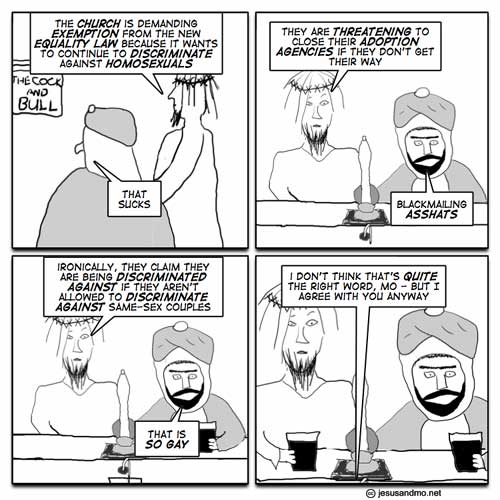





http://news.bbc.co.uk/1/hi/uk_politics/6297107.stm
“Reports say that Communities Secretary Ruth Kelly, who is charged with fighting discrimination and who is a devout Catholic, is considering resigning over the issue.”
That’s a result, then. (BTW, I think “devout Catholic” is understating things somewhat.)
very nice! “That is so Gay” lol
For the first time reading these great cartoons I disagree. The Catholic Church has beliefs (I disagree with them) and if they are running an adoption service they should not be forced to compromise those beliefs. To my mind the Government should not be making laws about this anymore than it should about things like smoking in public. It is a matter of individual freedom of association (or disassociation).
Come on, Nick. So if it’s my firmly held belief, religious or otherwise, that black children should never be adopted by white families, then that’s OK? Oh… hang on… that IS the case??
OK, I’ve got a better one. If it’s my firmly held belief that aryan-looking children should only be adopted by aryan couples, then that’s OK? Or if it’s my firmly-held religious belief that I’m going to refuse employment to black women?
Kidding aside, you may agree or disagree with the gay-discrimination law, but we *have* to stop making special arrangements and exemptions for people *just* because they happen to believe in the supernatural. Or worse still, a particular flavour of the supernatural.
Nick, the Catholic Church receives Public Money through local govt to provide the adoption services. It is absolutely NOT OK for my tax money to be spent supporting institutionalised homophobia.
Ruth Kelly is a member of Opus Dei. An organisation practising a kind of Catholic Dominion Theology. It attempts to get members into positions of authority with the aim of influencing policy. It is a dangerous cult.
nick, the smoking in public argument is faulty too.
if one wants to smoke in one’s house, great. if one wants to smoke in public, one is making the decision for all within breathing distance that they are going to suffer the effects of second-hand smoke. the effects and dangers are documented and it isn’t ok for someone to increase another’s chances of long term health issues. one’s liberty ends where it infringes on another’s.
plus, in countries where health services are paid for by public funds, smokers are taxing non-smokers for their decision to endanger their health. that gets into murkier waters (b/c all sorts of health endangering practices might be ruled against.), which deserves attention.
with either outlook, libertarianism or socialized health care, arguments against public smoking or smoking in general, respectively, are stronger.
Nick,
As T&Z says, they recieve public funding. They place children of any religion or none with adopters of any religion or none. It isn’t their core business, it’s a charity supposed to be done out of the goodness of their hearts. They apparently do it well and the government is glad to have the support, but that doesn’t mean they get to decide on who is unworthy of the service on the grounds that they feel a bit squeamish about it.
Now, if they came out and said ‘Homosexuals will burn in Hell and any children in their charge are likely to so too’ that would at least be a coherent position. But it would rather tip their hand, so they give a lot of flannel about valuing equality and whine about their consciences. Which apparently over-ride the welfare of the 120 or so vulnerable kids they place per year.
Nick, someone’s religious beliefs cannot preclude human rights. If I run an orphanage and believe, based upon scripture, that it is okay to kill the children who are disobedient, would you say that I have a right to do so?
T&Z, are you sure that Roman Catholic Church (RCC) which operates orphanage in, say, Chad, receives your tax money?
Can we put a bit different spin on this? Let’s assume that alcoholism is a life style choice, and that we all may be latent alcoholics. If we don’t state publicly that we are alcoholics, nobody would prevent us from adopting children. However, I am sure that there would be lots of people objecting for openly-alcoholic couple adopting a baby, so I do not think that any adoption agency would facilitate such an adoption. Would you consider this to be a wrong thing? And why would be ok for a government of the day to make a call on what is right and what is wrong on the matter of… well – moral. If you think that RCC is morally bankrupt, I’d say you’re probably right. But why do you think that government is more qualified to make a call on any moral issue. Oh, I know – it can FORCE YOU!!! So… Opus Dei is a dangerous cult? Can they force you to do anything?
VanDerVal, your alcoholics example suggests pretty openly that there is something inherently destructive about homosexual parenting. This has been pretty well proven not to be the case. Alcoholic parents, on the other hand…
I hope the church does close its adoption agencies. Such services should be administered by the government, which is obliged to do so in a fair and just manner (unlike religious organizations, which are apparently just as interested in judging and discriminating as they are in looking after the welfare of children).
And if Opus Dei isn’t able to force anyone to do anything, this is merely because they have not yet achieved their goals. In this way they are like many other aggressive religions intent on imposing “morality” on society.
Jonathan, why are you (continuously) reading things that I did not write? I am certainly not suggesting that there is anything “inherently destructive about homosexual parentingâ€Â. I suppose that you’re making this conclusion because you think that there is something destructive about alcoholic parenting. At any rate, being a gay does not make you a bad parent. It doesn’t make you a good parent either. Who is to say that you cannot be a gay and an alcoholic? So what would matter more than: the fact that you are alcoholic, or the fact that you’re gay? Somehow, I believe that politically correct minds would consider sexual preference first, and then human qualities. When we deal with moral issues, *we* are making decisions for ourselves and assume responsibility. When we act according to the law, we do what we’re told, and delegate responsibility to something inherently irresponsible – government.
Bottom line, by discussing how bad the church is, we are missing on opportunity to discuss how good or bad the law is.
As for Opus Dei achieving their goals – dude, could there be a more dangerous set of governments than one we have now?
IMHO, Opus Dei is a joke. And I thought that RCC did not have a sense of humor.
“if they are running an adoption service they should not be forced to compromise those beliefs.”
The fux shouldn’t be running adoption agencies in the first place.
“Opus Dei is a joke”.
Opus Dei is no joke. They are the Wahabist Taliban of the RCC. For example they teach that it’s OK for a OD member to deny that they are a member. Check out Wikipedia and http://www.odan.org/
What’s an asshat? Is that something you can only find in the UK, like Ribena and barely water? Do Englishmen wear hats on their asses?
BTW – what’s the world coming to when bigots can’t make sure innocent children are brought up bigoted? Boyoboyoboy.
VanDerVal, the Church does receive UK tax money to operate Adoption Services (amongst other FBI’s, so to speak) in the UK. Secular organizations, better reflecting the values of the society they operate in, would be moraly better positioned to operate Social Services. So lets hope the RCC closes its services.
I don’t necessarily think that government is more qualified… etc. I think I agree with where you are coming from there, as a Libertarian. But the subject of Author’s satyre was the Church, not the State.
Carolita, an asshat is someone who wears their butt as a hat. That is, they have their head firmly inserted up it. The perfect epithet in this case.
Hi guys. Well thanks for the (mostly) polite and intelligent response, but you know, most of you are missing the point.
The government should not be legislating what we can or cannot do or think. That is tyranny. Being politically coreect is tyranny. Freedom of speech and association should mean exactly that. The RCC choose not to approve of gay people.
I am an atheist and I believe wholeheartedly in ‘live and let live’. I think the RCC is wrong to believe that gay couples should not be parents but I defend their right to think and say it.
This is the issue and it is the same for smoking. If I owned a pub I should have the right to decide whether it is a smoking pub or not. Those customers, and potential employees, who choose not to enter that environment can choose to go to a non-smoking pub. The government should not be telling us what to do. And, by the way, I am also a non-smoker.
I think that’s a bit strong, Nick.
The government can not and should not legislate what we are allowed to think, but can and will and *must* legislate what we are allowed do. We’re not allowed to kill people or steal from them, for example! You miss the point that the government is not telling the Church what to think. It’s telling it what it is allowed to do in today’s society.
One of the things we’re not allowed to do is discriminate against people on the basis of gender, colour or religion. Why should sexuality be any different? Would you support the right of someone to decide whether or not black people could enter their pub?
Back in the day Christians used their religion to justify slavery, but that’s now a notion thankfully confined to the past. Any opposition to same-sex adoption is just naked bigotry masquerading as ‘conscience’. You may believe in live and let live, but unfortunately the RCC does not.
Nick, there is a contradiction in your position that you are missing. It may be, for argument’s sake, fair enough to say beliefs, bigotted or otherwise, are a private matter. But the UK State FUNDS the RCC’s imposition of bigotted thinking on other humans. It’s NOT a Private matter at all. Especially when we are talking about placing a human child into the hands of an organisation that practices the very kind of thought control that you (I think rightly) express disapproval of.
As a resident of a heavily Catholic part of Massachusetts, I sincerely apologize on behalf of the Catholic Church.
I console myself that while the church hierarchy is nasty, it’s only the hierarchy, and a few fundamentalists. Fewer than there seem to be in the south.
And Catholic Charities had no objection to placing with homosexuals.
The Catholic Church, however forbade Catholic Charities to obey the state, and told them that if the state insisted, the Charities would have to end the program.
Despite the hype, it’s not the freedom of the charity which is being infringed on by the state, it’s the freedom of the Church’s members which are being infringed on by the hierarchy.
I’ve never met an intolerant Catholic layman, nor one who believes in papal infallibility or the teachings on homosexuality and women in the church. However these same people are generally trapped, because of the guilt that their parents or tios or whatnot may lay on them.
Some members of all too many Catholic families get very upset when members leave the Church, or even when friends do not join (my paternal grandparents were Protestants forced by their “friends” to join the Catholic Church while they were in a majority Catholic town. They reverted to Protestantism quickly when they moved out).
My mother, an apostate Catholic, doesn’t see her uncle, a priest, all that often. I get the impression that it has something to do with her conversion to Unitarianism and refusal to marry within the Church.
Catholic fundamentalists (a small minority) make noises that the other Catholics are not really Catholics. I wish the Church would go ahead and enforce its idiot teachings through excommunication.
It won’t though, since it would lose the majority of its members were it to do so. In Latin America, I’ve heard that even many priests disregard the teachings on birth control.
Well, I suppose that they’re not Pentacostals or Scientologists.
Pentacostalism is Catholicism’s main rival in Latin America. I think I prefer the Church to the Pentacostal preachers, and even Pentacostals to the lawsuit-happy Scientologists.
VanDerVal, you wrote: “Jonathan, why are you (continuously) reading things that I did not write? I am certainly not suggesting that there is anything “inherently destructive about homosexual parentingâ€Â. I suppose that you’re making this conclusion because you think that there is something destructive about alcoholic parenting.”
Yes, you are exactly right, I believe there is something inherently destructive about alcoholic parenting. And so when you make a direct comparison and just happen to select an obviously (for me) destructive example, please forgive me for seeing a corresponding connotation. When in both cases the concern is the welfare of the children, I would suggest you choose a more neutral example next time in order to avoid such misunderstandings.
In any case, I’m not sure why you take pains to argue that homosexuality has no influence on the quality of parenting while failing to comment on alcoholism, which is quite clearly at least potentially detrimental.
I believe that by discussing the law (designed to be anti-discriminatory) we are missing a chance to talk about how bad the church is. I am generally suspicious of charities so deeply influenced by bigoted ideology. I’d like to see any state funding withdrawn and placed in the hands of an organization committed to upholding anti-discrimination laws. If people want to be bigots, I believe that is their right. However, they should legally be prevented from making life difficult for the targets of their bigotry. And of course tax exemption should be out of the question for any organization that discriminates. Otherwise the state is subsidizing discrimination.
Nick Timms Says:
“If I owned a pub I should have the right to decide whether it is a smoking pub or not. Those customers, and potential employees, who choose not to enter that environment can choose to go to a non-smoking pub. The government should not be telling us what to do. And, by the way, I am also a non-smoker.”
As I understand it the ban only applies to the owner’s premises which are licenced to sell fermented and spirituous liquors. If the owner seriously wished to allow access to the premises for the purposes of taking tobacco then he could relinquish that licence.
The holders of such licences are members of an oligopoly. As such society which has granted them the licence has the right to regulate the activities of the oligopolists if that is perceived to be of benefit to the society. It is not compulsory for anyone to hold such a licence unless they wish to participate in the liquor trade.
In our polity it the right of anyone to campaign the repeal of the laws which restrict the sale of liquor and those which restrict the use of tobacco in licenced premises.
“In our polity it the right of anyone to campaign the repeal of the laws which restrict the sale of liquor and those which restrict the use of tobacco in licenced premises.”
In my experience among the first to object to any proposal for relaxation of the restrictions on the sale of liquor in unlicenced premises are existing members of the oligopoly.
I’m also a libertarian, and it’s my belief that there is a certain point where one person’s freedom infringes on another’s, and it stops being freedom then and becomes anarchy. This is a difficult line to see, and is the true meddle test of any society. To ensure the maximum freedom possible with the least regulation. Most western nations are losing their momentum and about to stagnate because of this.
IMHO, of course.
Ruth Kelly might resign over this? That sounds like a great reason to keep pushing. We already have the Roman church too involved in the lawmaking process – so ridding the government of Kelly would be more than welcome at this point.
LQ you said that most Catholic laymen disagree with the Catholic teaching on homosexuality, but I don’t think that you or the other Catholic laymen understand the Catholic teaching on homosexuality
Fortunately, it’s not necessary to understand the Catholic teaching on homosexuality. As a myth-based teaching, it carries no weight.
I disagree. Catholics believe that homosexuals are perfectly normal and fine but acting on homosexual desires is wrong. The Catholic church holds a life of celibacy in high esteem so homosexuals are called to something greater than the rest of us.
Of course, it is your right to disagree, but until you can show those of us who require evidence and sound reasoning that the basis of this Catholic teaching is anything more than a myth, we will have no basis to give it any weight.
I could but I wouldn’t know where to start. If you are Christian then it will be easy, but if you aren’t then it will be more difficult. I can give you plenty of sound reasoning without involving religion.
I’ll warn you that I’ve heard many, many (unsuccessful) arguments, but you are welcome to try to convince me. Incidentally, as you may have suspected, I am not a Christian. And I suspect your “more difficult” is a bit of an understatement.
If you are not a Christian then I’m assuming you believe in the theory of evolution (I do too but it is slightly different and most Christians don’t). We live in a world where the highest evolved animals (next to humans) have no consciousness or very little, no deep emotions such as love, hate, etc…, and are incapable of creating a complex society that isn’t just on an instinctual level. Human beings are extremely odd. There are no creatures like us. We are personal beings, capable of deep emotions, and are capable of rational thought and using it to overcome our animal emotions. My question is that why would an earth so opposite human nature evolve creatures such as us? We are so contrary to anything else in this world. If this is just evolution then we are fish out of water. If an effect can’t be greater than its cause, and we (the effect) are personal beings then logically the cause must be a personal being. This sounds a lot like God to me.
There is a Christian (maybe just Catholic) alternative to intelligent design that, logically, makes plenty of sense. What if human beings were monkeys physically and had evolved, strictly on a physical level, to having human like characteristics. Then God, in one instant, not over time, gave humans a soul, reason, and intelligence. This does not contradict any scientific fact that I know of and it goes along with the Bible. The Bible says six day, but I have heard that the original Hebrew had no phrase for a period of time so it did not mean a literal day. It also says that man was formed from the slime of the earth, not mud. Couldn’t slime mean anything relatively insignificant. It could be monkey with human like features. This theory seems to fit well. It allows for God and the scientific facts that point to evolution. This gives life meaning and calls us to something higher as well and it helps to know that we aren’t just freak accidents of evolution.
I get a lot of this from an excellent book. I highly recommend it because for a while I was questioning the existence of God myself. I noticed that the burden of disproof does not lie on the agnostic, so I had to prove that God existed and this book put this into context and explained things very well.
I forgot to put the name if you were interested. It is called “Letters from a Skeptic”. It is a compilation a letters from an agnostic father to a Christian son. Though, I disagree with some of his views on God’s knowledge of our future choices he makes some excellent points about the existence of God and the validity of the Bible. It is at most Barnes and Nobles and Borders.
Richie, regarding your first point about humans being far beyond (other) animals, I am afraid I don’t agree. There is a great deal of evidence pointing to the presence of the characteristics you list and others that at least some other animals share with humans, though perhaps in lesser degree. It is true that humans have surpassed other animals in terms of technology, but we are still very much animals. I see no reason to assume that our species does not merely comprise animals that have managed to climb to the top of the food chain. And everything humans are today can be traced back down the evolutionary ladder. Rather than ask myself “how can this be?”, I ask myself how it could be any other way.
I would also argue that our so-called “animal emotions” are in fact simply our emotions. I don’t believe that we are contrary to other life forms on our planet at all.
My problem with anything religious is the fact that it is not based on scientific method, the only reliable way humans have managed to come up with for gaining knowledge about the world. A basic assumption is that we should believe nothing that is not verifiable through evidence. This principle shoots down all religious arguments because these are based on religious texts and ideas, which are never based on evidence or logic. Sometimes a religious assumption is followed by a logical chain, but this just means that the argument is invalid from the very start. Starting with the bible and looking for things that may coincide with science is not scientific. Science and religion are in my view completely incompatible, primarily for this reason. A theory that “allows for God” is in my view absolutely unscientific.
There is no burden of disproof. There is only burden of proof, and religion, lacking such proof, can be dismissed out of hand by anyone who views things scientifically.
Regarding agnostics, you may have heard of the Flying Spaghetti Monster (there is a Wikipedia entry). An agnostic, whose claim it is not to know whether gods exist because he cannot disprove them, also cannot disprove the existence of the Flying Spaghetti Monster and must, logically, consider him (the FSM) to be equal in probability to any other gods. I find the idea of agnosticism exactly as absurd as the possibility of the existence of the FSM.
I’ll remain an atheist until verifiable evidence proving the existence of god (s) turns up. But based on what I’ve learned so far, such evidence would be absurdly improbable as it would contradict all of the things we have proven using scientific method. Additionally, I personally am happy with life the way it is and would not want to be subject to any sort of god. I’ve never believed in any god and have never understood some people’s need to believe. This probably explains my lack of interest in the bible. Religion interests me primarily because I don’t get it myself at all, but for many people it is a good enough reason to blow themselves up, even taking others with them. I must admit I have not seen this behavior in other animals.
I completely agree that the burden of proof lies on the theist, but (if I understand you correctly) you are saying that you are not an agnostic. I tend to stay away from the term atheist because it literally means no gods. You can’t disprove God so you can’t be an atheist. I use the term agnostic because you can’t be 100% sure that God oesn’t exist. Now back to the matter at hand.
If you need physical evidence that there is a god then I can’t help you because there is no fossil record that points to God and you can’t find secular documents that show God’s existence with physical evidence. If you are open to arguments of logic then that’s how God is proven. Now about your point that people look for scientific facts that coincide with the bible. I agree that that is just moronic. Those people do not grasp the main point of the Bible. The Bible never claims any scientific in errancy . There is a certain part in the Bible that calls bats birds. We now know, through science, that bats are mammals. Does this mean that the Bible loses its credibility? No, the Bible never makes a claim to be a book of scientific facts. It only makes the claim that it is inerrant on matters of faith and morals. I see science and religion (pure theism, not any specific religion, just for this point) are not contradictions but paradoxes. Looking at the Bible strictly at its word, it says Jesus was fully God and fully man. The definition of God is not lack of man and the definition of man is not lack of God. This would be a paradox, not a contradiction.
I don’t think that any animals have the reasoning, intellectual, and loving capacities that humans do. Emotions, I believe, are not just instinct. There is an instinct in most animals to protect their young, but I don’t know of any animals, besides humans, that show mercy, compassion, and charity to their young and to others. Human beings tend to want to help those in need, but all of the animals that I have heard of either contribute to the herd or get kicked out. Compassion and charity seem out of place in this world.
I was just thinking about another thing as well. If we mirror our world, as you say, because we are not out of place then why was Hitler wrong? I don’t see any morals in other animals. Where do we draw our moral boundaries? Do we just happen to think that murder is wrong? Because most animals follow the law of kill or be killed. I am sure that you know that murder is wrong. Why? I think that we need a moral reference point to base our own actions off of. We don’t have to think about it, but it is in the human nature to want to help those who can’t help themselves and not to murder others. That must reflect something; it doesn’t reflect the world we live in so it must reflect a being greater than us which in turn must be a higher power of some kind.
Also humans are the only beings with such a highly evolved form of reason able to contradict instinct so blatantly (except for the instincts that we need to live). Why, if humans are such great creatures and the highest form of life, are there no other forms of life like us. I want to know your thoughts on what I wrote about the alternative to intelligent design that allows for both God and the physical part of evolution. It seems to make more sense to me than either of the two separately.
I made a mistake in my last paragraph. Humans can contradict the instinct for food, water, etc… I want to add something as well on the same note. If you starve a dog for a few days and put a steak in front of it then it will attack the steak and eat it. If a Nazi had captured a soldier and told him that he could eat if he told him the location of his squad, the soldier could refuse where any other animal would just eat.
Richie, I call myself an atheist because I assume there are no gods until convincing evidence for their existence is presented. Otherwise, I would be trapped in the situation of having to entertain the idea of the existence of literally everything for which there is no evidence, regardless of whether it contradicts that which science has already demonstrated. Such as the Flying Spaghetti Monster. This is the problem with agnosticism. It makes everything for which there is no evidence equal. And if Jesus, Mohammed, Zeus etc. are equal to the FSM, then I rest my case.
Since none of the supposedly holy books are based on good science, I would not bother bringing them into contact with science. Even if you can find things in them that don’t directly contradict science, that isn’t evidence of anything since you did not start with a scientific basis. Science piled on top of an unscientific assumption is not science. Personally, I have never had a need or interest in “allowing for God” in my science. Which is why I am not on the lookout for alternatives to “intelligent design” and other theories that do not have a scientific basis. I am instead quite fond of the scientific model.
I still think you are making too strict a division between humans and other animals. Yes, humans have some impressive differences, but, as I mentioned before, just about every characteristic humans have is present in some animals in greater or lesser measure.
And for the record, many animals do not live on a kill-or-be-killed principle. Animals also form societies, and many of the skills necessary for living in these societies must be learned, i.e. are not instinct. I’m sure you have seen films of animal parents teaching their offspring the skills necessary for life.
Of course, there are also humans who operate on a kill or be killed principle. Even religious humans. Just look at any of the wars going on today.
Perhaps where I disagree with you most strongly is your apparent claim that religion is the basis of morality. Treating others the way you would like to be treated is not a religious concept, it is a logical concept, and forms the basis of nearly every society. Many animals have learned that there is more to be gained from cooperation than killing, though they, like us, are often torn between principles.
The cooperation principle does compete with other principles, including kill or be killed, not just among other animals, but also among humans.
Regarding your Nazi example, there are emotions among both people and other animals that seem powerful enough to override the survival instinct. (And that’s not to mention something called conditioning.) Have you never seen examples of animal parents risking their own lives to save their offspring? Never seen pictures of a mother monkey that won’t let go of it’s dead baby? Never seen an animal mourn the loss of a mate? I think other animals are more like humans than you claim. And humans are more like other animals.
I think you misunderstood my point on the bible. I agreed with you and just stated objectively how it is supposed to be interpreted, as a book that is inerrant on faith and morals. I think that any scientific statements in the Bible, whether right or wrong, hold no bearing on the point that is trying to be gotten across.
Human beings are greater than other animals because of their innovation. Animals usually have some form of brute strength, claws, shell, or another defense mechanism. Humans have survived through invention and innovation. Humans have created weapons to fight with while apes have a vast amount of strength. Humans seem so weak compared to the other animals in the world. Why would humans have the capacity for innovation if it goes against every other animal on earth? It is just not how animals survive. Animals have always had a physical survival mechanism like a porcupine has spikes. It is just contrary to how animals have survived since the dawn of animal-like life. If you say that all of our human characteristics mirror something on earth then why doesn’t this. It is just contrary to everything.
I just came across this in an article I was reading. Great apes communicate information. They can speak about where the predator is. Is it on a level comparable to that of a human? I think you are drawing too vague a distinction between humans and animals. Humans can debate, hold opinions, try to change others’ opinions, and look at things and question why. Apes do not realize that any other apes have ideas, opinions, or desires different from their own. Yes humans share many other characteristics with animals, but the things that make us different from other animals is what also puts humans above those animals. Our differences are not just differences, but they are vast superiorities. No other animals contain the theory of mind like humans do. That is what does not reflect anything in this world. That is why I refuse to believe that there is no God because we are different from everything in this world and our differences make us superior. Our differences have to reflect something and they seem to reflect the Judeo-Christian idea of a loving and intellectual God.
Richie, my comments on “holy” books were designed not to argue that they do or do not contain much (or any) science (you have already acknowledged this); instead they were intended to show the futility of trying to integrate faith (generally based on such books) and science.
I think you might find it interesting to examine the more closely the societies of the higher apes. They not only share 98% of our DNA, they mirror us in many aspects of our emotions, behavior, communication etc. Though, of course, not quite at the level of humans. (And they don’t, apparently, have religion. But then, neither do I.)
By the way, I would be interested to hear your response to my discussion of agnosticism, and, as a follow up, how you would respond to the discovery (just for the sake of argument) of extra-terrestrials that are more advanced than humans. Logically speaking, more advanced extra-terrestrials are far more likely than gods. Would this not have an impact on your strict human/animal division? How would you deal with a genetically engineered human/ape hybrid? Such a thing is also not completely outside the realm of the possible.
I think our main difference is how close animals are to humans. I think humans have vastly surpassed animals, while you don’t. I think this is the root of our problems. I don’t think that we are going to agree.
I see your point on the agnosticism argument and it makes sense, but I think the FSM is a metaphor just to show, if you can’t prove God exists, how silly it is to say that God exists because you can’t prove he doesn’t. I see what you mean, but I don’t think that agnosticism, in all seriousness, goes beyond the belief in God. I think that technically agnosticism can be used to put all things that cannot be disproved on the same level. My original point on this matter was that, by the definition of the word atheist, it is impossible to be an atheist. It is impossible to conclusively say that God does not exist because you can’t disprove him. You just won’t accept that God exists until you are given conclusive evidence, but you can’t say for a fact that God doesn’t exist. That doesn’t mean he exists, but it means you can’t find evidence to support a claim that God doesn’t exist.
If extra-terrestrials that were far more advanced than humans were discovered, I think that I could no longer be Catholic. Catholics believe, if you were not aware, that Jesus died on the cross and the priest during mass is turning bread and wine into the body, blood, soul, and divinity of Christ by reliving that eternal moment. (But, before I entirely threw away my faith, I would question and try to find out why I should still be Catholic and understand Church teaching better). That would mean that this alien species had to have Jesus come and redeem them as well and the same sacrifice would not be eternal. This would not change my animal/human distinction. This distinction only applied to how humans reflect the natural surroundings according to your reasoning. I think this new alien species would only help my point because I think that everything alive reflects at least some tiny aspect of God and some just reflect God more perfectly than others. This would mean that some aspect (their intelligence presumable) reflects God’s intelligence more perfectly than ours does. The distinction I made was to show that God exists, but if God exists then humans don’t need to be the pinnacle, they just need to be part of God’s plan.
Your human/ape hybrid is an interesting question. I’m not sure what you are looking for. I would be against it because scientists are playing God. I believe that it would be successful. I believe that apes had physically evolved to having human-like physical characteristics and in one instant God imparted rational thought onto them. After that, it was genetics. The children of the first humans were humans because of genetically passed on traits. So I think a genetic experiment like that would be possible, but just because it can be done does it mean it should be done.
The bible does not try to integrate faith and science. People try to use scientific statements in the Bible to show that the Bible is scientifically accurate. Any scientific statement in the Bible is there merely as a sidenote, and if it wasn’t there, the story wouldn’t change at all.
Now in an earlier message you said that religion and science are contradictions. The Catholic tradition has been that faith and reason go together. Out of curiosity, what are some contradictions between religion and science?
Richie, the central fallacy upon which your whole argument is based is here:
it is in the human nature to want to help those who can’t help themselves and not to murder others. That must reflect something
You need to justify this bold assertiion. If you cannot, then your position is unjustifiable.
I assume you want me to justify the bold statement. We as human beings have two parts, physical and intellectual. The physical part needs food, water, etc. Either we live in a world that accommodates our needs or we don’t. We hunger, and we thirst. This world accommodates us physical; we hunger and behold there is food , we thirst and behold there is water. Our physical needs are not out of the capacity of this universe and it is reflected by the bounty of things that fit our needs. Therefore our intellectual side must reflect something. We are personal beings that have intellects and reason and compassion. This must reflect something as well because all of the human person must fit in with the cosmos in which we live, or our existence is out of the ordinary. My point in saying that was to point out that if our physical needs are reflected then we as personal beings also must have something that from which it is reflected. If we are personal beings with intellect then there must be an overarching mind of the cosmos that is just as personal as we are. Otherwise we are freaks of nature. Why would the cosmos evolve something whose needs and capacities are not met by the same cosmos that did evolve it. The cosmos seems to be impersonal so there must be something which most people refer to as God
Richie, I see your point about the word atheism, and it is possible to argue your point as it applies to those who state that there are no gods. It is possible, however, to use the term atheism to mean simply a non-theist.
Then there’s the pragmatic use of language. While it is technically impossible to disprove the existence of something, there are things that are so much in contradiction with everything we know through science that there is little objection to general statements about their non-existence. Would you have protested if I had said there is no Santa Claus? I can’t prove he doesn’t exist. Yet I say without embarrassment that there is no Santa Claus, no Flying Spaghetti Monster and there are no gods. All three collide with what we have learned about the world through science. So I persist in calling myself an atheist, both in the first and second sense. I find agnosticism is used far to often by people who deny the existence of Santa Claus, but still can’t say there are no gods, and I don’t want to be lumped in with them.
Regarding other animals, yes, I acknowledge we have vastly surpassed them in some ways, but I can also see how the differences developed slowly over time. It does not seem like much of a mystery to me how the differences came to be through natural processes (i.e. evolution).
My human/ape hybrid question was to find out how you would react to a being not clearly animal and not clearly human. Would such a being go to heaven or not? How would the Catholic God decide whether to give it a soul?
I found your reaction to the superior alien race question very interesting. However, I would suggest that superior intelligence would have nothing to do with religion; instead the aliens would have to have the characteristics generally attributed to the Catholic God in greater measure (mercy, love etc.). Intelligence would not necessarily be accompanied by these things. And if they did more perfectly reflect the Catholic God’s intelligence than we humans, would we perhaps be animals to them? This would also open the question of how close to the nature of a god can we get without being gods ourselves?
As for science and religion being at odds, the basic contradiction for me is that it is not scientific to come to the conclusion that the universe was created by an intelligent being. There is quite simply no basis for such an assumption, and it is thus unscientific. A house without a foundation cannot stand no matter how carefully the rest is constructed. It’s the same reason I consider the “intelligent design” theory to be illogical.
I think wombat has a point, too.
Well I see your point about us being animals to aliens. Human beings do not have to be the pinnacle like I said earlier, but humans still are above any other animals in philosophical thought. Animals cannot have philosophical thought so we wouldn’t be animals to them. If we were animals to them then you would be an animal to Einstein because he was smarter than you. Intelligence does not dictate being an animal to someone else, but self consciousness and realizing that other people hold different opinions than you is the main distinction (not the only) I make between animals and humans.
As for your comment about religion and science, let me use an analogy. In math you may be given an answer to a problem. Isn’t it possible to work backwards. This argument only works with this number but another equation with more advanced math would work too. Say you have the number 4 and someone asks you to find a way to get that number by multiplying (using whole numbers). There are two ways (4×1 and 2×2). No look at the Catholic Church, it never contradicts a scientific claim in this present day. If science makes a statement that one can realize through religion as well does it make it less correct if it was said first by a pope. If the Catholic Church agrees with scientific fact then why does the person who said it matter. By the way Pope John Paul II stated in an encyclical that evolution is more than a hypothesis and should be looked at and examined carefully by the faith (Catholic followers).
I disagree with the intelligent design theory as well if you are speaking strictly of the 6 days and God literally sculpted man theory. I think that evolution happened merely on a physical level and the human reasoning capabilities where given to us by God in one moment. My question in my last entry was targeted at specific discrepancies between religion and science and I am pretty sure that they can coexist peacefully.
Now about your argument that you have seen natural differences develop over time. If humans are at the top of the food chain then they are the peak of evolution. So the point of evolution ,of apes anyway, is to evolve them to the point of humanity, logically. Apes have been around longer than humans have and apes have not started to take on human-like features slowly since the dawn of man. I just don’t think that it is possible to make the leap from communicating just information to being able to debate and be self aware and to realize that others have different opinions. It has happened and it doesn’t seem to be happening.
Your question about how close to God can we get without being gods ourselves seems to me to be ridiculous. If the Catholic idea of God is infinite in every way then how could a finite being take on all of the qualities of God.
I don’t know about your ape/human hybrid. I would have to find out, and I will put the answer in my next entry. It is an interesting question, though.
And I just have one more thing to ask because I want to set up another argument. My question is: can an effect be greater than its cause?
Richie, the essential difference in opinion we have on humans/animals seems to be difference in degree (my argument) or difference in essence (your argument). I still say that evolution, both of humans and apes, can be traced back step by step, indicating a difference in degree. BTW, check the recent news for accounts of apes that have developed their own tools. Now word yet on whether they have developed religion or philosophy.
I am aware that the Catholic church no longer repudiates evolution. However, my complaint with religion and all apologies for it is that it quite simply is not scientific. Science does not start with the answer and work backwards to prove that it is true. Yet this is exactly how religion misuses science. An intelligent god is simply not the most plausible or most likely explanation for anything. Not to mention, of course, the fact that no one has every had any success proving the existence of a god, at least from a scientific standpoint.
Intelligent design is not the theory with the 6 days of creation, as far as I know. It argues instead that simple forms cannot become more complex, and that based on the complexity of what we see in the world around us, especially in humans, there must be a more complex form who created it. In any case, it is a theory without serious scientific support, probably because it bends any science it uses to support its forgone conclusion. Which is unscientific. Religion and true science cannot coexist peacefully, unless the religion side allows itself to be pushed so far back that the definition of god (s) becomes something so vague and undefined that it could be described as merely the forces of nature. The concept of god (s) becomes more plausible the further it gets from a bearded creator floating in the sky making bets with the devil (Job) and giving orders to humans. The problem is, the concept of gods never becomes really plausible. It was a concept developed by primitive people to explain the world, and was progressively adjusted over time to accommodate facts that could no longer be concealed or denied. Religion has in this sense been on the retreat since the very beginning, except among people who give it a higher value that reason itself (radical Christians and Muslims, to name just two). Compare concepts of religion in the Catholic church today to concepts of gods a couple of thousand years ago. There is a world of difference. It would be pretty difficult to argue that people were even worshiping the same thing. Don’t even get my started about turtles backs and the Greeks etc. I can’t quite imagine you defending these varieties of religion. Yet they existed and to some extent still exist today. Is this what these people are doing with the souls the Catholic God supposedly gave them?
Regarding your question about an effect being greater than its cause, I can’t say much until you give me more of a framework. For your reference, I am a strict determinist for the simple reason that I see no reason to assume that causal relationships ever break down. (The consequence being that everything is caused, even our own thoughts, and there is no such thing as chance in the universe.)
I was on vacation for a while so I didn’t get to write back. Sorry for the delay.
About the animal vs. human points, I think that the difference cannot be in degree alone. If it was difference in degree then not only would the intellectual degree have risen, but also the physical degree. As you go up the evolution chain, you find that natural defenses go up as well. Snails have a shell that, in proportion to their size, is an excellent barricade. Chimps are extremely agile and evasive. Larger apes are very strong and also agile. Humans, though, don’t have any natural defense mechanisms. They have no spikes, like porcupines, they are by no means strong in relation to the great apes, etc. The human intellect does not work in cooperation with human natural capabilities, as with apes (relaying of information to determine whether to fight or flee). The intellect of humans serves a different purpose than the intellect of other animals. The essence is completely different than that of other animals. The human intellect is arguably not even the same thing as the animal intellect.
Religion has no authority to make any scientific claim. Religion does not have any forgone conclusion, as you said. The Catholic Church had taught Intelligent Design for a long time because it was the only explanation at the time. Were the Greeks wrong for saying that winter was caused by the sadness of a goddess, yes, but should they be condemned for thinking that? I don’t think so because science was not keeping up with the questions of why things happened, and how, so religion stepped in to fill the hunger for knowledge.
The Catholic Church does not make a claim to be infallible on scientific facts. The Church has no authority (the Bible included) to make a scientific claim as fact. In the times of the early Church, the Church was the center of knowledge, power, and authority. It was a given for the Catholic Church to make a statement on every matter. There was no government and there were no scientific advances being made in the early middle ages. The Bible said intelligent design so the Church always said intelligent design, as did the Greeks. The point is that the Church’s forgone conclusion was a given; human beings exist. This was not one of faith or of the Bible. This was something seen in ordinary life everyday. The people of the time were illiterate, did not understand the purpose of the Church, and treated it like any other pagan religion. Pagan religions had a consistency of making the gods responsible for everything. The Church needed to do something so it said intelligent design.
This was not an infallible statement, though. The Church has no preconceived conclusion of a scientific fact. The Church doesn’t need to be scientific in any fashion because it doesn’t incorporate science. Gregor Mendel, the father of genetics, was a priest. He did not say that things get attributes from parents. He followed the scientific method. He ran experiments and controlled tests. The Church had no impact on this discovery. This was an individual scientist who had a question about genetics. The Catholic Church had no forgone conclusion on genetics because science and religion, though they coexist peacefully (meaning one will never refute the other), ultimately, have nothing to do with each other. The scientific community cannot create new doctrine, and The Catholic Church cannot make a scientific claim. My point is that your view of the relationship of religion and science is flawed.
About your point on the Greeks and now we are not even worshiping the same thing. You said ,”Is this what these people are doing with the souls the Catholic God supposedly gave them?” God has no direct hand in day to day matters. I would have no idea what to worship, had I not been instructed by my parents. The soul is not a flashing sign that says “worship this way”. It is the spiritual part of the human being. Most people in the world never question their beliefs, not because they have been instructed in every aspect of the faith and have no doubt of its correctness. It usually never occurs to people. That is why I enjoy dialogue with atheists, because they, for the most part, were brought up in some religion and questioned it. I personally believe that they went in the wrong direction, but atheists seem to be very intelligent as opposed to most religious people who accept things blindly. My point is that it nearly was against the law to question the gods. One of the few Greeks who questioned the gods was Socrates. He realized that the Olympian deities were illogical, and he began to believe in a monotheistic concept of an unchanging god. If you look at the purpose of God (to be more like Him) then you also realize that God must be constant because to be like Him, He must have a set nature. Nobody questions their beliefs, not because their souls tell them otherwise, but because it never occurs to them that they might be wrong.
My question in my last entry was very vague and I apologize. My point was that we are undoubtedly the effect of something because we (human beings as a race) did not cause ourselves. What, do you believe, is the cause of everything? Because an effect cannot be greater than its cause. With humans being the effect, the cause must be equal to or greater than us.
Richie, you did reply I see. Hope you enjoyed your vacation.
I’m not sure I follow your argument for parallel physical and intellectual development. I don’t see any connection there. All animals, including humans, have adapted to their environments with varying degrees of intellectual and physical development.
My beef with religion is not its pronouncements on science (and it has made them at different points in history; I’m sure the Catholic church’s attempts to coerce scientists at various points in history are known to you), it is the fact that it can’t scientifically justify its existence. There is no scientifically plausible reason for religion to exist today. From my point of view, religion in general has no justification for its existence except as the subject of historical study.
If religions were content to remain social clubs where people get together for interesting rituals I would have no problem with it. Unfortunately, my atheistic views are not readily accepted by religious people of many variants and most religious people want to structure society in such a way that it is in accordance with their beliefs. This makes it a threat to me and my way of life. I believe that a government should make all decisions based on reason, not the unscientific tenets of some religion.
As for Socrates, the concept of an unchanging single god is no more logical or plausible than the belief of some Hindus that there are gods in all things.
I agree that we did not cause ourselves. What the first thing to happen was after which all things followed is unknown to us. Actually, we can’t even say that there was a beginning. Perhaps the universe, or existence itself, have always existed. We just don’t have the information. But a being that we call a god is among the least plausible theories. Personally, if I don’t know something and I don’t have the means to find out, I am unwilling to tell myself that I know the answer. That would be the acme of intellectual dishonesty.
As for me, I am always asking myself if I might be wrong, and always throwing my views into forums such as this one to see if anyone can take a bite out of them. When they do, I adapt my views in accordance with the new info.
My point was that humans have virtually no physical defenses. Also the intellect and ingenuity serves as the defense. Human intellect serves a different purpose than that of other animals. It is different in degree but also different in essence.
My point about Socrates was that what you said about the soul was wrong.
There are two scientific reasons I think for religion. One is that it might just be right and if it is then that would be good enough for me. The second is that there are ways to prove God. For example, in religion you have a question and you know the answer, so you know which direction to go. You may call this unscientific because you have a preconceived answer, but think of it like this. You are in Venice and you know where Rome is, and you need to get to Rome. Is that unscientific, just because you know where you need to go and need to find a way there. Most people think evolution therefore there is no God, but what if it is evolution therefore I look to see if it is incompatible with religion. And you saying that there is no scientific reason for religion can be turned around, and I could say there is no religious reason for science. Just because you don’t need science to prove religion doesn’t make it wrong. You don’t need religion to prove science. I think ultimately you could survive without understanding scientific principles, but could you survive without religion if it was right?
Actually, humans (ones that are physically fit anyway) are by no means physically defenseless. While humans would generally run from a fight with a bear, rabbits have to watch out for us, as do many other animals. Again, I will argue that intellectual ability and physical ability are always combined in such a way that allows for survival in the animal’s environment. Granted humans, having developed the ability to change our environment to suit our needs, have perhaps to some extent transcended this system. But it didn’t happen all at once; we can follow the history back to ape-like beings with behaviors not all that different from that of apes.
I’m not quite sure what you mean about my being wrong about the soul. Actually, I don’t even believe there is a soul in the sense of something immaterial that dwells in the physical body. I think that what people call the soul is just the set of complex brain functions.
I’m afraid I must strenuously disagree with your claim that there are two scientific reasons for religion. “It just might be right” is certainly not scientific and is completely unsupported by any type of evidence. There just might be a Flying Spaghetti Monster. The total lack of evidence is the same as for the Catholic god (and any other gods for that matter).
The way you want to prove the existence of a god is also in my opinion completely unscientific. What you describe as “knowing” is something also completely unsupported by scientific evidence. You may believe that you know, your emotions may tell you that you know, but you cannot supply the evidence that would be necessary to convince someone (like me) who insists on scientific proof. It can be proven that there is a Rome. It cannot be proven that there is a god.
I also can’t accept your suggestion that you can turn science’s argument against religion around and challenge science from a religious perspective. Science is a system that must continually demonstrate that it works through logic, transparency, reproducibility etc. Religion has never succeeded in showing that it works at all and relies on its adherents’ insistence that they “know” there is a god even if they can’t demonstrate the truth of what they “know”. Religion and science really have nothing in common. Science can be demonstrated to work, religion can’t.
Humans can survive without scientific principles. Of course, they would live like other animals from hand to mouth, but in some environments they can indeed survive. Could I survive without religion if religion was right? Could you survive without the Flying Spaghetti Monster if he/she/it were the creator of the universe? Both of these questions are absurd without evidence. And there is no evidence. That, in a nutshell, is why I consider religion to be completely without truth or substance.
Humans were always adapting their environments. Making weapons and bowls and such. Humans have completely transcended the system from the beginning.
Earlier you mentioned something about the Greeks worshipping weird gods and asked if this is what they were doing with the soul that the Catholic God gave them and my point was that if the soul exists that is not its purpose.
I didn’t mean know as in you are sure of, but you assume as given. I don’t know that there is a Rome. I assume there is one because the person that gave me the map said that the closest city is Rome. My point is that knowing where you are going before you start isn’t unscientific; it just helps guide you.
What do you mean religion can’t be demonstrated to work? What is the purpose of religion?
Not from the beginning, and it didn’t happen all at once… Again, a gradual process that we can trace back quite a way.
To an atheist, all gods are more or less equally weird. And you will first have to show me (scientifically) that a soul exists, right before you show me (scientifically) what its purpose is before I can accept your statement about what the purpose of the soul is not.
By the way, do Buddhists etc. go to the Catholic heaven? What about well-meaning atheists? What about serial killers who repent and confess?
And I would still ask you why you would assume that “Rome” is not just some fantasy place out of a story. How do you know it wasn’t the Flying Spaghetti Monster who inspired the map? Or was it just some guy (or gal) with a quill and some parchment and a little imagination? Here I would have to say that to assume you know where you are going when you don’t even really know the place you are going to exists is pretty unscientific.
And by “can’t be demonstrated to work”, I mean just that. I hear many people describe many purposes of religion, but none of them can convince me that it actually does that which they claim any better than the absence of religion, which is what I have as a comparison. Did I mention that I grew up completely religion free? (Except in the sense that I was told many times as a child that I would go to hell if I didn’t get religion.)
Humans started out with nothing, but they realized more efficient ways. For example, I’m sure humans originally hunted by hand, but they saw that it was inefficient and made spears (or something). The point is that apes still hunt by hand, jaguars still hunt by hand. Humans have never seemed to like the status quo and have tried for bigger and better things.
Rome doesn’t seem to be the best example because everyone knows about it and that it exists and accepts its existence. Let me try another example. If you are traveling through America and you are in the Midwest. You need food and water. You stop at a gas station and ask for directions because you don’t have a map of your own. He says that the next town is some small town that you don’t know about. The man lives around there. Do you assume that the man is wrong because it is a stretch of the imagination to be traveling to town that you aren’t sure of and can’t prove, but can assume is there? I would take the man’s word and go in that direction.
The Catholic teaching is that there are two kinds of Baptism (actually three but the third is irrelevant here): Baptism of Water, traditional Baptism, and Baptism of Desire, which is when someone who, if they knew Christianity, they would have been Baptized or if they were going to be Baptized and couldn’t be (death). I believe most Buddhists are going to heaven, because they are peaceful and try to do good. As for atheists I believe that a lot of atheists are going to heaven. An early Church saint called Socrates a Christian because he spent his life seeking the truth and if Christ is the truth then him and a lot of atheists are going to heaven.
I don’t know what reasons for religion you have been given but I think the main reasons for religion are hope, salvation, and spirituality. Salvation and spirituality are not temporal which makes them nearly negligible unless you believe. I think hope for eternal love and life is what is given. Religion will always exist, right or wrong, because people need something to give them hope. Life is not enough for some people and the thought of this being it is almost inconceivable.
You said “Yet they existed and to some extent still exist today. Is this what these people are doing with the souls the Catholic God supposedly gave them?” My point was that if the soul exists then this is not its function.
So what do you say about apes and birds that use tools; apes, big cats, wolves etc. that communicate and cooperate during the hunt? None of the abilities that humans have appeared all that suddenly or completely.
Your example of the gas station is no different from the Rome example. You know that the man lives in the area, because he runs a business he has a motivation not to lie to people. And the next town is also plausible.
This is not comparable to following a path in the direction of something that is both implausible and 100% unproven. Your example seems to me the equivalent of walking aimlessly.
The picture you paint of who gets into heaven is somewhat more benevolent than the versions I normally heard as a child. My problem with this vision is not its mildness, but rather the fact that it is not based on any sort of evidence. Also, although it’s beside the point, I have no desire to exist without my personality, relationships and things. So if I can’t take them with me, I’d just as soon not exist.
I have no need of anything to give me hope and spirituality as I already have these, though perhaps is a more realistic version (realistic = not in conflict with science – I suspect you would deny my spirituality is really spirituality), and as mentioned above, I don’t see the point of salvation. But I’m sure you are familiar with many of the bizarre things people hope to get from religion.
My view of religion is that it was born of weakness among people who wanted an easy answer for all of the things about life they didn’t like or couldn’t understand. I can see how such a motivation could perpetuate religion, but I can’t help thinking that people who aren’t indoctrinated as children and who have the strength to face the facts of life are stronger and have a fuller understanding of life. I think it builds character to learn to face facts, such as death. It disturbs me that children should be taught to believe something of which they can’t in any way confirm the existence. How do they then learn to accept anything about life they don’t like? How do they then avoid living in an imaginary world where they just have to believe something to make it true?
And regarding the function of the soul, do you at this point expect me to accept the existence of the soul on the basis of your comments and also that you know what its purpose is? Being who I am, how could I believe such a thing? I think we need to address the issue of faith itself if we are to resolve this discussion, though it would not seem that one or the other will be convinced of anything. I think we need to address the issue of faith itself if we are to resolve this discussion, though it would not seem that either of us will be convinced of anything new.
And by the way, what drew you to a web site such as this one?
Oops, no edit function for my duplicate sentence. Choose whichever one you like.
You seem to be missing me on the soul issue. You don’t need to believe it. But if there is soul then it doesn’t do what you said it did.
My analogy about the road has nothing to do with wandering aimlessly. The old man who lives in the area represents the Catholic Church. It is close to God, if he exists, and knows the way to him. You can’t find the town (God) on your own. You need the guidance of the Church. Most atheists that have fallen away from faith seem to not have a complete understanding of the religion side, but they have a full understanding of the science side. I’m sure you don’t know everything that you do about science from trying to rationalize it. You have studied and read things, but you seem to make an assumption about God by rationalization and without understanding the teachings on God from the Church. Isn’t that being unfair and not being open fully to the possibility of God.
Animals that use tools make bowls or nests or something. They aren’t rational and don’t invent new tools because they aren’t satisfied with the efficiency of it. It was instinct. Their tools and our tools seem incomparable. And helping each other in the hunt is also negligible. Simply being able to relay facts takes no reasoning capabilities whatsoever.
My point on the soul issue is that you seem to be claiming knowledge of the purpose of the soul (if one exists). If a soul existed, I would not necessarily concede to you superior knowledge of its purpose without evidence.
I see the argument you are making about directions to the next town. My point was purely from an atheistic perspective. For one who considers the existence of god to be one of the least likely things in existence, you are moving in the direction of something that does not exist, hence “aimless”.
I don’t think I have to be a Scientologist to criticize Scientology. Assuming you do not believe in the Scientology tenets, would you refrain from criticizing because you are not completely familiar with it?
For me, religion has failed to in any way provide a justification for its taking up my time. I would require at least a tiny piece of scientifically verifiable evidence before I would devote any effort to learning more. This tiny piece of evidence is still missing for me. You may call my conclusions rationalization, but I consider them merely skeptical. Many people have tried to convert me, even with the threat of hell, but none have yet provided that tiny shred of evidence necessary to motivate me to learn more about what they are talking about. I assume they all used their best arguments.
In short, I don’t find it at all necessary to know anything about religion or the Church to criticize its lack of a rational basis.
You are correct that I am not open to the possibility of gods, but I don’t consider this to be at all unfair given the lack of evidence that such things exist and the improbability of their existence.
You are making assumptions about animals that seem to come from a religious point of view. Where I see the rudiments of human development, you write it off with a claim it is all instinct, or negligible. I am sure it was not negligible when humans first figured these things out. You seem to underestimate the complexity of other animals and overestimate the reasoning capability of early humans.
There is no point arguing the purpose of the soul if you don’t believe in it.
You don’t have to be a Scientologist to criticize it, but you need to know something about it. I was always taught that Scientology was weird, but I never made any true criticisms of it until I studied and learned about it. You can’t come up with an informed opinion about any scientific principle without looking at the evidence for and against it. It is not fair. Most people use the ” You’re going to hell” argument but a few people have an understanding of why God exists.
If humans evolved from animals that already had these simple capabilities. It was instinct for humans. Humans can reason, study philosophy, and the gap between humans and apes on the evolutionary chain has to be much larger than the gap between apes and the species lower than it.
Also, just out of curiosity, what are your thoughts on the Lord, Liar, Lunatic Argument
I’m not arguing that I know the purpose of the soul (which I don’t believe in). I suppose my point is that you are making a claim to knowing the purpose of the soul (or at least what its purpose is not). If a soul existed, I would not concede to you that you are in a better position to know its purpose. As long as the soul doesn’t exist, therefore, you can be as much of an authority on it as you like. But if it should happen to exist, then it belongs also to my realm, qualifying me to argue as to its purpose.
And while we are on the subject of the point of making arguments, there is no point in suggesting that you have a more accurate “understanding of why God exists” since it it is impossible to prove that there are gods anyway.
I need to know only one disqualifying thing about anything to reject it. Knowing about the absurd Xenu story in Scientology is sufficient for me to reject Scientology. If Scientologists integrate something so absurd into a system, I can reject it for that reason alone.
Similar disqualifiers exist for religion, the largest being the inclusion of the concept of the supernatural. The existence of a god would fly in the face of everything we know through science. This, coupled with the total lack of evidence to support it is a disqualifier. I don’t need to know more to reject it. How do you consider that to be unfair?
Back to the nature of animals again. I am not denying that humans are now by far the most advanced of animals in things intellectual. But again, human intellectual capability developed over a period of countless years. There are many plausible theories on the development of these capabilities, but none of the plausible ones argue that humans got this capacity suddenly. The argument that it happened suddenly seems to already contain the unprovable assertion that there was a god to give humans the capability suddenly. For this reason (among others) I can’t buy your argument.
The lord liar lunatic argument is another word game used by the religious to try to trick unwary non-believers with semantics. However, like all other semantic tricks, it is not effective against anyone who carefully examines its assumptions before replying. From what I have read, no one really knows much about the historical Jesus anyway, there is even some doubt as to whether he really existed. If he did exist, I suspect he was much like the many other supposed prophets at the time.
It may interest you to know, though you will likely find it absurd, that I consider my own wisdom to be at least equal if not superior to any supposed wisdom in the bible (though I am certainly not calling myself the wisest man on earth). I assume you disagree, but I challenge you to demonstrate that I am wrong.
What is your position on morals and atheism? Does morality come from religion in your view?
If you don’t believe in the soul then we can’t argue its purpose. It is like me saying you have to prove that God doesn’t exist. I am not going to argue if the soul exists so I can’t argue its purpose. I could but for now I am not going to.
I was once reading something that had an almost airtight argument. I couldn’t find any flaws in it. So I assumed that there were right. Then a day or two later I saw the opposition and it made sense and made the other argument seem extremely flimsy. This is essentially your argument. “I have heard my side of the argument so there is no need to look at anything that might discredit it.” You say that it seems absurd to believe in God because your argument seems airtight, but how can you say you are right without looking at it from someone who know might know how to defeat it.
There were various Jewish historians that not only talked about Jesus, but they also said that he said he was the Son of God. The Roman historian Tacitus said it as well. There is plenty of historical evidence to say that Jesus existed and he was not misquoted in the Bible. What do you mean caught up in semantics?
Humans were always above apes by nature of themselves. If they evolved from apes then what apes already knew was instinct for humans. Humans have always had more reasoning capabilities than other animals. Humans now just have more to work with. I am sure some of the smartest people in the world came thousands of years before us. The Ancient Greeks had just as much reasoning capabilities as you and I, but they couldn’t make an atomic bomb. Di this mean their reason was lower than yours or did it mean that they lived 2500 years before you?
What do you mean by saying that your intelligence is equal to that of the Bible?
I think, ultimately morals come from religion. There are things that we are taught from birth, about morals, that are just part of our culture. Western society has certain values that you understand by being immersed in the culture. These morals are things that we take for granted, but, when Western society was trying to form itself, there was Christianity, and Christianity played a key role in integrating its morals into culture. The roots of Western morals and values are deeply rooted in Christianity because Christianity help form those roots.
Regarding the purpose of the soul, that was not my point. See my previous post.
And you have my next argument exactly backwards. I am not talking about airtight arguments against religion; I am saying that an argument with a visible fatal flaw can be dismissed without further ado. (Does it contradict reason / science? Is there any evidence supporting it?)
There are few if any direct accounts of Jesus. Even biblical scholars acknowledge that almost none of the quotes attributed to Jesus in the bible can be confirmed by direct accounts. This, coupled with the fact that many impossible things were attributed to Jesus does not speak for the accuracy of the accounts of him. Personally, I think it is likely that there was a man named Jesus, but I find the likelihood of his being a miracle-working son of God to be nil.
My use of the word semantics was later, in my comments about the lord liar lunatic argument. In my experience, nearly all of the supposed proofs for the existence of god are semantic tricks. (Do you believe x? If you believe x then you must believe y, and if you believe y then God must be real. That kind of thing.) One thing they all have in common, however, is that they are unscientific.
And I am sorry if I am not able to accept your statements about humans and animals. “Humans have always had more reasoning capabilities than other animals” and the like have no scientific basis that I can detect and seem to stem from your prior conclusion that humans have their abilities because they are in some way connected to God. I don’t believe most anthropologists would accept your statements, either. The ancient Greeks were not that long ago in terms of the time it took to evolve. As Homo sapiens they were genetically virtually identical to us and therefore had virtually identical intellectual capacity. The rise of intellect as the most powerful survival characteristic came in slow steps. As we can see, intellect was so successful that humans now have time to devote to things not directly connected with survival. Such as philosophy, religion and television, the latter swallowing by far the most time for the average person.
I didn’t say that my intelligence was equal to that of the bible. I said I consider my wisdom to be at least a match for the wisdom set forth in the bible. This was a challenge to you, actually, to find something in the bible (a book I am not completely familiar with) that I don’t know from my own experience, and to defend the parts of the bible that I would attack as absurd. Personally, I think someone looking for good advice on how to live life is better off asking me than they are reading the bible, though I may not have *all* the answers. Indirectly, my point is: what do we need the bible for?
I am sure it will not surprise you to learn that I think the idea that morals come from religion is completely absurd. For me, the logic of morals is crystal clear. If the concept of morals had not existed previously, it would be discovered spontaneously because morals are a necessary foundation of every society. I can also perfectly understand why people do things considered to be immoral. After all, the system of moral behavior is not the only system that works, though it does have many advantages. The fact that most people in most societies have a moral code is simply a testament to the fact that moral behavior works efficiently.
I think that buddhist moral codes are more moral than the Christian ones, and they are also older. (By the way, buddhism started out as just a philosophy, not a religion.) Problems I see with western moral codes include inequality of the sexes, making sex taboo, condemnation of homosexual behavior, and the many bloody and immoral things in the old testament. (I’m very glad the old testament is not used as the basis of modern society!)
One thing that really frightens me is people who say they don’t kill only because it says so in the bible. I hope they don’t lose their religion!
Does religion really contradict reason and science? I would call them paradoxical.
Doesn’t it make more sense that their are only a few direct accounts of Jesus? He the son of a carpenter who lived in the far east of the Roman Empire. He was probably one of the most insignificant people in the known world. Anybody who was anybody lived in Rome. Why would anybody write about an individual in Judea, especially some carpenter. A few accounts of Jesus is proportional to a multitude of accounts of Augustine.
I don’t see how this is just semantics. If the premises make sense and a conclusion follows logically then I don’t see what the problem is. Here is a quote by a historian who wrote a history of the Jews.
“At that time lived Jesus, a wise man, if he may be called a man; for he performed many wonderful works. He was a teacher of such men as received the truth with pleasure. He drew over to him many Jews and Gentiles. This was the Christ. And when Pilate, at the instigation of the chief men among us, had condemned him to the cross, they who before had conceived an affection for him did not cease to adhere to him.”
This man was a Jew calling Jesus Christ and saying he performed many works. I think Jesus claimed to be God.
Western moral codes do not make the sexes unequal. In China, if a couple has a daughter then they will kill her because they think men are superior so they want a son. Tabooing sex outside of marriage makes sense even in a secular context. I am pro- gay marriage. There is no legal basis for homosexuals to not be allowed to marry. I disagree with homosexual acts, but so have all societies from the beginning. Christianity is not the basis of looking down on homosexuality. Societies have always functioned heterosexually. Homosexuality has always been looked down upon, and Christianity’s belief on homosexuality is less harsh than most beliefs. The problems you see with the Western moral code seem to be invalid.
What parts pf the Bible would you find as absurd? I think, looking through Christian eyes, all parts of the Bible can make sense.
If anything contradicts reason and science, it is religion. For me, paradoxical gives religion too much credit for making sense. When one considers religion’s premise, that there is a god/creator, it vigorously flies in the face of reason and science for reasons discussed several times above.
Yes, it would make sense that there are few (if any) direct accounts of Jesus. Of course, that also limits the amount of information on him and the chance to confirm any facts with different accounts. And a story can also be embellished, as stories of Jesus must certainly were, especially considering the gospels that were not selected for inclusion in the bible that, as I understand it, contradict other gospels. All in all, not much can be said for sure about Jesus.
Are you talking about the lord liar lunatic argument when you mention semantics? What premises are you referring to and what are the conclusions? What is the point of your quote?
Many western moral codes do make the sexes unequal. Until 100 years or so ago there was still a number of countries where women could not own property, or were considered the property of their husbands. Have we become more Christian since that time or just more logical/moral? Obviously, there are many moral codes in the western world, and many of them display the aspects that I have problems with mentioned in my last post. Furthermore, western morals do not come only from Christianity. That other moral codes are are more prejudiced than western ones is no argument, and your own views, while interesting, are not relevant to my argument. I fail to detect the invalidity of my point. Homosexuality was not always looked down on, incidentally. Check out the history of the ancient Greeks.
There are entire web sites devoted to the bizarre and immoral practices in the old testament. The new testament is also chock-full of ideas that were not so absurd at the time but are absurd now from a scientific perspective. (Noah’s ark, for example, was a genetic impossibility – one pair of any species does not possess enough genes to save the species – but they didn’t know that back then when the story was written. Adam’s rib? Garden of Eden? Believable back then, perhaps, but today?)
Can you really seriously claim that “because the bible says so” is a good reason for moral behavior? Would it not be better in many ways to understand the benefits of moral behavior and the pitfalls of immoral behavior? (keeping in mind that “moral” is quite subjective)
Sorry it has been so long but I’ve been busy.
My point wasn’t that stories of Jesus weren’t embellished which we are pretty sure they weren’t. My point was that if anyone chose to write about this poor carpenter from Judea then that seems to me to be the equivalent of hundreds writing about the emperor Augustus. Any writing of Jesus proves that he existed. The canonical gospels were written written before 68 A.D, thirty years after Jesus supposedly died. We are pretty sure of this because the Acts of the Apostles has no mention of the destruction of the temple and the diaspora. This would have effected the Apostles in such a drastic way that Luke (author of Acts) would have almost had to have mentioned it. So we know Acts was written before 70 A.D. We also know that the gospels were written before Acts, so this probably means that they were written around or before 68 A.D. All of the other gospels were written 100- 200 years after Jesus died. The further one gets from the actual event the more embellished the story becomes. People would have written anything that mentioned Jesus to get fame. The canonical gospels were the ones always used by the Christians. They were used before the canon was outlined, but when someone asked the question what about this book/gospel/epistle the canon had to be explicitly outlined. The excluded gospels were so far from the time of Jesus when Christianity was becoming popular that writing a new gospel would give them fame. It was always understood, before it was defined by the Catholic Church and these gospels were excluded that public revelation (Scripture) ended with the death of St. John the Evangelist. These gospels weren’t introduced when people accepted a general practice of excluding what wasn’t there already.
The point of the quote was that a Jewish historian writing 30 years or so after Jesus died claimed that he performed miracles and called him God. He was still a Jew when he wrote this. The Jews hated Jesus. 30 years is a short time when it comes to history and a writing that close to Jesus must have plenty of validity especially being by someone who was instructed to think that Jesus was wrong from birth. It says that he performed miracles. Why would anyone say something like this, especially when Christianity was condemned, unless it was true?
The lord, liar, lunatic argument basically states that Jesus was either the greatest liar on the face of the earth and deserved to die for his blasphemy, he was crazy, or he was actually God. The point is he couldn’t have just been a good man with good teachings because he actually spoke the greatest and most unholy blasphemy, claiming that he was God. He was a Jew and Jews were instructed from birth to treat the name of God with respect. No Jew in his right mind would ever make such a claim knowing he was under penalty of death. It just doesn’t seem worth it. Which leads to the next point. He was out of his mind psycho. This probably wasn’t the case either. If you look at his teachings, they seem to make sense. They are compassionate, logical, and sane. Treat others as yourself, turn the other cheek, try to treat your enemies with respect and not to just ostracize them. His teachings were revolutionary and drastically different from the common practice, but in the same way made perfect sense. Jesus knew what he was saying and was fully responsible for it. This means that Jesus must have been God because nothing else makes sense.
There are things in the old Testament that aren’t taken literally. There didn’t have to be a garden of Eden. Or even the rib thing. The point is man and wife and there was a first sin. There has been evidence that there could have been a flood in that Mediterranean/ Black Sea are which was the world to them. There could have been a worldwide flood within their little world. And there is a deeper point. Same with Job, Maccabees (if you are Catholic), etc. There is a point to the story and then the actual story can be translated as literally as reality would allow.
Men have always been seen as superior to women. Men are physically stronger so women were pushed down as simply the child bearers (except in Minoan society). My point was that the West has given women more freedom than they have ever had. The Catholic Church has always taught that women are equal to men, but not always acted upon it. I think people acted upon what they already knew by giving women equality. The reason I said that your point was invalid was because you said that Western moral codes had things in them that you said were fine, but that do have non religious reasons for being bad too. I was actually aware of the ancient Greek practice. I was hoping you wouldn’t know or bring it up. The point of Greek homosexuality was that the admiration of the male strength and beauty was raised from respect and admiration to lust. For society to continue the formula should be man+woman=child. Society cannot continue without this and it seems illogical to have it any other way.
In response to your last point the bible, interpreted with a Christian mindset always works as a good moral guide. You saying that morality is subjective is wrong. Morality is objective because it is part of absolute truth. Once you say that morality is subjective then you have become a relativist and illogical.
Hi again.
I can see the argument you are trying to make regarding accounts of Jesus. However, I don’t see how we can be at all sure that the stories weren’t embellished, or that they contained any fact at all, especially since the miracles claimed remain unconfirmed and implausible. And Jesus wouldn’t have been the only man around claiming to be a prophet, or claiming to have performed miracles. Accounts of a few people who thought Jesus claimed to be the son of God and that he performed miracles would be considered absurdly unreliable by any but Christians.
As for the lord liar lunatic scenario, this is indeed a semantic trap. The three possibilities are far too restrictive, and once one of them has been chosen, the trap closes. One scenario I consider likely: Jesus was a fanatic who was willing to risk or sacrifice his own life for his beliefs and/or his followers. This is not one of the possibilities given. Jesus had to be God because nothing else makes sense? Please.
Indeed, there are those like yourself who don’t need to literally believe every story in the bible. But even if these are only stories with a moral, it doesn’t save the bible from that fact that it is a mere book, relatively old, and no more wise than many other books with some moral content.
Once again, from a non-Christian perspective, the bible is just a book, and it is unwise, perhaps even dangerous, to take your moral code from just a book. Any thinking person will develop a moral code on his own. People who don’t kill only because it is forbidden by the bible frighten me. And morality is not an absolute truth except for absolutists. Relativism is not necessary illogical, in fact, it is normally quite logical.
Another thing that disturbs me about the church and its arbitrary and superstitious rules regarding things like homosexuality is that it sets down rules that all should follow. For homosexuals, it makes absolutely no sense to live an unfulfilled life just because a book is against homosexual behavior.
I disagree with what you describe as the point of Greek homosexuality. First, it is pretty well proven that homosexuality is not chosen out of, for example, “admiration of the male strength and beauty”. Rather, it seems to be genetic. It is true that it was not frowned upon, and I don’t believe that there were fewer homosexuals then than now. Homosexual behavior was probably more prominent because it was not taboo and anyone with an interest had no reason not to indulge. Homosexual behavior has always existed alongside heterosexual behavior. I do not see any danger of its driving out heterosexual behavior. There are many animals (including humans of course) that apparently are bisexual when it comes to their sexual behavior. But bisexuals can also reproduce. Even homosexuals can (and do) marry heterosexually and produce children.
I think in your two most recent posts you have relied on arguments that for the most part can only work on avowed Christians. Your earlier posts contained arguments that were, while for me unconvincing, at least based on reasoning not dependent on religion.
You may want to look back on your original intention to convince me that Catholic teachings (on homosexuality or otherwise) are not based on myth. You won’t make much progress with arguments that assume the truth of religion.
“I don’t think that any animals have the reasoning, intellectual, and loving capacities that humans do. ”
I once saw a crowd of cows standing on the highway around a cow that had been knocked dead by a truck. Most of the cows had streaks such as made by tears under their eyes. Just because animals dont have brocas convolution in their brains to allow them speech to express their emotions and thoughts dont assume that they dont have intellectual, reasoning and loving capacities.
[…] questo mi ha fatto subito tornare in mente questo (attenzione: il link conduce a un fumetto pubblicato online particolarmente discusso per la sua […]
In all situations, one must always ask the pertinent question:
“What would Hitler do?”
My, my – what a lot of piffle paffle………
What really stood out from all that is that Richie really doesn’t have any great understanding of animal behaviour, or evolution- which makes all arguments based on this poor understanding highly flawed.
Plenty of species show parental care to offspring that is not their own.
Numerous species show tool use.
Attributes that are shown in various species that are not human are not necessarily instinctual, but are learnt during their lifetimes. To suggest that humans are the only species that operates outside of instinct is arrogant and factually wrong.
Communication is not only instinctual, it has complex social aspects in animal societies, in the same way that it does in human societies.
Evolution does not operate consciously, there is no “obvious” hierarchy that should eventually result in humanity.
Artificial separation of human attributes from animal expressions of these same attributes is not evidence of a higher power.
The Salvation Army has said it would close soup kitchens and homeless shelters if forced by law to provide spousal benefits to gay partners in civil unions that are in their employ. USA BTW
I read Jonathan and Richie’s entire argument. It was very interesting, although Richie’s arguments always left the sour taste of arrogance and egocentricity.
However it is encouraging to know that the arguments for an almighty creator have been implacably eroded from such extravagant claims such as a geocentric universe to ‘we’re a bit smarter than most other animals so there must be a god’.
Well truthfully they shouldn’t have to be forced to do homosexual marriages, because America is supposed to be about freedom. If someone is forced to do something that isn’t freedom, but tyranny. I mean I don’t agree with them not doing them, it should still be their choice.