Actually, as a Christian I find agnostics more annoying. At least atheists have the guts to get off the fence and commit to something (even if they are wrong >;-? )
Agnosticism isn’t about riding the fence and playing it safe. It’s about acknowledging the inability of humanity to substantially prove the existence or lack of any god or spiritual realm. It’s about having the balls to admit our own shortcomings; to stand up and say “we don’t know. We’re not smart enough to know. Not yet, anyway.” What exactly makes it more virtuous to commit oneself adamantly to something without knowing it’s true, than to keep oneself open to other equally plausible explanations? I’ll say one thing though, if there are any supreme beings out there, Christianity is surely far from the truth. As for atheists: at least they base their beliefs on observation rather than pure speculation. I certainly appreciate that.
Oh yeah, and I love the comics. I really love them. Sorry for the sermon.
Admittedly I identify myself much more with the Atheists than with the Theists. The reason I claim to be Agnostic however is not because I hold out for some final confirmation that the imaginary friend isn’t so imaginary, but because the universe is so full of paradoxes and unknowns that seem to defy rational explanation [i.e. extent of the universe, time before the big-bang,…] that my scientific mind won’t allow me to ignore the more mystical hypotheses. Brian Greene said that the purpose of his scientific endeavors is to find the ultimate answers to why and how, and that if in the end they find God it will be as satisfying a conclusion as any.
Why is it that agnostics are generally willing to leave open the possibility of god (s), but not the possibility of flying spaghetti monsters and the like? If they *do* leave open the possibility of flying spaghetti monsters, isn’t there any idea at all they would be willing to categorize as (extremely) improbable?
Why focus on the negative? I think we have a pretty good idea of how the universe did *not* get here, no disrespect to the flying spaghetti monster.
Standing up and saying “we don’t know. We’re not smart enough to know. Not yet, anyway.†is the ultimate cop-out. We may not know it all, but there is a hell of a lot we do know. And not a scrap of it points in the direction of omnipotent beings who forbid graven images or beings with noodly appendages.
For Jonathan, I think I should clarify that my Agnostic viewpoint doesn’t entail defending the possibility of world religions such as Christianity and FSMism (although I have to admit to feeling touched by his noodly appendage). For me it’s not an admission that absolutely anything is possible, or that we may have guessed it right. In fact, to the contrary, I don’t believe any of our religions are right. I see them all as vain human attempts to define and describe things we can’t possibly define and describe. If anything, I think philosophies based more around spirituality than theism and law seem more plausible, but no, I don’t see Christianity or the FSM as possible explanations. Nor do I see that claiming myself Agnostic requires me to do so. However, I simply don’t think we have the capability to say with complete conviction that there is no ‘dimension’ to existence beyond those we can observe and measure. I believe that the best way to go through life, and the best way for a society to act, is with an open mind. To have an open mind requires the acknowledgment that you don’t know everything or have all the answers, and I believe that extends to the ultimate questions of Why and How.
Nevertheless, I am fundamentally against acknowledging the possibility of, for example, the possibility of god (s) without even the smallest scientific indication that such a thing could possibly exist. Doing so would logically force me also to acknowledge the possibility of other things for which there is not the slightest shred of evidence, and honestly, that would make life too complicated. The truth for me can be broken down into things I will say we “know”, i.e. things that are very likely based on the evidence. At the other end of the scale are the things for which there is no evidence, and which would contradict so much of what we do know that they would have to be categorized as absurdly unlikely. The existence of god (s) falls into this category for me.
As for the questions of “why” and “how”: I believe there is no why that we do not ourselves create, and our knowledge of the “how” is limited to our scientific ability.
Philip K Dick and others may take this to extremes by suggesting that you can’t trust any of your senses, but even without that suggestion most “evidence” is described to us by scientists (I didn’t see a big bang, or even deduce its existence from red shift) and our belief in them is an act of faith in the religion of science. By that I don’t mean that pure science is a religion, just that lots of rational people would believe anything a scientist told them without asking why.
It is true that I am willing to accept, or at least entertain the possibility of what the scientific *community* reports about things such as the big bang without experiencing it myself. But we should not forget that science is not active only in the relatively speculative field of figuring out where the universe came from, it is all around us. At the most basic level we can confirm the validity of science ourselves. Anyone who employs consistent reason to categorize and analyze experience is, in fact, a scientist, albeit not necessarily at the professional level.
And no, rational people don’t blindly accept anything a scientist says without asking why. Anyone who does that doesn’t understand science and isn’t rational.
The body of science that forms the basis of our knowledge of life, the universe and everything is not isolated bits of knowledge, completely independent of one another. Science is an interconnected whole, with scientists, and even just people who think scientifically, always at work checking for inconsistencies. Where these come to light, scientists go to work finding the problem. This system enables us to “trust” even those areas of science where we do not have personal experience, though it should be acknowledged that it is not the same as personal experience.
Yes, it is remotely (very remotely) conceivable that our senses are lying to us all of the time, and with perfect consistency so that we are completely unaware of it. If that were the case, there wouldn’t be much we could do about it. On the other hand, however, there is no good reason why we should believe such a thing to be true, even if it is an interesting intellectual puzzle.
^Attributing likeliness or unlikeliness to something unprovable and essentially unfalsifiable is pure sophistry. Critical analysis is impossible without admissible input. How is that possible without trusting our senses? It’s, dare i say it, a paradox.
On the question of atheism and theism, I’m beginning to think it’s more to do with our egos than any desire for truth or meaning. Like someone once said, God is either the most important thing or the least, depending on it’s validity. Since it’s validity is, like solipsism, unprovable and unfalsifiable, it’s up to everyone to make up his own mind.
Very very very few people are able to believe or disbelieve completely, and of those who do believe completely, at the very least they should follow their religion in it’s entirety and without qualms or hesitation, according to the accepted scripture. With those who disbelieve, nothing is required and nihilism is not, repeat NOT, necessary.
The rest of us are fence sitters, leaning one way or the other, but not in either place actually. Pathetic but true.
Roderic, I’m sure you have heard all of the (correct) arguments about the futility of proving the non-existence of anything.
However, your comment that it would be pure sophistry to claim to be able determine the likeliness or unlikeliness of something unprovable does not make sense.
Strictly speaking, outside of mathematics there is no such thing as perfect proof, meaning that the truth of nearly everything we “know” must be categorized as likely or unlikely. In some areas we have collected so much information that we can be virtually certain that our analysis is correct, in others we speak only of possibilities for want of information.
Thanks to scientific method, we have collected a huge volume of information on the world around us. Any idea that is consistent with this information and is itself based on scientific observation would clearly have to be categorized as more likely.
On the other hand, ideas, such as that of the existence of god (s) and / or flying spaghetti monsters, people who can heal by sticking their hands into people’s chests without creating a wound etc., would contradict much of the knowledge we have collected over centuries and would throw into question not only nearly everything we know, but also scientific method itself. Thus far, we have never had a reason to doubt scientific method.
Therefore, it is anything but sophistry to judge the probability of an idea by the degree to which it is consistent with the body of scientific knowledge. Sophistry would be to claim it is otherwise.
To put it another way: accepting the possibility of an idea that contradicts all of your knowledge and observations is a fast track to madness. It is logical to treat such ideas with extreme skepticism. The possibility of the existence of god (s) is an idea that deserves our most extreme skepticism, and it is not reconcilable with logic.
Evidence and lack of evidence do not carry the same weight, yet for a fence sitter they must. I consider it disingenuous to be a fence sitter if you are not always ducking flying spaghetti monsters, which you can’t be sure aren’t flying about your ears at this very moment. Me, I’ll spare myself the ducking, I’m pretty sure they don’t exist and I’ll get off that fence on the side of the evidence every time.
I agree with everything you said, but i believe you misunderstood me.
When i said “Attributing likeliness or unlikeliness to something unprovable and essentially unfalsifiable is pure sophistry.” I was referring to the specific case of solipsism. I agree that it’s unlikely that the FSM or the invisible pink unicorn, despite them being unprovable. And,
I am an atheist as well, but like i said in my earlier post, if you don’t believe or disbelieve completely you’re nothing but a leaning fence sitter. I remember once when i was swimming I was caught by an under tide, and after god knows how much time struggling, i started getting a cramp in my calf. I was absolutely sure i was going to die. Despite being an atheist, the kind that mocked theists and put fundamentalists one step above the slug on the evolutionary ladder, i prayed. I prayed my ass off. I was saved by a windsurfer who noticed me struggling. He later said he had been maneuvering for ten-fifteen minutes against the wind before he got to me.
This episode didn’t change my mind about my fence leaning, but i learned humility and, i like to think, a little wisdom. Theist who listen to my story say it’s obviously god who intervened. Atheists scoff at my lack of faith in the no-god. Or something. I don’t get any atheists, including myself.
Rodric, I’m afraid I’m not quite sure what you are getting at here with the solipsism. But you do seem to acknowledge that the likeliness of unprovable ideas can be judged, and that this is consistent with reason.
I don’t think it’s particularly important what one says when death approaches; I suspect that religious utterances coming from supposed atheists has to do with one’s upbringing. Religion never crossed my mind during my few brushes with what I perceived as likely or certain death, but then I grew up religion-free.
As for fence sitters, for me, these are people who refuse to choose sides, and anyone who calls himself an atheist is in my view not a fence sitter.
Jonathan Says:
>>Anyone who does that doesn’t understand science and isn’t rational.
You’re right, my mistake. Let me restate that point to say that I don’t think many people are completely rational… even some scientists.
Remember, I pointed out that I didn’t think science was a religion, just that I think many people (by which I mean the majority) treat it as one. An example is the faith that many people in the US have that science will save us from climate change. They’re willing to bet our survival as a species on it. I can’t think of a better example of blind faith, after all, Abraham was only going to kill his son.
Rich, I agree completely that many (most? nearly all?) people are not completely rational. Reason is, after all, an ability that can be turned on and off. I also agree that many people do not employ reason; I think most are not even consciously aware what reason is.
This is also undoubtedly true about the climate change issue, though I’m not sure if you are trying to make a point about climate change itself.
it would be awesome to do an episode of Jesus and Mo featuring Buddha the dead-beat dad..Didn’t he leave his wife and kids to go pursue Nirvana…wouldn’t we call that a heroin habit today…
Agnostics simply adhere to scientific principle. As long as atheists claim that there is no god, something that they cannot as yet prove, then they subscribe to belief. Belief without proof is faith. No matter how much evidence there is that god does not exist..it is not conclusive. Therefore agnostics must maintain their stance until such evidence presents itself. Hopefully they can do it without being wrongly called chickenshit. Im now Apatheist btw.
i don’t think theists are stupid, in fact i have the utmost respect for all rightly guided religions. it seems that there is a fundemental need to believe, just because someone chooses not to fight it, doesn’t mean that they are bad.
To know that there are no gods, requires that one know the whole universe. Since no atheist can say that they do, it is wrong to put words in our mouths and claim that only believing this qualifies one to be an atheist.
I don’t expect there are any gods, and I will be surprised the day one shows up and offers proof of its godhood. I do concede that it theoretically could happen, though I maintain that it is vanishingly unlikely.
I would say that it is the agnostic position that is flawed. First, it doesn’t occupy a halfway point between theist and not-theist as so many seem to want to use it. This is a single bit binary function; On or Off, black or white, with no grey.
I’ll ignore the historical Gnostics which early Christians declared to be heretics (making themselves agnostics?) and point out that just as Atheists cannot show evidence there is no god, Theists have no evidence that there is one (definition of Faith) and thus no-one knows and everyone is technically agnostic, making it meaningless.
For me the question is whether or not you live your life as if there is a god. Note, this definition may identify some nominally religious people as atheists, though they might claim otherwise. Con men who prey on the gullibly religious and pædophile priests come to mind.
Jesus and Mo obviously attracts a thoughtful fan base. Thanks for this discussion. I’d been flipping back and forth between calling myself an agnostic and calling myself an atheist until fairly recently. I grew up in a religious home, and can still recite the Apostles creed. I was always taught that we must treat religion with respect, because it’s somehow… uh…respectable. But it doesn’t deserve my respect. And calling myself an agnostic leaves open the possibility that I agree with idiots. I don’t. Not at all.
Forget prove or disprove. It doesn’t matter. What matters is that we take back some of the claims that religion has made and give them back to humanity in general, claims such as being the basis of all morality. This is just more nonsense. Morality is built into our humanity. They’ve recently discovered that virtually all serial killers have brain dammage. It’s not that they just lost sight of their God.
All my life the religious have been demanding respect, but they give atheists no respect at all. Take a look at Ben Steins latest rant, “Expelled, no Intelligence Allowed”. It lays the blame for the haolocaust on Darwin and atheists, completely forgetting the Gott Mit Ens on the German belt buckles. If I point to a group and blame them for something that was not their fault, it’s called hate mongering. But the religious can do this to atheists any time they want, and all they get is applause.
The religious can say the most inane things (Why would God allow huricane Katrina? Well, we’ve kicked him out of our government and our schools. How can we expect him to help us. I mean, he’s a loving God and all, but his patience does wear thin after a while, and then he lets innocent men, women and children die because we don’t adore him the way we should.) and still get elected to public office.
Oops. This triggered my rant reflex when all I really wanted to say was how great it is to read your comments, and to have confimation of intelligent life in the universe.
Thanks folks.
[…] useimmin joko yhteisestä sängystään lukemassa kirjoja (Raamattu ja Koraani, mutta myös Richard Dawkinsin “Jumalharha” ja Daniel Dennettin “Lumous murtuu”) tai kantakapakastaan väittelemässä ateistisen baariminnan kanssa. He eivät ole karikatyyrejä […]
While anything is possible, not everything is probable. I think the chances of the Abrahamic god being real are about the same as the FSM being real, practically nil. This is why I identify as atheist. Maybe it’s unfair, but when I hear someone say they are agnostic, all I hear is ‘coward’ (as in unwilling to offend others by speaking their mind).
Mythbuster says: “I’m an atheist but I will admit to having imaginary friends every now and then. I call it masturbation.” This is by far the best comment I’ve ever seen on this website!
Jesus & Mo (the characters) are absurd, blinkered, and oddly very sweet. J&M (the cartoon) is brilliant: sharp, delicious, irresistible. Salman Rushdie
Jesus and Mo cartoons are wonderfully funny and true. Richard Dawkins
Jesus and Mo make the world a better place, bless their little hearts. Ophelia Benson
In a world defined by outrage and offence and liberal spinelessness, Jesus and Mo is a treasure, whose value we should never fail to recognize. Read them. Laugh. And think. Kenan Malik
The brilliant, celebrated, freaking hilarious atheist comic strip ... Greta Christina
...rays of sanity in a befuddled world. Keri Hulme
The liveliest depictions of Muhammad currently available... Malise Ruthven
J & Mo is the funniest and most consistently thought-provoking cartoon strip on the Net. In a saner world, it would run in a major newspaper. Nelson Jones, Heresy Corner
Consistently amusing, frequently thought-provoking and often heart-warming. New Humanist
Jesus & Mo is one of the most wonderful things on the internet.. JT Eberhard
Wittily captures much of the absurdity of religious apologetics. Mano Singham
I love jesusandmo.net cartoons - witty and sharp! Katha Pollitt
Often hilarious, frequently wry, these cartoons do what all the best cartoons do: they tell the truth through humour. Terry Sanderson, NSS President
...a wonderfully acid British cartoonist... Nick Cohen
I love the scrappy mockery of Jesus and Mo. Freedom of speech
includes the freedom to mock any person, any thing, any activity, and
any belief -- and J&M stands up for this unflinchingly Richard Stallman
...empowering, important and deeply progressive, not to mention hilarious... Council of Ex-Muslims


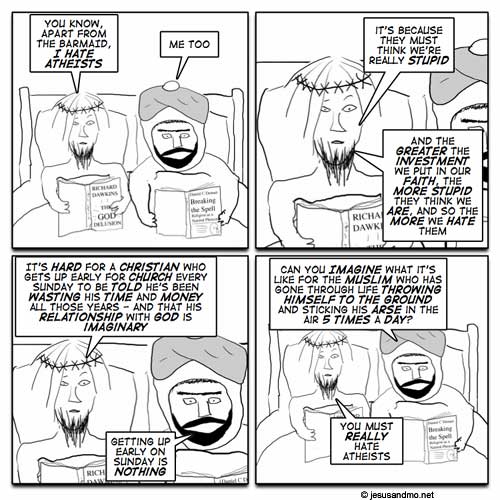




Look carefully and (as well as J reading Dawkins) you can see Mo is reading Dennett. Nice touch.
In my experience it’s the “imaginary friend” observation that touches a raw nerve eliciting the most defensive aggression (hate). Not sure why.
Actually, as a Christian I find agnostics more annoying. At least atheists have the guts to get off the fence and commit to something (even if they are wrong >;-? )
I’m an atheist but I will admit to having imaginary friends every now and then. I call it masturbation.
Agnosticism isn’t about riding the fence and playing it safe. It’s about acknowledging the inability of humanity to substantially prove the existence or lack of any god or spiritual realm. It’s about having the balls to admit our own shortcomings; to stand up and say “we don’t know. We’re not smart enough to know. Not yet, anyway.” What exactly makes it more virtuous to commit oneself adamantly to something without knowing it’s true, than to keep oneself open to other equally plausible explanations? I’ll say one thing though, if there are any supreme beings out there, Christianity is surely far from the truth. As for atheists: at least they base their beliefs on observation rather than pure speculation. I certainly appreciate that.
Oh yeah, and I love the comics. I really love them. Sorry for the sermon.
André, strictly speaking Agnosticism and Atheism are coterminous synonyms (cf B Russel). I think the difference between an Agnostic and an Atheist is often that the former labours under vestigial psychoses. Being Agnostic requires more effort. Perhaps that deserves some admiration.
Admittedly I identify myself much more with the Atheists than with the Theists. The reason I claim to be Agnostic however is not because I hold out for some final confirmation that the imaginary friend isn’t so imaginary, but because the universe is so full of paradoxes and unknowns that seem to defy rational explanation [i.e. extent of the universe, time before the big-bang,…] that my scientific mind won’t allow me to ignore the more mystical hypotheses. Brian Greene said that the purpose of his scientific endeavors is to find the ultimate answers to why and how, and that if in the end they find God it will be as satisfying a conclusion as any.
Transcend the Atheism-Agnosticism debate by coming out as a Bright. Dawkins and Dennett have already.
Why is it that agnostics are generally willing to leave open the possibility of god (s), but not the possibility of flying spaghetti monsters and the like? If they *do* leave open the possibility of flying spaghetti monsters, isn’t there any idea at all they would be willing to categorize as (extremely) improbable?
Why focus on the negative? I think we have a pretty good idea of how the universe did *not* get here, no disrespect to the flying spaghetti monster.
Standing up and saying “we don’t know. We’re not smart enough to know. Not yet, anyway.†is the ultimate cop-out. We may not know it all, but there is a hell of a lot we do know. And not a scrap of it points in the direction of omnipotent beings who forbid graven images or beings with noodly appendages.
I am an agnostic because I DO NOT think God’s existence can be proven or disproven.
So scaryjim,life is not black-or-white. We do not need to take a “stand” as if belief is a battlefield.
I say that our abilities to perceive metaphysics(provided it exists) and physics are insufficient.
I admit that my and our knowledge is very few,apart from destroying ourselves.
This is agnostism.
For Jonathan, I think I should clarify that my Agnostic viewpoint doesn’t entail defending the possibility of world religions such as Christianity and FSMism (although I have to admit to feeling touched by his noodly appendage). For me it’s not an admission that absolutely anything is possible, or that we may have guessed it right. In fact, to the contrary, I don’t believe any of our religions are right. I see them all as vain human attempts to define and describe things we can’t possibly define and describe. If anything, I think philosophies based more around spirituality than theism and law seem more plausible, but no, I don’t see Christianity or the FSM as possible explanations. Nor do I see that claiming myself Agnostic requires me to do so. However, I simply don’t think we have the capability to say with complete conviction that there is no ‘dimension’ to existence beyond those we can observe and measure. I believe that the best way to go through life, and the best way for a society to act, is with an open mind. To have an open mind requires the acknowledgment that you don’t know everything or have all the answers, and I believe that extends to the ultimate questions of Why and How.
André, though I am comfortable calling myself an atheist (even a ‘hard’ atheist), I do not claim to have all of the answers to all of the questions. My viewpoint seems to differ from yours in that I do not accept the vainness of trying to describe things that we have, as I would put it, “not yet completely described and explained”. I do not refuse to acknowledge the experience associated with what many call “spirituality”, nor would I exclude any other complex, not yet adequately researched and understood aspects of existence. About these things I draw no absolute conclusions.
Nevertheless, I am fundamentally against acknowledging the possibility of, for example, the possibility of god (s) without even the smallest scientific indication that such a thing could possibly exist. Doing so would logically force me also to acknowledge the possibility of other things for which there is not the slightest shred of evidence, and honestly, that would make life too complicated. The truth for me can be broken down into things I will say we “know”, i.e. things that are very likely based on the evidence. At the other end of the scale are the things for which there is no evidence, and which would contradict so much of what we do know that they would have to be categorized as absurdly unlikely. The existence of god (s) falls into this category for me.
As for the questions of “why” and “how”: I believe there is no why that we do not ourselves create, and our knowledge of the “how” is limited to our scientific ability.
Yet I would still argue that I have an open mind.
Re: Jonathan’s post on the 24th Nov:
I think the difference between your atheism and André’s agnosticism is Descartes idea “cogito, ergo sum” that you can’t really prove anything, other than proving to yourself that you exist in some way. Even your senses can lie to you (and regularly do).
Philip K Dick and others may take this to extremes by suggesting that you can’t trust any of your senses, but even without that suggestion most “evidence” is described to us by scientists (I didn’t see a big bang, or even deduce its existence from red shift) and our belief in them is an act of faith in the religion of science. By that I don’t mean that pure science is a religion, just that lots of rational people would believe anything a scientist told them without asking why.
Shrug.
It is true that I am willing to accept, or at least entertain the possibility of what the scientific *community* reports about things such as the big bang without experiencing it myself. But we should not forget that science is not active only in the relatively speculative field of figuring out where the universe came from, it is all around us. At the most basic level we can confirm the validity of science ourselves. Anyone who employs consistent reason to categorize and analyze experience is, in fact, a scientist, albeit not necessarily at the professional level.
And no, rational people don’t blindly accept anything a scientist says without asking why. Anyone who does that doesn’t understand science and isn’t rational.
The body of science that forms the basis of our knowledge of life, the universe and everything is not isolated bits of knowledge, completely independent of one another. Science is an interconnected whole, with scientists, and even just people who think scientifically, always at work checking for inconsistencies. Where these come to light, scientists go to work finding the problem. This system enables us to “trust” even those areas of science where we do not have personal experience, though it should be acknowledged that it is not the same as personal experience.
Yes, it is remotely (very remotely) conceivable that our senses are lying to us all of the time, and with perfect consistency so that we are completely unaware of it. If that were the case, there wouldn’t be much we could do about it. On the other hand, however, there is no good reason why we should believe such a thing to be true, even if it is an interesting intellectual puzzle.
^Attributing likeliness or unlikeliness to something unprovable and essentially unfalsifiable is pure sophistry. Critical analysis is impossible without admissible input. How is that possible without trusting our senses? It’s, dare i say it, a paradox.
On the question of atheism and theism, I’m beginning to think it’s more to do with our egos than any desire for truth or meaning. Like someone once said, God is either the most important thing or the least, depending on it’s validity. Since it’s validity is, like solipsism, unprovable and unfalsifiable, it’s up to everyone to make up his own mind.
Very very very few people are able to believe or disbelieve completely, and of those who do believe completely, at the very least they should follow their religion in it’s entirety and without qualms or hesitation, according to the accepted scripture. With those who disbelieve, nothing is required and nihilism is not, repeat NOT, necessary.
The rest of us are fence sitters, leaning one way or the other, but not in either place actually. Pathetic but true.
Roderic, I’m sure you have heard all of the (correct) arguments about the futility of proving the non-existence of anything.
However, your comment that it would be pure sophistry to claim to be able determine the likeliness or unlikeliness of something unprovable does not make sense.
Strictly speaking, outside of mathematics there is no such thing as perfect proof, meaning that the truth of nearly everything we “know” must be categorized as likely or unlikely. In some areas we have collected so much information that we can be virtually certain that our analysis is correct, in others we speak only of possibilities for want of information.
Thanks to scientific method, we have collected a huge volume of information on the world around us. Any idea that is consistent with this information and is itself based on scientific observation would clearly have to be categorized as more likely.
On the other hand, ideas, such as that of the existence of god (s) and / or flying spaghetti monsters, people who can heal by sticking their hands into people’s chests without creating a wound etc., would contradict much of the knowledge we have collected over centuries and would throw into question not only nearly everything we know, but also scientific method itself. Thus far, we have never had a reason to doubt scientific method.
Therefore, it is anything but sophistry to judge the probability of an idea by the degree to which it is consistent with the body of scientific knowledge. Sophistry would be to claim it is otherwise.
To put it another way: accepting the possibility of an idea that contradicts all of your knowledge and observations is a fast track to madness. It is logical to treat such ideas with extreme skepticism. The possibility of the existence of god (s) is an idea that deserves our most extreme skepticism, and it is not reconcilable with logic.
Evidence and lack of evidence do not carry the same weight, yet for a fence sitter they must. I consider it disingenuous to be a fence sitter if you are not always ducking flying spaghetti monsters, which you can’t be sure aren’t flying about your ears at this very moment. Me, I’ll spare myself the ducking, I’m pretty sure they don’t exist and I’ll get off that fence on the side of the evidence every time.
I agree with everything you said, but i believe you misunderstood me.
When i said “Attributing likeliness or unlikeliness to something unprovable and essentially unfalsifiable is pure sophistry.” I was referring to the specific case of solipsism. I agree that it’s unlikely that the FSM or the invisible pink unicorn, despite them being unprovable. And,
I am an atheist as well, but like i said in my earlier post, if you don’t believe or disbelieve completely you’re nothing but a leaning fence sitter. I remember once when i was swimming I was caught by an under tide, and after god knows how much time struggling, i started getting a cramp in my calf. I was absolutely sure i was going to die. Despite being an atheist, the kind that mocked theists and put fundamentalists one step above the slug on the evolutionary ladder, i prayed. I prayed my ass off. I was saved by a windsurfer who noticed me struggling. He later said he had been maneuvering for ten-fifteen minutes against the wind before he got to me.
This episode didn’t change my mind about my fence leaning, but i learned humility and, i like to think, a little wisdom. Theist who listen to my story say it’s obviously god who intervened. Atheists scoff at my lack of faith in the no-god. Or something. I don’t get any atheists, including myself.
I forget what my point is.
the end
Rodric, I’m afraid I’m not quite sure what you are getting at here with the solipsism. But you do seem to acknowledge that the likeliness of unprovable ideas can be judged, and that this is consistent with reason.
I don’t think it’s particularly important what one says when death approaches; I suspect that religious utterances coming from supposed atheists has to do with one’s upbringing. Religion never crossed my mind during my few brushes with what I perceived as likely or certain death, but then I grew up religion-free.
As for fence sitters, for me, these are people who refuse to choose sides, and anyone who calls himself an atheist is in my view not a fence sitter.
Jonathan Says:
>>Anyone who does that doesn’t understand science and isn’t rational.
You’re right, my mistake. Let me restate that point to say that I don’t think many people are completely rational… even some scientists.
Remember, I pointed out that I didn’t think science was a religion, just that I think many people (by which I mean the majority) treat it as one. An example is the faith that many people in the US have that science will save us from climate change. They’re willing to bet our survival as a species on it. I can’t think of a better example of blind faith, after all, Abraham was only going to kill his son.
Rich, I agree completely that many (most? nearly all?) people are not completely rational. Reason is, after all, an ability that can be turned on and off. I also agree that many people do not employ reason; I think most are not even consciously aware what reason is.
This is also undoubtedly true about the climate change issue, though I’m not sure if you are trying to make a point about climate change itself.
it would be awesome to do an episode of Jesus and Mo featuring Buddha the dead-beat dad..Didn’t he leave his wife and kids to go pursue Nirvana…wouldn’t we call that a heroin habit today…
Imagine there’s no imaginary friends,
John Lennon almost said that.
http://boskolives.wordpress.com/
Agnostics simply adhere to scientific principle. As long as atheists claim that there is no god, something that they cannot as yet prove, then they subscribe to belief. Belief without proof is faith. No matter how much evidence there is that god does not exist..it is not conclusive. Therefore agnostics must maintain their stance until such evidence presents itself. Hopefully they can do it without being wrongly called chickenshit. Im now Apatheist btw.
i don’t think theists are stupid, in fact i have the utmost respect for all rightly guided religions. it seems that there is a fundemental need to believe, just because someone chooses not to fight it, doesn’t mean that they are bad.
To know that there are no gods, requires that one know the whole universe. Since no atheist can say that they do, it is wrong to put words in our mouths and claim that only believing this qualifies one to be an atheist.
I don’t expect there are any gods, and I will be surprised the day one shows up and offers proof of its godhood. I do concede that it theoretically could happen, though I maintain that it is vanishingly unlikely.
I would say that it is the agnostic position that is flawed. First, it doesn’t occupy a halfway point between theist and not-theist as so many seem to want to use it. This is a single bit binary function; On or Off, black or white, with no grey.
I’ll ignore the historical Gnostics which early Christians declared to be heretics (making themselves agnostics?) and point out that just as Atheists cannot show evidence there is no god, Theists have no evidence that there is one (definition of Faith) and thus no-one knows and everyone is technically agnostic, making it meaningless.
For me the question is whether or not you live your life as if there is a god. Note, this definition may identify some nominally religious people as atheists, though they might claim otherwise. Con men who prey on the gullibly religious and pædophile priests come to mind.
Jesus and Mo obviously attracts a thoughtful fan base. Thanks for this discussion. I’d been flipping back and forth between calling myself an agnostic and calling myself an atheist until fairly recently. I grew up in a religious home, and can still recite the Apostles creed. I was always taught that we must treat religion with respect, because it’s somehow… uh…respectable. But it doesn’t deserve my respect. And calling myself an agnostic leaves open the possibility that I agree with idiots. I don’t. Not at all.
Forget prove or disprove. It doesn’t matter. What matters is that we take back some of the claims that religion has made and give them back to humanity in general, claims such as being the basis of all morality. This is just more nonsense. Morality is built into our humanity. They’ve recently discovered that virtually all serial killers have brain dammage. It’s not that they just lost sight of their God.
All my life the religious have been demanding respect, but they give atheists no respect at all. Take a look at Ben Steins latest rant, “Expelled, no Intelligence Allowed”. It lays the blame for the haolocaust on Darwin and atheists, completely forgetting the Gott Mit Ens on the German belt buckles. If I point to a group and blame them for something that was not their fault, it’s called hate mongering. But the religious can do this to atheists any time they want, and all they get is applause.
The religious can say the most inane things (Why would God allow huricane Katrina? Well, we’ve kicked him out of our government and our schools. How can we expect him to help us. I mean, he’s a loving God and all, but his patience does wear thin after a while, and then he lets innocent men, women and children die because we don’t adore him the way we should.) and still get elected to public office.
Oops. This triggered my rant reflex when all I really wanted to say was how great it is to read your comments, and to have confimation of intelligent life in the universe.
Thanks folks.
[…] useimmin joko yhteisestä sängystään lukemassa kirjoja (Raamattu ja Koraani, mutta myös Richard Dawkinsin “Jumalharha” ja Daniel Dennettin “Lumous murtuu”) tai kantakapakastaan väittelemässä ateistisen baariminnan kanssa. He eivät ole karikatyyrejä […]
Why do people think that “agnostic” is incompatible with “theist”?
An agnostic theist believes in a deity but can’t claim to know one exists.
While anything is possible, not everything is probable. I think the chances of the Abrahamic god being real are about the same as the FSM being real, practically nil. This is why I identify as atheist. Maybe it’s unfair, but when I hear someone say they are agnostic, all I hear is ‘coward’ (as in unwilling to offend others by speaking their mind).
Hey, agnostics are the bravest of all, because they take heat from both sides.
Mythbuster says: “I’m an atheist but I will admit to having imaginary friends every now and then. I call it masturbation.” This is by far the best comment I’ve ever seen on this website!