that’s always been a tripping point for me – how can a person really think they are humble AND that the universe was created by a power skydaddy just for them?
How also can they think that their skydaddy is wholly concerned with what they behave, what they do with their genitals, sacrifice Jebus for them – and yet at the same time, be unworthy.
How can people be so comfortable with cognitive dissonance?
@ nina: I recall exactly that cognitive dissonance from when I was a christian. Except of course then, there was no hint of dissonance. I still thought of god as a vastly magnified human being, somehow simultaneously cosmic architect and human savior.
Gradually, I became aware of the undeniable (for me) discrepancies between those two roles, the contradictions of the Bible, and the cherry-picking of doctrine that all believers (including me) indulged in. And that was when I consciously left faith behind.
I’d be quite happy to go without this comic strip if religion was seen for the irrational, imaginary friend syndrome that it is by all of its billions of followers.
I’d actually have some hope for humanity if the majority could get over that childish hurdle.
Even more so, why would the God create something – The Crown of Creation, allegedly – just to go through all the hasseles on this earth if it is to be returned to heaven? He might as well have kept it there. Safely.
A friend of mine (devout Christian) and I keep having this conversation about eternal existance. Man I get bored here on earth while waiting for my next book or next movie to come out. How about waiting a millenia for something exiting to happen like when that first reptile crawled out of the mud. Ohhh thrilling or waiting for that first humanoid to start fire. Of course my friend seems to think he would always have something to do like explore the universe. Does heaven exist inside the universe? Puffy clouds and harp music forever, yuk!
Seconding the ‘”I’d do without Jesus and Mo to see the back of religion” sentiment, although I don’t think Humanity is entirely doomed.
And to John Moore, I think some of the more sophisticated religiots try to claim their fairy of choice exists outside of space and time, so wouldn’t necessarily have to experience it as we do. I think this is also forwarded as an attempt to avoid the ‘Who created God then?’ infinite loop. Of course, the volume [both acoustic and quantitive] of nonsense spouted means it can be quite hard to keep track of all of it, so I may be overstating someone’s case.
To paraphrase the original Poor Richard, who said he was able to achieve an “Appearance” of Humility, but not the “Reality”: “If I did indeed attain Humility, I would be proud of it.”
I stopped going to church at 10 – I wasn’t old enough to explain cognitive dissonance naturally, but I was old enough to know that the stories we were told didn’t make any sense.
I always felt a strong injustice was done to Cain, since there was no clear reason why his offering wasn’t acceptable and no one could ever explain when he was banished, how he came to be married since the only people in the world at that juncture were Adam, Eve and himself since he snuffed Able.
A sunday school teacher vaguely referenced some other kingdom of men – but I wasn’t willing to buy that.
I became an atheist at 12, leving god on the same childhood scrap heap as the tooth fairy, Santa and the Easter bunny.
@ nina – I was on a business trip with a co-worker and while ironing my clothes I stumbled across The Ten Commandments on television. Of course it gave a quickie version of the beginning with Cain, Able et al. Of course I brought the same point up and was told matter of factly that God simply didn’t tell the whole story and it shouldn’t influence my decision to not beleive. I almost spit orange juice out of my nose. You would think with the four people mentioned in the begininng that a whole bunch other people would have been worth mentioning. I like you left religion behind early in life.
Richard Feynman expressed the idea in this week’s strip well:
(QUOTE)
“It doesn’t seem to me that this fantastically marvelous universe, this tremendous range of time and space and different kinds of animals, and all the different planets, and all these atoms with all their motions, and so on, all this complicated thing can merely be a stage so that God can watch human beings struggle for good and evil — which is the view that religion has. The stage is too big for the drama.” (UNQUOTE)
* Statement (1959), quoted by James Gleick in Genius: The Life and Science of Richard Feynman (1992)
@nina: good for you, leaving that all behind at an early age. I think it’s true that most kids have no problem making the distinction between fantasy and reality. If they’re taught any kind of critical thinking early on, then even if they’re immersed in religion, they question its claims at some level, at some point in their lives.
Admittedly, that is pure speculation and anecdotal; I can’t back it up. But it dovetails with what I’ve read and observed about the decline of religion in the US, at least.
Excellent reference to Feynman. “A stage too large,” would be a terrific title to a book or movie about the consequences of discovering multiple civilizations in our galaxy, many advanced far beyond ours.
I heard that question asked somewhere recently. One person said it would be the end of religion. I think he was underestimating “the power of myth.” Such a discovery would simply cause the more hard-core to circle the wagons and defend their faith against all those satanic forces. It would be seen as a “test.” The more liberal believers would simply rationalize away their cognitive dissonance.
The Origin of Species (150y ago) really should have been the straw to break the camel of belief’s back. With coherent explanations of geological time and a powerful and simple mechanism for species to exist and develop, there really isn’t any need for a creator god. But see if the believers get it. “The power of myth” is still going strong, so even if we encounter intelligent non-earth creatures or civilizations, it’ll just be another “proof of god”.
I love the “God simply didn’t tell the whole story” explanation: there’s not even a need to believe the magic books; just believe the priest 😀
Perhaps Mo wouldn’t feel like he was bursting if he had passed on seconds from the burrito plate? Or as Jesus once said, “Well, you can all kiss my tacos”. At least, that’s what it sounded like he said.
If you can bear to listen to some fundies, you’ll find they’ve already pre-emptively dealt with the prospect of alien life by declaring that it would inevitably be “satanic”. No question is too knotty for a bolted-up mind trained in theological acrobatics (the Jesuits are a bit more sophisticated, saying that they would do their best to “save” our tentacled friends).
Can you imagine if the first human message to an advanced civilisation was some fevered screed of religious gibberish, urging them all to convert?
@Gronk. That is a genuinely scary thought. Do you have a reference for that?
I have just had a worse one- what if believing that this is somehow all for your benefit is something that convergent evolution has generated in the aliens? They are coming over to convert us! It sounds like the plot of Jerry Zuckheimer movie….
Of course, lefty Atheoids don’t see humans as the ‘Crown of Creation’, we just part of Nature like all other life-forms…..oh, except for our carbon emissions, they’re different cos they’re ‘Anthropogenic’ gases you see, so we gotta stop emitting our unnatural CO2 to Save The Planet…
@ Crusader. Ya think humans the “Crown of Creation?” Let’s look at a few of these “crowns”: Attila the Hun, Stalin, Hitler, Pol Pot, Caligula, Religious zealots in general, not to mention the 10’s of thousands of axe wielding maniacal little “crowns” who follow such bigger “crowns” and of course, many if not most were following a skydaddy, including the Judo/Christian skydaddy who told them to commit genocide and ethnic cleansing. Now, if that is a “Crown of Creation,” it certainly is more a act of an evil skydaddy rather than a benevolent one.
I would have pressed my friend to know then what else Skydaddy is holding back.
If leaving out a whole kingdom of people, who are then presumably living rather well without “His” involvement….
@wright
I tend to agree with you – the other kids I knew who weren’t church going tended to be the smarter ones, who asked questions in class on any subject – wanting to know the backstory or more.
The ones who accept religion’s tales, seem less interested in learning and are less curious about the world. They appear satisfied with very basic explainations or simply aren’t interested in any ouside of what they already decided.
@cina
As much as I’d like to take credit for skydaddy – I picked up that expression on the http://www.topix.com atheist forum.
I did start spelling it buybull though
and in response to a fanatic insisting that the Shroud of Turin was proof of Christ’s passion, coined the phrase Tissue of Turin
It’s interesting seeing the difficulty a (funda)mentalist has with the concept that humans are ‘just part of Nature like all other life-forms’. It’s a point of view that never occurs to me – that humans are somehow fundamentally superior to other animals. Obviously we (most of us) are more intelligent than other animals, and use more tools, sophisticated language and so on, but it’s interesting to consider the view that some people believe that we are somehow a different category of being. I think the consequences of that viewpoint can inevitably be only toxic and harmful – that the world around us is put there for us to consume and destroy as we need, and that if we fuck it up completely, it doesn’t matter because our invisible daddy will either fix it for us, or fucking it up was what we were meant to do all along.
It also couldn’t be much more ironic, given ‘makes me feel so humble’.
That Tissue of Turin was definately one of my better ones.
Yes, that beleif that there’s mineral, vegetable, animal and humans is very bizzare to me – especially when a lot of so called lower animals actually have a more complex genome than us.
It occurs to me that this cartoon could just as easily be about modesty – since isn’t wearing special clothes to show your modesty actually bragging about it?
@Crusader. We need to lower pollution for OUR (our kids really) benefit. The planet will get along just fine once we have evolved ourselves out of existence. Just like it did with the sabre-toothed cat, irish elk etc. Other life will fill the gap. There are mass extinctions (90% + species) every few milion years. As one of the few puppets of evolution that can see the strings we have a chance not to be a cause of one such. But something else will gleefully fill the gap if (when) we screw up. Eventually.
Read this, and I’ll wait for the clunking sound of your jaw hitting the ground: http://www.encyclopedia.com/doc/1G1-13417541.html
I forget where I read the original fact, some church history book I think, but in it the observatory’s director states that if aliens are discovered, and some way is developed to reach them, “of course we will try to save them.”
@nina & wright
Answer a child’s questions often enough with the reply that “goddunnit”, and finally that kid’s natural curiosity will atrophy. He’ll look at a rainbow or some other natural marvel and shrug “goddunnit”, and this bovine indifference will last his lifetime. Which is why I regard religion as child abuse.
@Daoloth. What’s ‘pollution’ to you is ‘food’ to trees (& other green stuff). Species go extinct due to circumstances; they don’t ‘evolve themselves out of existence’.
@ Hobbes. I think you missed my point (by that much).
‘Species go extinct due to circumstances‘ – Jesus fucking christ! If an external force rapidly alters the habitat a species has evolved over millions of years to inhabit, it won’t be able to survive in it, or to evolve rapidly enough to compensate.
Manual records, mud and ice-cores show that the world’s climate has been warming more rapidly in the past hundred years or so than any time for thousands of years previously.
CO2 and methane in the atmosphere cause it to warm.
The human race has been digging coal and sucking oil and gas out of the ground on a mass scale for the last 150 years, burning it, releasing the CO2, and additionally, multiplying our own population by a factor of 4 and farming methane-producing animals and crops on a massive industrial scale to provide for ourselves and our increasingly meat-based diet.
Ice caps are melting, glaciers are melting, sea-levels are rising, 10s of millions of people in coastal cities and towns – not to mention low-lying islands – are being flooded out, forests are being torn down, the consequent soil erosion is creating expanding deserts, rivers are silting up and drying up, the increasing amounts of CO2 in the oceans are acidifying them and killing coral reefs and shelfish, the warmer waters are disrupting ocean currents, the reduced amount of permanent ice-cover itself reduces the albedo effect and so further increases warming, and so on and on and on.
Where is there any doubt in any of this? Really – even for bible-belt web-footed rednecks, what is hard to understand about this process? Which part of it isn’t accurate?
The idea of an Incarnation of God is absurd; why should the human race think itself so superior to bees, ants and elephants as to be put in this unique relation to its maker? And why should God choose to come to men as a Jew? The Christian idea of a special providence is nonsense, an insult to the deity. Christians are like a council of frogs in a marsh or a synod of worms on a dunghill, croaking and squeaking, “For our sakes was the world created.”
Hi all! I really like “Jesus and Mo” (right now I am going through the archive of 2006 and enjoying it a lot). I am a member of a mainstream protestant church and I think it’s really important to keep making fun of silly or not-so-silly things people may believe.
If you’re an atheist, fine. I even agree that being an atheist is perfectly rational (why believe in something there is no proof for, like the Loch Ness or Flying Spaghetti Monster). But even if you are an atheist, there are questions about your life that you can’t avoid. You can try to answer them on your own, consult your friends or family, literature, Jesus and Mo, philosophers, become a member of the Communist Party or whatnot… After being an atheist for some time, I found the best answers, or rather, the best conditions for looking for the answers, in a moderate Christian assembly.
‘If you’re an atheist, fine.‘ – Gee, thanks. Glad we have your permission.
‘…even if you are an atheist, there are questions about your life that you can’t avoid.‘
What questions do you imagine atheists are ‘trying to avoid’ Tom? You describe yourself as a former atheist, yet you now take refuge in christian magical fantasy explanations for existence. Surely it’s theists who avoid difficult questions.
to Toast: sorry, I didn’t mean to get personal, I just meant “Some atheists are OK, some Christians are OK too, some muslims etc.” I live in the most secularised country in the world (guess where 🙂 ), and I don’t feel like having to exercise any moral supremacy over anyone.
Now to the questions you requested (and it has to get personal): Who are you? (and I am not asking for the name) Where are you going to? Why are you here? Why do bad things happen to good people? Why do they happen to you? Are you going to die? Will it hurt? What will happen after that? Why should you be nice to people if you get nothing back? Is there such thing as supreme good? What is the nature of the God you believe (or deny your belief) in?
That sort of questions. I wrote that I found a welcoming group of educated people who happen to be Christians with whom I can share my thoughts on these questions. I slightly doubt that there are similar groups of atheists and that they are more likely to find themselves on their own in looking for the answers, which, I must admit, I see as a bad thing.
Nevertheless, I wish you good luck in your search.
It’s interesting that you think you’re in a position to ‘exercise moral supremacy‘ – it sounds astonishingly arrogant. Unless that’s just inarticulately worded. Anyway, your questions:
Who are you?
That’s both too complicated and too simple to answer. Either way, why do you think atheists are trying to avoid answering it?
Where are you going to?
The shop to buy some lunch.
Why are you here?
Because I work here. Or, because my parents had sex and my mother gave birth me.
Why do bad things happen to good people?
Why wouldn’t they?
Why do they happen to you?
Why wouldn’t they?
Are you going to die?
Are you serious? This isn’t an honest question. If you’re asking this question, you’ve already decided to deny the incontrivertible evidence of your eyes, and everything in the world around you. It’s childish wishful thinking.
Will it hurt?
Depends how it happens I guess.
What will happen after that?
My body will rot, or be burnt or possibly devoured by badgers, depending as above. The rest of the world will continue more or less unaffected.
Why should you be nice to people if you get nothing back?
Don’t be if you don’t want to. Why do you think you get nothing back? Doesn’t it make you feel better, to think of yourself as a kind person? Or do you expect a bag of money through your letter box?
Is there such thing as supreme good?
No. The words are meaningless.
What is the nature of the God you believe (or deny your belief) in?
I don’t ‘deny my belief‘ in a god. I don’t believe in one. Can you really not understand the difference? You’ve decided from the beginning that you believe in god, and that there’s life after death, and you’re clinging to a group of ‘educated people‘ who, because of their status in your eyes as authorities validate your desperate need to believe in your own personal significance and most importantly – immortality. Because these supposedly learned people agree that there is a god etc, you feel less stupid for telling yourself there is one. As for its nature, you’ve invented it – you tell me.
As to ‘slightly doubting’ that there are groups of atheists – look around you. I think you’ll find quite a few on this website, just for starters. Of course, there are numerous reasons there tend to be fewer groups in real life for atheists, not least for the same reason that there aren’t groups of non-stamp collectors, or un-orchestras. There are some however, and I’m sure you could find one if you tried.
@Tom surely the question “why do bad things happen to good people” cannot make you run towards the Judeo-Christian invisible yet psychopatic deity? When you are Judeo-Christian the answer to that question (as to all the others you might have) is as follows “because the old dude in the sky wants it so” – which means that deity is a mean, cruel, evil bastard jerk whose plan is to make good people suffer and reward nasty jerks during their lifetime.
All the evil and bad shit that happens randomly or intentionally in the world on a daily basis is a constant, never ending proof that no deity exists, especially not a provident and kind to humans one (which by no means is that Yahwe asshole anyway). The deity as you know it is either absolutely illogical or viciously venomous since it allowed Holocaust or bombing of Hiroshima or the ongoing slaughter of various RELIGIOUS people fighting each other. Why doesn’t that invisible friend in the sky at least protect the believers who spend a lot of time and energy addressing that fairy thing? Answer: because that deity doesn’t exist and never has. And why doesn’t that thing ever talk back and at least tell you about the plan it’s supposed to have for you? Because that fairy doesn’t exist and it has no plan for you.
Just accept that your existence is random, your life is a coincidence – and make the best of it for you. Don’t waste time on ancient lies.
Re ‘you win‘ on the morality issue. A discussion isn’t a contest, and it’s important to express yourself clearly, partly so other people can understand what you mean, and just as importantly so you understand your own thoughts yourself. It’s not a question of anyone ‘winning’.
Further to your question: Who are you?
A simple answer would be to give you my name, a physical description, where I work, names of friends, family, personal history perhaps – but that wouldn’t answer your question, even if I were prepared to do it. A more complicated answer would be to describe my various and varying states of mind; how I felt when I woke up this morning, the thoughts that occurred to me, how I felt whilst having breakfast, what I was thinking about, the thoughts and feelings I had whilst travelling to work, and so on. Obviously that would be very time consuming and probably not very interesting to anyone else. I also doubt it would in a meaningful way answer your question. My thoughts and feelings are mine, but they’re probably not hugely different from most other peoples’, so perhaps you can expand on exactly what the question means.
Why do bad things happen to good people?
Why wouldn’t they?
Why do they happen to you?
Why wouldn’t they?
My answers were perfectly serious and not in any way evasive, and I think – again – you need to think more about what your question means. Why is it a question? Why would ‘bad things’ happen only to bad people? What are ‘bad people’? The only way ‘bad things’ could be apportioned specifically to ‘bad people’ would be if ‘bad things’ were caused or controlled by a being or organisation which knew what people had done, judged them, and then caused ‘bad things’ accordingly. The only thing that sounds like to me is a god. So you’ve already decided there’s a god before you’ve asked the question. (And that, even when the very reason you’re asking the question is because the evidence shows there IS no such being acting in such a way.)
To me, the world is ball of rock, smeared with various forms of life and bodies of water, surrounded by an atmosphere of gasses, hurtling around a vast thermo-nuclear reactor. Earthquakes happen because of tectonic plate activity – plates of rock floating on moving mantle. Hurricanes happen because of complicated interactions between heat from the sun, the ocean, the earth’s rotation and so on. Sometimes people murder other people – there might be masses of complicated reasons behind it, but the point remains, there’s no way, and no reason why, in a natural world such things would be selective according to the victim’s ‘goodness’ or ‘badness’ – why do you think there’s a question to answer in the first place?
As for a definition of god, I would tend to keep it fairly simple: an invisible, supernatural, all-powerful being. People from specific religions add further detail, but in my experience that definition covers the conception of god of every christian and muslim I’ve ever met or who’s opinions I’ve ever read. Is yours different? If it is different, do the differences make it any less implausible?
“bad things” and “good people” are generalizations, of course. However, there are things that can be described as “bad” by a consensus of say, 99 percent, of all people of any cultural background. Think of e.g. cold-blooded murder of a 3 year old child.
The injustice I see around me makes me ask the question. I sort of can’t consider it a non-question. If you call it “deciding for an existence of a god” before asking the question, so be it. These two things go hand in hand for me.
My definition of God (and I have no systematic theological education, so please excuse my formulations):
1. He/she is undescribable. Calling him/her “invisible, supernatural, all-powerful” means anthropomorphing (is there such word?) him/her in the wrong way. (Loosely based on the ideas of Justin the Martyr and Clement of Alexandria)
2. The only exception to the above: He/she is compassionate. He/she can feel pain and takes part in our suffering. (Loosely based on the ideas of Kazo Kitamori)
That’s it. Such a God is hard to disprove or condemn, isn’t he/she? 🙂
The injustice I see around me makes me ask the question. I sort of can’t consider it a non-question. If you call it “deciding for an existence of a god” before asking the question, so be it. These two things go hand in hand for me.
… and that’s a non-answer. I’m not calling it anything – that’s what it is. What you see around you isn’t injustice – we live in a materialistic world. Suffering is not injustice. It’s simply the subjective experience of materialistic events by sentient creatures – sometimes we might describe our experiences as suffering. You confuse yourself when you think of it as injustice. It’s only ‘injustice’ if you’ve already decided that there is an objective ‘right’ and ‘wrong’, that there is a deity who cares that people are punished or rewarded, and that that deity has the power to act accordingly and does so.
You said even if you are an atheist, there are questions about your life that you can’t avoid – but it is you who is avoiding questions. As you now admit that that is ‘deciding the existence of god before asking the question‘ that is at least a small step of progress.
Your (non-)description of the god you believe in is meaningless and self-contradictory. You start by saying it’s ‘indescribable‘, then go on to describe it. Are you saying your god *is not* invisible? Is it *not* supernatural? – is it mortal, for instance? is any part of the universe outside its influence or control?
You say that to describe it in the very general way I put forward is somehow to wrongly anthropomorphosise it, but then anthropomorphosise it considerably more yourself by claiming it is ‘compassionate‘.
No one has ‘condemned‘ any god – that is simply a straw-man and a rather disingenuous one. The onus is on you to prove the existence of your non-anthropomorphic-yet-compassionate, non-invisible-yet-not-visible etc god, not the other way around. It is you who is making the claim that it exists.
Ad the “proof of God”: There is no proof of the existence (or nonexistence, for that matter) of God. There are just hints. Some people interpret them one way, some interpret them other ways. Therefore there is no burden of proof on anyone. As long as people don’t put other people into prisons or kill each other for their faith or lack thereof, I am happy.
It’s not atheism I’m criticising, it’s the pure materialism that some people feel that follows from atheism. Relativising the subjective (“suffering”, “injustice”) in theory usually leads to relativising these things in practice. Just look at the history of countries that used atheistic materialism (dialectical materialism, i.e. Marxism-Leninism) as their founding philosophy.
And BTW, if you say there is no absolute moral standard, whether dependent or independent of God, then you can’t really say that your opinion is “better” or “worse” than my opinion, and therefore our debate is meaningless. Or am I “wrong”? 🙂
Yes, you’re wrong, in many ways, and I think you know that. The most immediate being – what has a ‘moral standard’ to do with whether you or I are right or not? It’s a nonsense question, and you’re just confusing yourself again.
You make the same mistake when you use the word ‘hints’ that you make when you use the word ‘injustice’ – it only makes sense if you accept a priori that a god exists. Theists claim there is a supernatural being – this is an exceptional claim and the burden of proof is entirely on you to prove it. You know you can’t which is why you slide and equivocate, avoid difficult questions, and throw up distractions when you’re shown to be wrong.
A prime example: you begin your next paragraph ‘It’s not atheistm I’m criticising‘ yet it very clearly is. You said: ‘even if you are an atheist, there are questions about your life that you can’t avoid‘. You are stating that atheists ‘avoid difficult questions‘ and clearly implying that this is a prerequisite of being an atheist. The example you gave of one those questions was ‘Why do bad things happen to good people?‘ – yet this is a very simple example of *you* avoiding a ‘difficult’ question (difficult only because you don’t want to accept the answer) – ie, why does a ‘compassionate’ god allow eg, Haiti? – and the answer you’re avoiding being ‘because there isn’t one. The causes of suffering are simply natural events. There is no moral ‘why?’, only an empirical ‘how?”. Your ‘injustice’ and your ‘hints’ are the same self-deception. You’ve decided in advance that there is a god, therefore you have to explain the overwhelming lack of evidence for one by describing natural, empirical phenomena in terms that agree with your belief – turning euphemisms and metaphors into facts.
The goodness or badness in practise of any regime or system has *absolutely nothing* to do with the veracity of claims about the supernatural. Religious regimes throughout history have caused more torture, death and human misery than anything else, yet this is not the reason they are factually wrong – only an example of their hypocrisy, and yet you are now trying to hide behind the misery imposed under Soviet communism, as though that somehow made your god real.
The closest you’ve come to saying something true is ‘our debate is meaningless‘. Not ‘meaningless’ I would say, but pointless. Whenever I’ve shown you to be wrong or contradicting yourself, you’ve tried to slither out of it and change your argument, or hide behind distractions. Either you are an insincere debater or you are genuinely too unintelligent to follow reason applied to your own words. This debate is increasingly un-rewarding either way.
If you read my first post carefully, I’m not criticising atheists (“if you’re an atheist, fine”), I’m criticising “atheists who avoid certain questions”, materialistic atheists, if you want a provisional short term. And I’m using the argument about communism to support the thesis that “materialistic atheists” are generally “morally wrong”, not to support the thesis about the existence of God.
As a “hard atheist”, denying the existence of any god, you probably subscribe to Clifford’s principle “It is wrong always, everywhere, and for anyone, to believe anything upon insufficient evidence.” The word “wrong” in this sentence can be understood in either the ethical/moral meaning (just as in your post from Feb 2 referring to “injustice”), or in the epistemical meaning (as in your post from Feb 3) referring to our discussion.
If you apply Clifford’s principle with the epistemical “wrong”, then I ask you, why should you “believe” that Clifford’s principle is right? Do you have sufficient evidence for it? Or are there just “hints” like with the non/existence of God? What I’m trying to get at is that you first decided that there is no God and then you engaged in a debate applying the seemingly neutral principle based upon that decision. But the principle is not neutral, it is your principle, and it’s subjective. Just like mine.
If you apply Clifford’s principle with the ethical “wrong”, while at the same time denying the existence of objective “right” and “wrong”, the sentence doesn’t make any sense.
It’s you who is using so many ad hominem arguments that you are getting lost in them (and sorry for this ad hominem argument, it is my last one in this discussion).
To quote the entirety of the first paragraph of your first post :
‘If you’re an atheist, fine. I even agree that being an atheist is perfectly rational (why believe in something there is no proof for, like the Loch Ness or Flying Spaghetti Monster). But even if you are an atheist, there are questions about your life that you can’t avoid. You can try to answer them on your own, consult your friends or family, literature, Jesus and Mo, philosophers, become a member of the Communist Party or whatnot… After being an atheist for some time, I found the best answers, or rather, the best conditions for looking for the answers, in a moderate Christian assembly.‘
So you now attempt to give the impression that you were drawing a distinction all along between ‘atheists who avoid certain questions‘ and a group of some other kind of atheist. What you actually wrote can only be read as ‘to be an atheist means avoiding certain questions‘, with this meaning emphasised with a further recommendation, based on your personal experience, that the answers can be found in ‘a moderate Christian assembly‘.
You now define a sub-group which you call – ‘materialistic atheists‘. How is this group different from other atheists? What is a ‘non-materialistic atheist’?
As you made no suggestion in your original post that any such sub-groups exist, let alone that you were referring only to one of them, the fact that you are now creating one and restricting your criticism to that sub-group only, suggests that you are accepting your first post was wrong, but can’t openly admit it.
How can it be ‘morally wrong‘ not to accept an assertion about a being’s factual existence or non-existence? It’s not a moral question – it’s a factual one.
Clifford’s principle seems sound to me. Do you feel you don’t have sufficient evidence to accept it? Excluding your belief in god – which you accepted in your first post is irrational anyway – how many examples can you think of where Clifford’s principle wouldn’t apply? I would suggest that in most cases, most of the time, it’s a description of how we interact with the world around us. If you believe its validity is merely subjective, do you think it would harm or benefit your life if you attempted to live counter to it?
Moreover, do you think a question of the unique scale and significance of ‘Is there a supernatural being who created the universe?’ should be decided by an exceptional/extreme loophole in an otherwise sound principle?
You confuse yourself by drawing a parallel between your belief that there are ‘hints‘ of a god’s existence and the belief in Clifford’s principle, but the comparison is false because the words have different meanings even though they appear the same. To consider any phenomenon in the world as a ‘hint’ is to accept a priori that there is something it is *hinting at* – ie, in this case that it was created by a god. Whatever your ‘hints’ are, you conclude inductively that they are evidence for a god. Clifford’s principle is measured in an entirely different way – it is deduced from the way we live, and then tested by being applied to our experience. If you can think of any major problems applying Clifford’s principle creates in your life, I’d be interested to hear what they are.
It’s a shame that you finish again on a disingenuous point. I’ve never said it is ‘wrong (bad) to believe in g/God‘ – and I think it is rather hypocritical of you to complain about ad hominem’s whilst doing things like that, or stating that ‘“materialistic atheists” are generally “morally wrong” not to support the thesis about the existence of God.‘.
It is simply factually wrong to believe in a god. Moral implications may follow from that, but the statement stands objectively by itself.
*sigh* I really should stop reading the comment section. Cause I actually like this comic bt everybody here seems to scorn religion. Oh well now I’m just complaining. Back to laughing.
@Toast: Ok, a materialistic atheist believes that nothing transcends the material man, be it in time (“Let us eat and drink, for tomorrow we will die.”) or magnitude of reason (“Man is the measure of all things.”, i.e. “I am the measure of all things.”, i.e. sometimes “The Party is the measure of all things.”).
A non-materialistic atheist at least acknowledges his/her “…faith in fundamental human rights, in the dignity and worth of the human person and in the equal rights of men and women…”.
You see it’s “faith” in “fundamental human rights” that helped create the world you and I live in. The framers of the Declaration of Human Rights were reluctant to say something like that there is enough evidence of “fundamental human rights”. Compare also the Declaration of Independence “We hold these Truths to be self-evident…”. “Hold” means “believe”, and the “truths” are “self-evident”. So there is an admitted lack of external evidence for those truths, yet there are people who are not ashamed to hold those truths. I believe that this limits the applicability of Clifford’s principle to the area where it properly belongs: natural sciences.
Therefore I believe that it’s wrong (both ethically and epistemically) to strictly apply Clifford’s principle to some beliefs, among which is also the religious belief.
I hope your definitions of ‘materialist atheists‘ and ‘non-materialistic atheists‘ give you pleasure – they certainly don’t offer much in the way of meaning. Where on earth did you get the idea that ‘materialist atheists‘ believe humans to be un-transcendably intelligent? That’s simply bollocks.
An atheist is someone who does not believe in a god or gods. It’s that simple.
The concept of “fundamental human rights” is one invented by man. It’s an aspiration. It’s not something which exists in any form other than through our creation.
The Declaration of Indepence states:
We hold these truths to be self-evident, that all men are created equal, that they are endowed by their Creator with certain unalienable Rights, that among these are Life, Liberty and the pursuit of Happiness. That to secure these rights, Governments are instituted among Men, deriving their just powers from the consent of the governed, That whenever any Form of Government becomes destructive of these ends, it is the Right of the People to alter or to abolish it, and to institute new Government, laying its foundation on such principles and organizing its powers in such form, as to them shall seem most likely to effect their Safety and Happiness…
Again, in this example’Hold‘ (or ‘believe‘) is used in a completely different way than in the phrase ‘I believe “it is wrong always, everywhere, and for anyone, to believe anything upon insufficient evidence.”‘
The Declaration doesn’t state: We hold it to be self-evident that water is wet – that actually is self-evident.
Clearly, these ‘rights’ don’t exist in nature. Very obviously, if they did they wouldn’t need to be stated or enshrined amongst the founding principles of a new country. It is an aspirational statement, casting the creed of the new country in opposition to wrongs its founders perceived in other existing countries. It is obviously not *literally* true that ‘all men are created equal‘ – we’re not all the same height, or equally ugly, or of equal intelligence, but the Declaration creates a principle of legal equality – notwithstanding that slavery continued for many decades in the USA.
‘hold’ or believe means ‘it ought to be the case that…’
The statement could be re-written: we wish it to be a fundamental principle that it is wrong for any man or woman to discriminate against any other man or woman on grounds of race, sex, nationality, sexuality, age, disability or any other factor over which they have no control, and that everyone will be treated equally under the law
As the second sentence states, these ‘rights’ are bestowed through human civilisation – they are not in any way pre-existing. They are principles which, as human societies evolve, they seek to implement and protect through law. They are also regularly attacked by the religious, cf, the pope’s recent rejection of equality legislation, and the church of england tearing itself apart about women bishops.
(1) Human rights can be a human creation, but then it’s the belief in their existence that made their existence come true, is it not? (And could you accept such a concept of g/God?)
(2) There are only two types of “believe”: “believe that/in (a proposition)” and “believe in (a person). The proposition can be either normative (as with the human rights) or descriptive (God’s non/existence), but the fact remains, we are talking about propositions here, not about persons, and I am asking you for the justification of your beliefs that Clifford’s principle holds in all situations and that there is sufficient evidence for the non-existence of God. Are we getting to your “properly basic” beliefs now? 😉
(When you say an atheist is someone who does not believe in a god or gods, I believe that it is equivalent to “an atheist believes that there is no god”.)
(3) Materialist atheism: Do you know a being more intelligent than humans, if there is no God?
(1)You concede that ‘human rights can be a human creation‘, though you don’t state where else you think they might come from. I notice you don’t argue about the misogyny and homophobia of the church – hardly conducive to human rights.
Sadly, you then make the same mistake you’ve consistently made – you use the word ‘believe’ in two different ways without realising or admitting you are doing so.
Your belief in god is in a being which you claim *actually* exists, but for which there is no evidence.
The belief in human rights is in a concept or way of behaving towards other people which *it would be desirable if it came into existence*. There is of course, ironically, plenty of evidence of the *lack* of these – and thus the need to create them.
Do you understand the difference?
(2) Show me where I said ‘Clifford’s principle holds in all situations‘
To save you time, I said this:
Clifford’s principle seems sound to me. Do you feel you don’t have sufficient evidence to accept it? Excluding your belief in god – which you accepted in your first post is irrational anyway – how many examples can you think of where Clifford’s principle wouldn’t apply? I would suggest that in most cases, most of the time, it’s a description of how we interact with the world around us. If you believe its validity is merely subjective, do you think it would harm or benefit your life if you attempted to live counter to it?
I didn’t mention Clifford’s principle of course originally; you did. Presumably because you wanted to try to equate belief in it with your belief in god – by mistakenly conflating two different uses of ‘believe’, as I explained in point (1) above, and in previous posts.
Show me where you are quoting “properly basic” from. I didn’t say it. Why are you quoting it when it isn’t a quote? Because you think it makes your position look better? Is that honest behaviour?
(3)What difference does it make whether I know a ‘being more intelligent than humans‘ or not?
You said a materialistic atheist believes that nothing transcends the magnitude of reason of man. I didn’t say that. That’s your belief. There may well be species elsewhere more intelligent than man.
And just to remind you of what we are in fact arguing about, and which you have tried to wriggle out of and distract attention from, without admitting you were wrong, here I’ll quote your first post and my response from a few posts back:
‘‘If you’re an atheist, fine. I even agree that being an atheist is perfectly rational (why believe in something there is no proof for, like the Loch Ness or Flying Spaghetti Monster). But even if you are an atheist, there are questions about your life that you can’t avoid. You can try to answer them on your own, consult your friends or family, literature, Jesus and Mo, philosophers, become a member of the Communist Party or whatnot… After being an atheist for some time, I found the best answers, or rather, the best conditions for looking for the answers, in a moderate Christian assembly.’
So you now attempt to give the impression that you were drawing a distinction all along between ‘atheists who avoid certain questions‘ and a group of some other kind of atheist. What you actually wrote can only be read as ‘to be an atheist means avoiding certain questions‘, with this meaning emphasised with a further recommendation, based on your personal experience, that the answers can be found in ‘a moderate Christian assembly‘.
You now define a sub-group which you call – ‘materialistic atheists‘. How is this group different from other atheists? What is a ‘non-materialistic atheist’?
As you made no suggestion in your original post that any such sub-groups exist, let alone that you were referring only to one of them, the fact that you are now creating one and restricting your criticism to that sub-group only, suggests that you are accepting your first post was wrong, but can’t openly admit it.’
(1) No, I don’t see any difference. These beliefs can be justified and true for some, unjustified or even false for others. The justification is a different issue. Foundationalism, coherentism, foundherentism, pragmatism, skepticism…
(2) Sorry for making it look like I was quoting anyone with the term “properly basic” – I would have used italics if I knew how to do it – I just wanted to point out that it’s a term. I am trying to show that even you have some unprovable beliefs upon which you found your arguments.
(3) What the sentence means is “there are questions about your life that you can’t avoid” – whatever your confession is. The meaning between the lines is, of course, “some atheists try to”, but that says nothing about the other atheists and all theists.
A non-materialistic atheist acknowledges the existence of things beyond the material world. A strict materialist would e.g. call love a chemical imbalance, a non-materialist would acknowledge that it’s so, but that it’s not the whole picture. As long as the materialistic atheists are denying the importance of spirituality, I feel offended.
(4) The Roman-Catholic Church is a conservative institution almost by definition. Is that good or bad? I think that it’s necessary to have a conservative voice in the debate about ethics, as long as it doesn’t have or try to gain a monopoly. But that goes for all other opinions.
The notion of Natural Law (from which originated the idea of human rights) was widely discussed by Christian philosophers throughout the Middle Ages. There are two sides to every coin (as long as it’s not a Moebius coin).
(1)Expand the word ‘believe’ in both sentences:
‘I believe in god.’
=
‘There is a being/entity/however-you-want-to-define-it known as god that *actually* exists.’
‘I believe in human rights.’
=
‘It would be better if people behaved towards each other in a particular way, ie treated each other equally, and didn’t cause unnecessary suffering.’
Try using the same subject in both cases, so the second sentence becomes:
‘People do *actually* behave towards each other in a particular way, they do *actually* treat each other equally, and don’t cause unnecessary suffering.’
The word ‘believe‘ is different in each case, and it is wrong to suggest that one is equivalent to the other. Even MS Word’s thesuarus shows this:
‘believe (verb) 1. accept something as true transitive verb to accept that something is true or real
… 6. think something is good intransitive verb to be of the opinion that something is right or beneficial and, usually, to act in accordance with that belief’
– these are the two meanings you are confusing.
(2)There’s an infinite supply of ‘terms’. It doesn’t help to start throwing them in to a discussion randomly, in quotes. And you haven’t ‘shown that even [I] have some unprovable beliefs upon which you found your arguments‘. See my quote of myself re Clifford’s principle. It may be useful, but if it’s proven wrong in any circumstance I don’t have to hold to it.
(3)If you’re unambiguously retracting the suggestion that to be an atheist one must necessarily ‘avoid questions’ then good. It seems to me that to be religious one must avoid the unpleasant answers to certain questions – that’s the reason our species invented religion in the first place.
(3b)’A non-materialistic atheist acknowledges the existence of things beyond the material world.‘ – what does this actually mean?
‘…A strict materialist would e.g. call love a chemical imbalance,‘ – would they? Who says? Where did you get this from?
‘Love’ could be discussed materialistically on many levels. It evolved for a reason, or more than one reason. It might suit the purposes of religious extremists to portray their opponents as emotionless robots by describing it in this way, but it sounds more like a charicature of Mr Spock to me. Who are you quoting here?
‘…a non-materialist would acknowledge that it’s so, but that it’s not the whole picture. As long as the materialistic atheists are denying the importance of spirituality, I feel offended.‘
Whether you ‘feel offended’ or not is irrelevant. If ‘spirituality’ is a thing, and needs to be included in debate, you’ll have no difficulty defining it and justifying why – so, go ahead.
(4)I specifically didn’t limit that point to the Catholic church. Even the C of E is being torn apart by this kind of mindless bigotry, let alone Judaism and Islam. You ask whether it’s good or bad? Do you ask that question also in light of fascist political parties, or does the exemption from ‘fundamental human rights‘ only apply to religious bigots?:
‘The British National Party is a conservative institution almost by definition. Is that good or bad? I think that it’s necessary to have a conservative voice in the debate about ethics, as long as it doesn’t have or try to gain a monopoly. But that goes for all other opinions.‘
Does that sound equally reasonable? If not, why not?
(1) Both of the sentences you provided use the verb “believe in” in the same meaning: http://dictionary.reference.com/browse/believe (see meaning 6a – I guess that 6b could apply to belief in God too, but as long as you insist on the impersonality of God, we cannot use that).
Belief in human rights and belief in God are different beliefs only because human rights and God are different concepts. But the meaning of “belief” is the same. (see also “Belief” at wikipedia or at the BBC’s H2G2: http://www.bbc.co.uk/dna/h2g2/A855371)
(2) OK, so we have done away with Clifford’s principle. Do you still want a proof that God exists? Even Richard Dawkins is cautious enough to say that “a supernatural creator almost certainly does not exist” (quoted from wikipedia). Almost certainly? (Battleground God http://www.philosophersnet.com/games/god.htm discusses this argument nicely.)
(3) I must admit that some theists also avoid questions. Too bad for them.
(3b) Try googling love chemical imbalance.
Ad spirituality: Spirituality is the ‘inner life’ of an individual, his/her subjective feelings and opinions, “deepest values and meanings by which people live”, for a nice quote. I think that the looking for meaning in life is the defining aspect of spirituality. Some people may say – hey, you are not going to find the meaning of life by sitting at home and reading a lot of books by wise people who think they found the meaning of life. They are right. It takes more luck and effort to follow a promising spiritual path in life. Those who criticise the extreme forms of spirituality are justified. I am more worried about the people who just don’t care. The people who only read the prolefeed and lead their lives accordingly. Those who elect populist politicians because they can only see as far as their stomachs. The populist politicians themselves.
(3c) If people and groups of people act as if there is an ineffable but caring-and-suffering deity, can the society become more stable? Religion obviously entailed some kind of evolutionary advantage to early societies. And my question is – can it be advantageous nowadays? Is God hard-coded in our genes? And do we have to try hard to overcome religion? And should we?
(4) Your example is different from my example – extremist political parties try to gain a monopoly, almost by definition. I do believe that conservative opinions are necessary to any ethical discussion.
You probably acknowledge that not all branches of the Christian Church are conservative – I picked the Catholic Church specifically to show that reasonable conservatism is something that I am not worried about.
(1) No, they really aren’t. Saying you *believe* that something exists is categorically different from *asserting your agreement* of the value of something. They are different. Really try to understand that.
‘I believe in god.’
=
‘There is a being/entity/however-you-want-to-define-it known as god that *actually* exists.’
‘I believe in human rights.’
=
‘It would be better if people behaved towards each other in a particular way, ie treated each other equally, and didn’t cause unnecessary suffering.’
‘God’ is a being/entity/whatever which actually does or doesn’t exist.
‘Human rights’ are human actions. If we act in a particular way, it can be described as demonstrating accordance with the concept, human rights.
If you take away people, ‘god’ still exists or doesn’t.
If you take away people, ‘human rights’ becomes meaningless.
(2)’Do you still want a proof that God exists?‘ – where have I asked for this? Why are you throwing in more irrelevant questions and pretending I asked them?
(3)’I must admit that some theists also avoid questions. Too bad for them.‘ – so now you’re weasling out of your apparent retraction?
In however many hundreds of words you’ve typed in this thread you still haven’t stated what question you think a person must avoid to be an atheist. So state it now.
(3b) No. I have better things to do. If you don’t take your own arguments seriously enough to support them, don’t be so arrogant as to ask me to do it for you.
(3c) Spirituality: ‘Spirituality is the ‘inner life’ of an individual… subjective feelings and opinions, “deepest values and meanings by which people live  looking for meaning in life is the defining aspect of spirituality…‘
Is it? I have those things. They’re not my ‘spirituality’. My ‘subjective feelings’ are just my subjective feelings. My ‘values’ are just my values, and so on. I don’t need to dress them up in mumbo jumbo terms.
And you provided this description to support this statement:
‘A non-materialistic atheist acknowledges the existence of things beyond the material world.‘
Are you seriously saying these ‘materialistic atheists’ you believe in *deny* subjective feelings, opinions, values, and everything else you mentioned? Do you think it’s possible you’ve actually simply created a robot enemy in your own mind, then convinced yourself it actually exists and wears the label ‘materialistic atheist’? Do you really believe there are people who don’t have, eg ‘subjective feelings’?
(3c) Utility of religion. Yes, obviously it was useful in some ways. That doesn’t for one moment make it any less bullshit.
(4) Fascist bigotry bad: Religious bigotry good – And which religion *doesn’t* want a monopoly? Christianity aims to spread the ‘good news’. Islam goes one further – you’re born muslim whether you know it or not. And again, why is the exact same bigotry acceptable – or ‘reasonable‘ when it comes from a group which is defined by its religion, but not when it comes from one defined by its political views?
Also, how is lieing that condoms *cause* aids ‘reasonable‘? Or that lobbying that states should not extend marriage privileges to two people because one of them is the wrong sex? Or campaigning against research using stem-cells? Or for the right to deny children an objective education about sex?
You define these things as ‘reasonable‘ *because* they come from a religious group rather than a political one. Not because of anything specific about the forms of bigotry themselves. They all harm other people, but you consider them ‘reasonable’ because they’re religiously inspired – and therefore exempt from human rights concerns.
(2) How else can a “bullshit” stop being “bullshit” for you than by a proof?
(3) ’I must admit that some theists also avoid questions. Too bad for them.‘ – theists, not atheists
Spirituality: there are people who grossly underestimate the importance of subjective feelings and values (spirituality) and in turn don’t respect the spirituality of others who are willing to respect others. These are the materialists. (those who overestimate their own spirituality and in turn don’t respect others’ – religious fanatics and other superstitious lunatics)
(3c) “Utility of religion. Yes, obviously it was useful in some ways. That doesn’t for one moment make it any less bullshit.” – I call the last sentence your properly basic belief. Pretty much sums up this discussion.
(4) Bigotry bad, tradition good. Condoms OK, civil partnerships OK, stem-cell research OK, education about sex OK (but parents should be educated that it’s primarily their responsibility to educate their children about sex and not to leave it to the children’s peers).
1 a) ‘There is a being/entity/whoever-you-want-to-define-it known as god that *actually* exists.’
1 b) ‘It would be better if people behaved towards each other in a particular way, ie treated each other equally, and didn’t cause unnecessary suffering.’
‘Belief-that-x-is-true’ vs ‘assertion-of-the-superior-value-of-certain-behaviour’. Just think about the two sentences. It really isn’t complicated.
2) You’re digressing and distracting. You said ‘Do I still want a proof that God exists?‘ (my emphasis). I’ve never asked for proof of God’s existence, yet your question states that I have, and then for no reason you drag in Richard Dawkins. It’s just distraction because you still haven’t even ATTEMPTED to justify your initial point, from which this whole discussion arose and which I’ve asked you for several times, namely:
3)…the question you think a person must avoid to be an atheist
– what is it? What question am I and every other atheist avoiding?
Spirituality: there are people who grossly underestimate the importance of subjective feelings and values (spirituality) and in turn don’t respect the spirituality of others who are willing to respect others. These are the materialists. (those who overestimate their own spirituality and in turn don’t respect others’ – religious fanatics and other superstitious lunatics)
Ultimately, every ‘subjective feeling’ I might have could be traced down to physical, electrical and chemical action in my brain. There’s nothing ‘spiritual’ about it; there’s
nothing outside the natural world about it. It’s not extra-material in any way. It’s very, very small and very complicated, but it’s entirely material.
Your definition of ‘materialists’ (ie, ‘people who grossly underestimate the importance of subjective feelings and values (spirituality) and in turn don’t respect the spirituality
of others’) – seems to have nothing to do with whether they accept this explanation for their subjective feelings or not, and is simply a description of whether they are
polite/sensitive/respectful to others or not. Indeed, your definition (‘These are the materialists… people who grossly underestimate the importance… etc.’) could be re-written as: Materialists are people who are sometimes rude, insensitive or obnoxious.
You may not like people who view existence materialistically, but you haven’t offered any reason – or evidence – why someone who sees their own and others’ subjective
feelings naturalistically must necessarily ‘grossly underestimate the importance of subjective feelings and values (spirituality) and in turn don’t respect the spirituality of others’.
Seeing things realistically doesn’t for a moment necessitate underestimating other people’s subjective feelings.
It sounds more like you are simply offended by the idea that some people choose not to accept your views on the supernatural/spiritual or whatever you prefer to call it. In fact you said:
‘As long as the materialistic atheists are denying the importance of spirituality, I feel offended.‘
As you’ve still not provided any support for your own initial point (this mysterious question atheists must avoid), and given your explanation re ‘materialism’, it seems to me that your main motivation here is your ‘offence’ at people expressing views which make it difficult for you sustain your belief in the spiritual/supernatural. The problem is the conflict between the reasoning, rational part of your mind and the emotional part. Rationally, you know we are just meat, with a limited use-by date, and it causes you emotional discomfort to confront that, so you are offended when this is brought home to you by people who consciously reject the spirituality/supernatural which offers you a way out of that unpleasant knowledge. That would be perfectly natural – for you and for every other human being. The awareness of our own mortality is the seed of god/s, the afterlife and religion.
(1) God doesn’t equal human rights, but belief equals belief.
(2) Fine, then you don’t want a proof and therefore you accept my belief as equally justified for me as yours for you.
(3) Not only some atheists, but also some theists try to avoid questions like: “Why are we here?” to repeat myself. You can call it non-sensical or irrelevant, mock it or whatever, but still you have to answer it, at least by continuing your life. The “floating question why”, to quote my favourite poet.
The ‘materialists’ are not making it difficult for me to sustain my belief (remember, I used to be an atheist too). They can just be obnoxious to other people by considering their own position (There is/are no g/God/s) as the universal truth achievable by ‘reason’ (i.e. Belief in g/God/s is rubbish.). Similar to late-19th-century Catholic traditionalist triumphalism (God can be known solely by reason), only the other way round.
Of course there can be a conflict between the rational and emotional part, but it can’t be solved by crippling the emotional part.
“The problem is the conflict between the reasoning, rational part of your mind and the emotional part. Rationally, you know we are just meat, with a limited use-by date, and it causes you emotional discomfort to confront that, so you are offended when this is brought home to you by people who consciously reject the spirituality/supernatural which offers you a way out of that unpleasant knowledge. That would be perfectly natural – for you and for every other human being. The awareness of our own mortality is the seed of god/s, the afterlife and religion.”
I almost completely agree with the above. Only the “spirituality” is not offering me a “way out”, but rather a “way in” to lead my limited life down here with a proper fear of God, not trying to think that I know all the answers when I don’t.
ad the nexus between underestimating the subjective and being intolerant: the more you hold a proposition to be “objective truth” the more likely you are to be intolerant to those who don’t see the “truth” as “objective”.
Propositions in the magisterium of science can be verified/falsified by scientific means, and therefore be tentatively called ‘objective truth’. Propositions in the magisterium of metaphysics cannot.
Perhaps I’m explaining this badly, possibly because it seems such an obvious difference to me that I’ve never considered anyone else couldn’t see it, but the dictionary link you yourself provided contradicts your view:
‘be·lieve (bÄ-lÄ“v’)
v. be·lieved, be·liev·ing, be·lieves
v. tr. 1.
To accept as true or real: Do you believe the news stories?
2.
To credit with veracity: I believe you.
3.
To expect or suppose; think: I believe they will arrive shortly.
v. intr. 1.
To have firm faith, especially religious faith.
2.
To have faith, confidence, or trust: I believe in your ability to solve the problem. 3.
To have confidence in the truth or value of something: We believe in free speech.
4.
To have an opinion; think: They have already left, I believe.’
Either 1) agrees with the ‘believe in god’ meaning. Intransitive 3) agrees with the ‘hold these truths’ meaning.
Wikipedia draws the same distinction:
‘To “believe in” someone or something is a distinct concept from “believe-that”. There are two types of belief-in:[11]
* Commendatory – an expression of confidence in a person or entity, as in, “I believe in his abililty to do the job”.
* Existential claim – to claim belief in the existence of an entity or phenomenon with the implied need to justify its claim to existence. It is often used when the entity is not real, or its existence is in doubt. “He believes in witches and ghosts” or “many children believe in fairies” are typical examples.[12]’
2a)I didn’t request a ‘proof that God exists‘ so it was a distraction for you to introduce it into the discussion, and dishonest of you to ask if I ‘still‘ wanted one. Your statement ‘OK, so we have done away with Clifford’s principle.‘ was similarly false. ‘We‘ hadn’t ‘done away‘ with anything. You raised Clifford’s principle specifically because you felt you were able to safely ‘do away with it’. I said it:
‘seems sound to me. Do you feel you don’t have sufficient evidence to accept it? Excluding your belief in god – which you accepted in your first post is irrational anyway – how many examples can you think of where Clifford’s principle wouldn’t apply? I would suggest that in most cases, most of the time, it’s a description of how we interact with the world around us. If you believe its validity is merely subjective, do you think it would harm or benefit your life if you attempted to live counter to it?
Moreover, do you think a question of the unique scale and significance of ‘Is there a supernatural being who created the universe?’ should be decided by an exceptional/extreme loophole in an otherwise sound principle?‘
To compare ‘belief‘ in Clifford’s principle with ‘belief‘ in god/God/gods is the same false equivalence that you make between god-belief and human-rights-belief, as above. One is literal belief in the existence of a supernatural being, the other is assertion of the value of some type of behaviour.
2b)‘Even Richard Dawkins is cautious enough to say that ‘a supernatural creator almost certainly does not exist’‘
And? The onus is on the person making the claim to support it, and a claim for the existence of a supernatural being requires extraordinary support. It would inevitably be an entirely separate discussion from any other point under consideration, but if you think you’ve got some, go ahead. Why you think you would need – or even think it possible to have *belief* in a god for whose existence you actually had proof, I don’t know.
3)’…’Why are we here?’ to repeat myself. You can call it non-sensical or irrelevant, mock it or whatever, but still you have to answer it, ‘
I gave you a straight answer to this right at the beginning Tom:
‘because my parents had sex and my mother gave birth me‘
In what way does that *not* answer the question? How is it calling the question ‘non-sensical or irrelevant‘ or mocking‘ it? It’s the answer at the specific level, and if you extrapolate it backwards, it’s the answer 3 billion or whatever years ago as well.
This is the question you said atheists avoid, yet there is my answer from the beginning of this thread. You may not find it satisfactory, but it is the answer. This materialistic explanation – like it or not – answers your question. You don’t like it, therefore you pretend atheists aren’t answering your question – because they don’t come to the conclusion you have about god. It’s you who is avoiding things – specifically, the answer to your own question.
‘…but still you have to answer it, at least by continuing your life‘
It would take a positive effort *not* to continue my life, and it would probably be painful, and it could well go wrong and cause me considerable suffering and put me in a worse condition than I am. And I would gain nothing anyway. And I would have the relatively certain knowledge that it would cause considerable unhappiness to a number of people. So what other – non-material – ‘why’ do I need? Is that not enough? Once it’s over it’s over. Continuing it for as long as possible seems a no-brainer.
3) ‘The ‘materialists’ are not making it difficult for me to sustain my belief (remember, I used to be an atheist too). They can just be obnoxious to other people by considering their own position (There is/are no g/God/s) as the universal truth achievable by ‘reason’ (i.e. Belief in g/God/s is rubbish.)‘
If it is ‘perfectly rational (why believe in something there is no proof for‘, how can it also be rational to believe the opposite? Why is it ‘obnoxious’ to say that you think someone’s position is irrational or just wrong?
‘Of course there can be a conflict between the rational and emotional part, but it can’t be solved by crippling the emotional part.‘
Who’s crippling anything? You’re just complaining people come to a different conclusion than you.
‘…a “way in†to lead my limited life down here with a proper fear of God, not trying to think that I know all the answers when I don’t.‘
Who *does* think they ‘know all the answers’? And how does ‘fear’ of an (usually all-loving – strange, that) imaginary being prevent it?
‘ad the nexus between underestimating the subjective and being intolerant: the more you hold a proposition to be “objective truth†the more likely you are to be intolerant to those who don’t see the “truth†as “objectiveâ€.
Propositions in the magisterium of science can be verified/falsified by scientific means, and therefore be tentatively called ‘objective truth’. Propositions in the magisterium of metaphysics cannot.‘
If a proposition can’t be verified or falsified then it can’t be investigated or tested by anyone other than the person subjectively experiencing it. Therefore it can’t be applied generally and cannot have the same value as a testable proposition, yet you complain that people who value objective, empirically testable views higher than un-verifiable, un-falsifiable ‘spiritual’ or ‘supernatural’ views are being obnoxious. It’s only when people force their subjective, un-falsifiable views on others that it leads to intolerance.
1) v.tr. 1 doesn’t apply to “believe in” sth., because that’s IMHO intransitive (I’m not a linguist, but cf. the example sub v.intr.3).
v.intr. 1 and 3 really are the nuances of the meaning. But if you look more closely at the equivalents (faith vs. confidence), are they really so different? Both of them express some bridging of a mental gap between reality and knowledge, more or less certain or uncertain. The only difference is, in my opinion, that you consider one of the beliefs irrational and the other one rational.
Commendatory vs. existential claims of “believe in”: both could apply to God, and both could apply to human rights.
Also note that both sentences can be rephrased as “I believe that God exists.” and “I believe that human rights exist.”, and now there really is no difference between these existential beliefs. If you are a legal positivist, then human rights exist thanks to codification, if you like the Natural Law approach, then they exist thanks to human nature. In fact, both of these theories can be correct at the same time. It’s just the way of looking at things. Light beam can also be viewed as a wave or a stream of particles. The world can be viewed as a smoothly operating machine, as a plant that grew out of a seed, as a giant baloon undergoing inflation, or as the work of God. All of these theories can be correct at the same time and I see no problem in believing them, as long as they don’t offend my reason or feelings.
2) You believe there is/are no g/God/s, I believe there is a God. There is no way to tell which of these beliefs is wrong, i.e. out of correspondence with reality, because both are coherent with reality. I e.g. find it quite unbelievable that something appeared out of nothing. Nothing – no Planck’s constant, no numbers, no information, no laws of nature, no power which brought the universe into existence. Nick Bostrom’s idea that we are probably living in a computer simulation is intriguing, but still there has to be [someone/something that created/a principle by which arose] the ultimate reality.
3) “It’s only when people force their subjective, un-falsifiable views on others that it leads to intolerance.”
I totally agree. Both atheism and theism are such subjective un-falsifiable views. Neither can be proven wrong by observing the reality (see also the Argument from Ignorance at wiki). If the “hard” atheists meta-believe that they are epistemically better off with respect to God than the theists, then it’s only their fallacious belief, and if they spread the “hard” atheism across the population, then they are proselytizing just like any other religion, and they can be just as intolerant as some theists.
“By their fruits you will know them.” Mt 7:16. Our beliefs, all of which should also be coherent with our dis/belief in God, can have great influence on how we lead our lives. The evolution will eventually take its toll. Either the various kinds of theists and atheists alike will learn to share the planet with those who believe differently, or we’ll all become the evolution’s blind alley.
I tried to criticise in my comments those who deduce such opinions from their disbelief in God as are incompatible with my understanding of morality. I admit that this is a subjective category, and one may always be wrong in placing particular people in the category. I hate judging people. I just don’t like those who don’t think about their lives, that’s all. It’s not your case, I believe.
I also tried to note that my experience with religion and religious people has so far been positive overall.
“Why is it ‘obnoxious’ to say that you think someone’s position is irrational or just wrong?”
a) If someone’s opinion is fallacious (see Argument from Ignorance), then it’s obnoxious if they think they are right by virtue of reason and force their opinion on others (hard atheists – those who believe that there is no God and that those who believe otherwise are fools). b) If someone has some weird opinions on values (like e.g. it’s OK to marry and consummate the marriage with a 9-year-old, and that we are wrong in prohibiting that), then what they say is obnoxious and potentially dangerous.
if you look more closely at the equivalents (faith vs. confidence), are they really so different?
Yes, essentially they’re completely different.
The comparison is between faith in the existence of something(‘1. To have firm faith, especially religious faith.‘) vs ‘3. confidence in the truth or value of something: We believe in free speech.‘
They’re not synonymous; they’re not interchangeable. There’s very little similarity between them at all.
Faith is belief irrespective of a lack of evidence. Confidence in the value of something is dependent on evidence.
‘Also note that both sentences can be rephrased…‘
…which is exactly where we started. You’re using what are essentially two *different* words, deployed with two *different* meanings, but because the word itself is the same, assuming/pretending/deceiving yourself that the *meanings* somehow become the same. They don’t.
‘…I e.g. find it quite unbelievable that something appeared out of nothing…‘ – Arguments from personal incredulity have no value.
Moreover, ascribing the origin of ‘something’ to g/God/s answers no questions and takes you no further, as the origin of your invisible friend has to be explained, and you simply push the inconceivable one step further back. Even without any other reason, it’s more economical not to add an invisible deity into the equation.
Both atheism and theism are such subjective un-falsifiable views. Neither can be proven wrong by observing the reality … If the “hard†atheists meta-believe that they are epistemically better off with respect to God than the theists, then it’s only their fallacious belief,
That depends on your definition of god. Some – as defined by humans – are logically self-contradictory, and therefore should be safely disregarded. But more broadly you’re equating *belief-in-god* with *non-belief-in-god* and giving them the same value of reasonableness. This it seems to me is false. Whether or not any particular definition of god is or isn’t possible, everything we see around us can be explained materialistically, with the sole exception of the origin of everything, and that is not clarified one iota by adding a supernatural being.
…and if they spread the “hard†atheism across the population, then they are proselytizing just like any other religion, and they can be just as intolerant as some theists. – ‘spread’ how? By talking about it? There’s a difference between actively proselytizing – whilst, for instance – enjoying the many privileges afforded to religions in every society I’m aware of, and simply arguing against false beliefs when they present themselves to you. Or even actively trying to end privileges unfairly provided to one group or another.
I also tried to note that my experience with religion and religious people has so far been positive overall. – I’m glad. Outside the subject of justifying their particular religion (and that’s a big caveat), mostly, so has mine. As it has been with atheists. But why wouldn’t it be? And why would it prove anything either way? Religion is an evolutionarily massively successful organism – if it automatically alienated everyone other than the person holding to it, it wouldn’t be.
“Why is it ‘obnoxious’ to say that you think someone’s position is irrational or just wrong?â€
a) If someone’s opinion is fallacious (see Argument from Ignorance), then it’s obnoxious if they think they are right by virtue of reason and force their opinion on others (hard atheists – those who believe that there is no God and that those who believe otherwise are fools). b) If someone has some weird opinions on values (like e.g. it’s OK to marry and consummate the marriage with a 9-year-old, and that we are wrong in prohibiting that), then what they say is obnoxious and potentially dangerous.
Who’s ‘forcing’ any opinions? How could an atheist – ‘hard’ or otherwise – do this? Religious people display their beliefs publicly constantly, receive funding from ordinary tax-payers, have thousands of explicitly religious schools dedicated to propagating their views, air-time on national broadcasters and seats in our democratic parliament, and still they demand more consideration when laws are formulated, and special exemptions when their – supposedly divinely-inspired – views conflict with human rights considerations.
(1) I think that I can agree with you that the two ‘beliefs’ are different with respect to the availability of evidence. And I am also aware of the ‘is-ought’ problem. However, I also think that the defining point of ‘belief’ is that it is a mental state in some kind of relation towards reality and its limits, and that’s the important thing these two ‘beliefs’ have in common. We can therefore discuss the possibility of their justification and truth (if you are a moral realist with respect to the idea of human rights), and evidence is a good thing to begin with.
(2) OK, a lot of people find it quite unbelievable that something appeared out of nothing 🙂
I think I see your point.
I would reply that maybe God has no origin, as opposed to the universe. Universe is contingent, and it probably had a beginning. God is the one who is – s/he is what remains when the universe is gone by Big Crunch or Big Rip. One can imagine him/her as the possibility that a universe can come into existence. That possibility exists with probability = 1, because we are here.
Now if something can cause a new universe to appear, then it’s probably pretty powerful. It can also be quite intelligent (balancing all the constants, setting the laws, creating a preference for the existence of things that can multiply themselves). Although considering the length of eternity, one can call it chance (on the other hand, it probably makes no sense to speak of time outside our universe).
It’s just a matter of looking at things – I believe that such a God as described above is at least logically possible, and IMHO exists with a decent probability. But if one has a different worldview, fine, as long as they don’t close me to a concentration camp.
(3) Why shouldn’t one believe? There is no evidence contrary to the possibility of existence of God (although there is evidence contrary to some practical implications that some theists derive from the existence of God). One is not getting the information one needs to be absolutely sure and it’s probable that one won’t get another life to reconsider. Religious belief can have a profound effect on one’s life – religious people have higher levels of personal happiness, they have bigger families and stronger family ties, they belong to a community (important during the time of rapid urbanization), they receive a safe way to practise their (sigh!) spirituality if they join a mainstream religion, which gives their children better protection from various cults, and they also get high quality passage rituals (sounds awful!).
It’s no science. One only has one life and can rarely experiment with it in a scientific way. It’s a decision one must take with incomplete information. Which takes me back to the idea in my first post – I just wanted to say that faith is one of the best things that I accepted in my life, and I recommend the experience to everyone.
(4) A lot of atheists throughout the 20th century actively fought against religions in very barbaric ways, while enjoying full state support. Church property got confiscated by the State. But you are probably talking about another country 🙂 sure, false beliefs must be spoken against, but the belief in God by itself cannot be proven false. Veritas omnia vincit. Thank God for religious freedom and freedom of expression.
LOL!…….. Ah, my……. I enjoyed, for the most part the volleyball Tom and Toast have been playing, each one of them thinking they’ve spiked thier serves, but amazed to find 0 – 0 on the scoreboard at the end. I wasn’t even going to comment, but the checkbox below made me laugh out loud! and I had to say something then. 🙂
@Stephen Turner — On the off-chance you ever return to this page, many thanks for the Feynman quote. Totally new to me, and especially brilliant, as was so much of what Prof Feynman said and did.
Jesus & Mo (the characters) are absurd, blinkered, and oddly very sweet. J&M (the cartoon) is brilliant: sharp, delicious, irresistible. Salman Rushdie
Jesus and Mo cartoons are wonderfully funny and true. Richard Dawkins
Jesus and Mo make the world a better place, bless their little hearts. Ophelia Benson
In a world defined by outrage and offence and liberal spinelessness, Jesus and Mo is a treasure, whose value we should never fail to recognize. Read them. Laugh. And think. Kenan Malik
The brilliant, celebrated, freaking hilarious atheist comic strip ... Greta Christina
...rays of sanity in a befuddled world. Keri Hulme
The liveliest depictions of Muhammad currently available... Malise Ruthven
J & Mo is the funniest and most consistently thought-provoking cartoon strip on the Net. In a saner world, it would run in a major newspaper. Nelson Jones, Heresy Corner
Consistently amusing, frequently thought-provoking and often heart-warming. New Humanist
Jesus & Mo is one of the most wonderful things on the internet.. JT Eberhard
Wittily captures much of the absurdity of religious apologetics. Mano Singham
I love jesusandmo.net cartoons - witty and sharp! Katha Pollitt
Often hilarious, frequently wry, these cartoons do what all the best cartoons do: they tell the truth through humour. Terry Sanderson, NSS President
...a wonderfully acid British cartoonist... Nick Cohen
I love the scrappy mockery of Jesus and Mo. Freedom of speech
includes the freedom to mock any person, any thing, any activity, and
any belief -- and J&M stands up for this unflinchingly Richard Stallman
...empowering, important and deeply progressive, not to mention hilarious... Council of Ex-Muslims


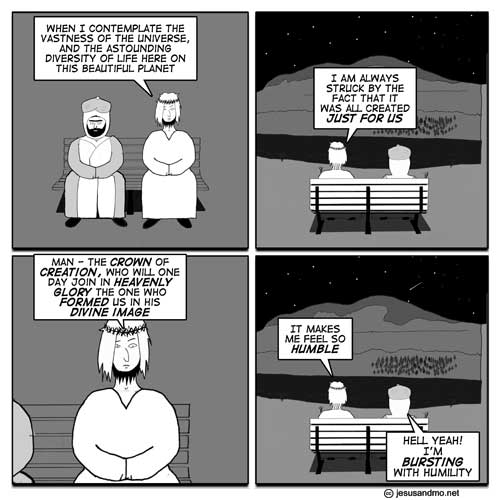



that’s always been a tripping point for me – how can a person really think they are humble AND that the universe was created by a power skydaddy just for them?
How also can they think that their skydaddy is wholly concerned with what they behave, what they do with their genitals, sacrifice Jebus for them – and yet at the same time, be unworthy.
How can people be so comfortable with cognitive dissonance?
Hitchens is wrong when he says that religion poisons everything: Without religion we would not have Jesus and Mo.
@ nina: I recall exactly that cognitive dissonance from when I was a christian. Except of course then, there was no hint of dissonance. I still thought of god as a vastly magnified human being, somehow simultaneously cosmic architect and human savior.
Gradually, I became aware of the undeniable (for me) discrepancies between those two roles, the contradictions of the Bible, and the cherry-picking of doctrine that all believers (including me) indulged in. And that was when I consciously left faith behind.
I’d be quite happy to go without this comic strip if religion was seen for the irrational, imaginary friend syndrome that it is by all of its billions of followers.
I’d actually have some hope for humanity if the majority could get over that childish hurdle.
What the hell is ‘heavenly glory’ anyway?
If it’s hanging around for ever with an unknowable uber being, who has an incomprehensible master plan, I’ll take the down escalator, thanks.
Infuckingeffable!
Even more so, why would the God create something – The Crown of Creation, allegedly – just to go through all the hasseles on this earth if it is to be returned to heaven? He might as well have kept it there. Safely.
@ Sach
It’s all part of his plan. Who are we to question it?
No. That’s not it. There must be some other explanantion.
A friend of mine (devout Christian) and I keep having this conversation about eternal existance. Man I get bored here on earth while waiting for my next book or next movie to come out. How about waiting a millenia for something exiting to happen like when that first reptile crawled out of the mud. Ohhh thrilling or waiting for that first humanoid to start fire. Of course my friend seems to think he would always have something to do like explore the universe. Does heaven exist inside the universe? Puffy clouds and harp music forever, yuk!
Seconding the ‘”I’d do without Jesus and Mo to see the back of religion” sentiment, although I don’t think Humanity is entirely doomed.
And to John Moore, I think some of the more sophisticated religiots try to claim their fairy of choice exists outside of space and time, so wouldn’t necessarily have to experience it as we do. I think this is also forwarded as an attempt to avoid the ‘Who created God then?’ infinite loop. Of course, the volume [both acoustic and quantitive] of nonsense spouted means it can be quite hard to keep track of all of it, so I may be overstating someone’s case.
To paraphrase the original Poor Richard, who said he was able to achieve an “Appearance” of Humility, but not the “Reality”: “If I did indeed attain Humility, I would be proud of it.”
@wright
I stopped going to church at 10 – I wasn’t old enough to explain cognitive dissonance naturally, but I was old enough to know that the stories we were told didn’t make any sense.
I always felt a strong injustice was done to Cain, since there was no clear reason why his offering wasn’t acceptable and no one could ever explain when he was banished, how he came to be married since the only people in the world at that juncture were Adam, Eve and himself since he snuffed Able.
A sunday school teacher vaguely referenced some other kingdom of men – but I wasn’t willing to buy that.
I became an atheist at 12, leving god on the same childhood scrap heap as the tooth fairy, Santa and the Easter bunny.
@ nina – I was on a business trip with a co-worker and while ironing my clothes I stumbled across The Ten Commandments on television. Of course it gave a quickie version of the beginning with Cain, Able et al. Of course I brought the same point up and was told matter of factly that God simply didn’t tell the whole story and it shouldn’t influence my decision to not beleive. I almost spit orange juice out of my nose. You would think with the four people mentioned in the begininng that a whole bunch other people would have been worth mentioning. I like you left religion behind early in life.
Let’s hope Mo doesn’t actually explode.
Richard Feynman expressed the idea in this week’s strip well:
(QUOTE)
“It doesn’t seem to me that this fantastically marvelous universe, this tremendous range of time and space and different kinds of animals, and all the different planets, and all these atoms with all their motions, and so on, all this complicated thing can merely be a stage so that God can watch human beings struggle for good and evil — which is the view that religion has. The stage is too big for the drama.” (UNQUOTE)
* Statement (1959), quoted by James Gleick in Genius: The Life and Science of Richard Feynman (1992)
http://en.wikiquote.org/wiki/Richard_Feynman
@nina: good for you, leaving that all behind at an early age. I think it’s true that most kids have no problem making the distinction between fantasy and reality. If they’re taught any kind of critical thinking early on, then even if they’re immersed in religion, they question its claims at some level, at some point in their lives.
Admittedly, that is pure speculation and anecdotal; I can’t back it up. But it dovetails with what I’ve read and observed about the decline of religion in the US, at least.
Once again, Author, you articulate perfectly objections that have been clanking round inside my head for years
nina, i love your sentence! i’m going to quote from you :))
how can a person really think they are humble AND that the universe was “created by a power skydaddy just for them?”
@ Stephen Turner
Excellent reference to Feynman. “A stage too large,” would be a terrific title to a book or movie about the consequences of discovering multiple civilizations in our galaxy, many advanced far beyond ours.
I heard that question asked somewhere recently. One person said it would be the end of religion. I think he was underestimating “the power of myth.” Such a discovery would simply cause the more hard-core to circle the wagons and defend their faith against all those satanic forces. It would be seen as a “test.” The more liberal believers would simply rationalize away their cognitive dissonance.
The Origin of Species (150y ago) really should have been the straw to break the camel of belief’s back. With coherent explanations of geological time and a powerful and simple mechanism for species to exist and develop, there really isn’t any need for a creator god. But see if the believers get it. “The power of myth” is still going strong, so even if we encounter intelligent non-earth creatures or civilizations, it’ll just be another “proof of god”.
I love the “God simply didn’t tell the whole story” explanation: there’s not even a need to believe the magic books; just believe the priest 😀
Perhaps Mo wouldn’t feel like he was bursting if he had passed on seconds from the burrito plate? Or as Jesus once said, “Well, you can all kiss my tacos”. At least, that’s what it sounded like he said.
@Hobbes
If you can bear to listen to some fundies, you’ll find they’ve already pre-emptively dealt with the prospect of alien life by declaring that it would inevitably be “satanic”. No question is too knotty for a bolted-up mind trained in theological acrobatics (the Jesuits are a bit more sophisticated, saying that they would do their best to “save” our tentacled friends).
Can you imagine if the first human message to an advanced civilisation was some fevered screed of religious gibberish, urging them all to convert?
@Gronk. That is a genuinely scary thought. Do you have a reference for that?
I have just had a worse one- what if believing that this is somehow all for your benefit is something that convergent evolution has generated in the aliens? They are coming over to convert us! It sounds like the plot of Jerry Zuckheimer movie….
Of course, lefty Atheoids don’t see humans as the ‘Crown of Creation’, we just part of Nature like all other life-forms…..oh, except for our carbon emissions, they’re different cos they’re ‘Anthropogenic’ gases you see, so we gotta stop emitting our unnatural CO2 to Save The Planet…
@ Crusader. Ya think humans the “Crown of Creation?” Let’s look at a few of these “crowns”: Attila the Hun, Stalin, Hitler, Pol Pot, Caligula, Religious zealots in general, not to mention the 10’s of thousands of axe wielding maniacal little “crowns” who follow such bigger “crowns” and of course, many if not most were following a skydaddy, including the Judo/Christian skydaddy who told them to commit genocide and ethnic cleansing. Now, if that is a “Crown of Creation,” it certainly is more a act of an evil skydaddy rather than a benevolent one.
The 1975 movie “Galileo”, based on the Bertold Brecht play, deals with G.G.’s work refuting geocentrism and his recantation forced by the catholic church.
It is a bit of a strange but weird movie, with its roots as a stage play showing.
http://www.imdb.com/title/tt0073029/
http://en.wikipedia.org/wiki/Life_of_Galileo
@John Moore
I would have pressed my friend to know then what else Skydaddy is holding back.
If leaving out a whole kingdom of people, who are then presumably living rather well without “His” involvement….
@wright
I tend to agree with you – the other kids I knew who weren’t church going tended to be the smarter ones, who asked questions in class on any subject – wanting to know the backstory or more.
The ones who accept religion’s tales, seem less interested in learning and are less curious about the world. They appear satisfied with very basic explainations or simply aren’t interested in any ouside of what they already decided.
@cina
As much as I’d like to take credit for skydaddy – I picked up that expression on the http://www.topix.com atheist forum.
I did start spelling it buybull though
and in response to a fanatic insisting that the Shroud of Turin was proof of Christ’s passion, coined the phrase Tissue of Turin
It’s interesting seeing the difficulty a (funda)mentalist has with the concept that humans are ‘just part of Nature like all other life-forms’. It’s a point of view that never occurs to me – that humans are somehow fundamentally superior to other animals. Obviously we (most of us) are more intelligent than other animals, and use more tools, sophisticated language and so on, but it’s interesting to consider the view that some people believe that we are somehow a different category of being. I think the consequences of that viewpoint can inevitably be only toxic and harmful – that the world around us is put there for us to consume and destroy as we need, and that if we fuck it up completely, it doesn’t matter because our invisible daddy will either fix it for us, or fucking it up was what we were meant to do all along.
It also couldn’t be much more ironic, given ‘makes me feel so humble’.
Also, Christ’s passion – ‘Tissue of Turin’: LOL.
@Toast
That Tissue of Turin was definately one of my better ones.
Yes, that beleif that there’s mineral, vegetable, animal and humans is very bizzare to me – especially when a lot of so called lower animals actually have a more complex genome than us.
It occurs to me that this cartoon could just as easily be about modesty – since isn’t wearing special clothes to show your modesty actually bragging about it?
@Crusader. We need to lower pollution for OUR (our kids really) benefit. The planet will get along just fine once we have evolved ourselves out of existence. Just like it did with the sabre-toothed cat, irish elk etc. Other life will fill the gap. There are mass extinctions (90% + species) every few milion years. As one of the few puppets of evolution that can see the strings we have a chance not to be a cause of one such. But something else will gleefully fill the gap if (when) we screw up. Eventually.
@ Daoloth
Read this, and I’ll wait for the clunking sound of your jaw hitting the ground: http://www.encyclopedia.com/doc/1G1-13417541.html
I forget where I read the original fact, some church history book I think, but in it the observatory’s director states that if aliens are discovered, and some way is developed to reach them, “of course we will try to save them.”
@nina & wright
Answer a child’s questions often enough with the reply that “goddunnit”, and finally that kid’s natural curiosity will atrophy. He’ll look at a rainbow or some other natural marvel and shrug “goddunnit”, and this bovine indifference will last his lifetime. Which is why I regard religion as child abuse.
@Daoloth. What’s ‘pollution’ to you is ‘food’ to trees (& other green stuff). Species go extinct due to circumstances; they don’t ‘evolve themselves out of existence’.
@ Hobbes. I think you missed my point (by that much).
@ Crusader – be careful lots of GW’s in here……
‘Species go extinct due to circumstances‘ – Jesus fucking christ! If an external force rapidly alters the habitat a species has evolved over millions of years to inhabit, it won’t be able to survive in it, or to evolve rapidly enough to compensate.
Manual records, mud and ice-cores show that the world’s climate has been warming more rapidly in the past hundred years or so than any time for thousands of years previously.
CO2 and methane in the atmosphere cause it to warm.
The human race has been digging coal and sucking oil and gas out of the ground on a mass scale for the last 150 years, burning it, releasing the CO2, and additionally, multiplying our own population by a factor of 4 and farming methane-producing animals and crops on a massive industrial scale to provide for ourselves and our increasingly meat-based diet.
Ice caps are melting, glaciers are melting, sea-levels are rising, 10s of millions of people in coastal cities and towns – not to mention low-lying islands – are being flooded out, forests are being torn down, the consequent soil erosion is creating expanding deserts, rivers are silting up and drying up, the increasing amounts of CO2 in the oceans are acidifying them and killing coral reefs and shelfish, the warmer waters are disrupting ocean currents, the reduced amount of permanent ice-cover itself reduces the albedo effect and so further increases warming, and so on and on and on.
Where is there any doubt in any of this? Really – even for bible-belt web-footed rednecks, what is hard to understand about this process? Which part of it isn’t accurate?
@crusader
“What’s ‘pollution’ to you is ‘food’ to trees ”
no, amazingly, the industrial and agricultural waste isn’t food to other things
The idea of an Incarnation of God is absurd; why should the human race think itself so superior to bees, ants and elephants as to be put in this unique relation to its maker? And why should God choose to come to men as a Jew? The Christian idea of a special providence is nonsense, an insult to the deity. Christians are like a council of frogs in a marsh or a synod of worms on a dunghill, croaking and squeaking, “For our sakes was the world created.”
–Celsus
Hi all! I really like “Jesus and Mo” (right now I am going through the archive of 2006 and enjoying it a lot). I am a member of a mainstream protestant church and I think it’s really important to keep making fun of silly or not-so-silly things people may believe.
If you’re an atheist, fine. I even agree that being an atheist is perfectly rational (why believe in something there is no proof for, like the Loch Ness or Flying Spaghetti Monster). But even if you are an atheist, there are questions about your life that you can’t avoid. You can try to answer them on your own, consult your friends or family, literature, Jesus and Mo, philosophers, become a member of the Communist Party or whatnot… After being an atheist for some time, I found the best answers, or rather, the best conditions for looking for the answers, in a moderate Christian assembly.
I wish all of you good luck in your pursuits.
‘If you’re an atheist, fine.‘ – Gee, thanks. Glad we have your permission.
‘…even if you are an atheist, there are questions about your life that you can’t avoid.‘
What questions do you imagine atheists are ‘trying to avoid’ Tom? You describe yourself as a former atheist, yet you now take refuge in christian magical fantasy explanations for existence. Surely it’s theists who avoid difficult questions.
to Toast: sorry, I didn’t mean to get personal, I just meant “Some atheists are OK, some Christians are OK too, some muslims etc.” I live in the most secularised country in the world (guess where 🙂 ), and I don’t feel like having to exercise any moral supremacy over anyone.
Now to the questions you requested (and it has to get personal): Who are you? (and I am not asking for the name) Where are you going to? Why are you here? Why do bad things happen to good people? Why do they happen to you? Are you going to die? Will it hurt? What will happen after that? Why should you be nice to people if you get nothing back? Is there such thing as supreme good? What is the nature of the God you believe (or deny your belief) in?
That sort of questions. I wrote that I found a welcoming group of educated people who happen to be Christians with whom I can share my thoughts on these questions. I slightly doubt that there are similar groups of atheists and that they are more likely to find themselves on their own in looking for the answers, which, I must admit, I see as a bad thing.
Nevertheless, I wish you good luck in your search.
It’s interesting that you think you’re in a position to ‘exercise moral supremacy‘ – it sounds astonishingly arrogant. Unless that’s just inarticulately worded. Anyway, your questions:
Who are you?
That’s both too complicated and too simple to answer. Either way, why do you think atheists are trying to avoid answering it?
Where are you going to?
The shop to buy some lunch.
Why are you here?
Because I work here. Or, because my parents had sex and my mother gave birth me.
Why do bad things happen to good people?
Why wouldn’t they?
Why do they happen to you?
Why wouldn’t they?
Are you going to die?
Are you serious? This isn’t an honest question. If you’re asking this question, you’ve already decided to deny the incontrivertible evidence of your eyes, and everything in the world around you. It’s childish wishful thinking.
Will it hurt?
Depends how it happens I guess.
What will happen after that?
My body will rot, or be burnt or possibly devoured by badgers, depending as above. The rest of the world will continue more or less unaffected.
Why should you be nice to people if you get nothing back?
Don’t be if you don’t want to. Why do you think you get nothing back? Doesn’t it make you feel better, to think of yourself as a kind person? Or do you expect a bag of money through your letter box?
Is there such thing as supreme good?
No. The words are meaningless.
What is the nature of the God you believe (or deny your belief) in?
I don’t ‘deny my belief‘ in a god. I don’t believe in one. Can you really not understand the difference? You’ve decided from the beginning that you believe in god, and that there’s life after death, and you’re clinging to a group of ‘educated people‘ who, because of their status in your eyes as authorities validate your desperate need to believe in your own personal significance and most importantly – immortality. Because these supposedly learned people agree that there is a god etc, you feel less stupid for telling yourself there is one. As for its nature, you’ve invented it – you tell me.
As to ‘slightly doubting’ that there are groups of atheists – look around you. I think you’ll find quite a few on this website, just for starters. Of course, there are numerous reasons there tend to be fewer groups in real life for atheists, not least for the same reason that there aren’t groups of non-stamp collectors, or un-orchestras. There are some however, and I’m sure you could find one if you tried.
I propose we leave the morality issue alone 🙂 something must be wrong with my English 🙂 you win.
Nice take on my questions. In my opinion, you avoided the answer to those questions where you answered with another question.
Sorry, I was not serious with the “Are you going to die” question 🙂
If you say you don’t believe in God, then you must have a definition of the word “God”.
@Tom surely the question “why do bad things happen to good people” cannot make you run towards the Judeo-Christian invisible yet psychopatic deity? When you are Judeo-Christian the answer to that question (as to all the others you might have) is as follows “because the old dude in the sky wants it so” – which means that deity is a mean, cruel, evil bastard jerk whose plan is to make good people suffer and reward nasty jerks during their lifetime.
All the evil and bad shit that happens randomly or intentionally in the world on a daily basis is a constant, never ending proof that no deity exists, especially not a provident and kind to humans one (which by no means is that Yahwe asshole anyway). The deity as you know it is either absolutely illogical or viciously venomous since it allowed Holocaust or bombing of Hiroshima or the ongoing slaughter of various RELIGIOUS people fighting each other. Why doesn’t that invisible friend in the sky at least protect the believers who spend a lot of time and energy addressing that fairy thing? Answer: because that deity doesn’t exist and never has. And why doesn’t that thing ever talk back and at least tell you about the plan it’s supposed to have for you? Because that fairy doesn’t exist and it has no plan for you.
Just accept that your existence is random, your life is a coincidence – and make the best of it for you. Don’t waste time on ancient lies.
Re ‘you win‘ on the morality issue. A discussion isn’t a contest, and it’s important to express yourself clearly, partly so other people can understand what you mean, and just as importantly so you understand your own thoughts yourself. It’s not a question of anyone ‘winning’.
Further to your question: Who are you?
A simple answer would be to give you my name, a physical description, where I work, names of friends, family, personal history perhaps – but that wouldn’t answer your question, even if I were prepared to do it. A more complicated answer would be to describe my various and varying states of mind; how I felt when I woke up this morning, the thoughts that occurred to me, how I felt whilst having breakfast, what I was thinking about, the thoughts and feelings I had whilst travelling to work, and so on. Obviously that would be very time consuming and probably not very interesting to anyone else. I also doubt it would in a meaningful way answer your question. My thoughts and feelings are mine, but they’re probably not hugely different from most other peoples’, so perhaps you can expand on exactly what the question means.
Why do bad things happen to good people?
Why wouldn’t they?
Why do they happen to you?
Why wouldn’t they?
My answers were perfectly serious and not in any way evasive, and I think – again – you need to think more about what your question means. Why is it a question? Why would ‘bad things’ happen only to bad people? What are ‘bad people’? The only way ‘bad things’ could be apportioned specifically to ‘bad people’ would be if ‘bad things’ were caused or controlled by a being or organisation which knew what people had done, judged them, and then caused ‘bad things’ accordingly. The only thing that sounds like to me is a god. So you’ve already decided there’s a god before you’ve asked the question. (And that, even when the very reason you’re asking the question is because the evidence shows there IS no such being acting in such a way.)
To me, the world is ball of rock, smeared with various forms of life and bodies of water, surrounded by an atmosphere of gasses, hurtling around a vast thermo-nuclear reactor. Earthquakes happen because of tectonic plate activity – plates of rock floating on moving mantle. Hurricanes happen because of complicated interactions between heat from the sun, the ocean, the earth’s rotation and so on. Sometimes people murder other people – there might be masses of complicated reasons behind it, but the point remains, there’s no way, and no reason why, in a natural world such things would be selective according to the victim’s ‘goodness’ or ‘badness’ – why do you think there’s a question to answer in the first place?
As for a definition of god, I would tend to keep it fairly simple: an invisible, supernatural, all-powerful being. People from specific religions add further detail, but in my experience that definition covers the conception of god of every christian and muslim I’ve ever met or who’s opinions I’ve ever read. Is yours different? If it is different, do the differences make it any less implausible?
“bad things” and “good people” are generalizations, of course. However, there are things that can be described as “bad” by a consensus of say, 99 percent, of all people of any cultural background. Think of e.g. cold-blooded murder of a 3 year old child.
The injustice I see around me makes me ask the question. I sort of can’t consider it a non-question. If you call it “deciding for an existence of a god” before asking the question, so be it. These two things go hand in hand for me.
My definition of God (and I have no systematic theological education, so please excuse my formulations):
1. He/she is undescribable. Calling him/her “invisible, supernatural, all-powerful” means anthropomorphing (is there such word?) him/her in the wrong way. (Loosely based on the ideas of Justin the Martyr and Clement of Alexandria)
2. The only exception to the above: He/she is compassionate. He/she can feel pain and takes part in our suffering. (Loosely based on the ideas of Kazo Kitamori)
That’s it. Such a God is hard to disprove or condemn, isn’t he/she? 🙂
The injustice I see around me makes me ask the question. I sort of can’t consider it a non-question. If you call it “deciding for an existence of a god” before asking the question, so be it. These two things go hand in hand for me.
… and that’s a non-answer. I’m not calling it anything – that’s what it is. What you see around you isn’t injustice – we live in a materialistic world. Suffering is not injustice. It’s simply the subjective experience of materialistic events by sentient creatures – sometimes we might describe our experiences as suffering. You confuse yourself when you think of it as injustice. It’s only ‘injustice’ if you’ve already decided that there is an objective ‘right’ and ‘wrong’, that there is a deity who cares that people are punished or rewarded, and that that deity has the power to act accordingly and does so.
You said even if you are an atheist, there are questions about your life that you can’t avoid – but it is you who is avoiding questions. As you now admit that that is ‘deciding the existence of god before asking the question‘ that is at least a small step of progress.
Your (non-)description of the god you believe in is meaningless and self-contradictory. You start by saying it’s ‘indescribable‘, then go on to describe it. Are you saying your god *is not* invisible? Is it *not* supernatural? – is it mortal, for instance? is any part of the universe outside its influence or control?
You say that to describe it in the very general way I put forward is somehow to wrongly anthropomorphosise it, but then anthropomorphosise it considerably more yourself by claiming it is ‘compassionate‘.
No one has ‘condemned‘ any god – that is simply a straw-man and a rather disingenuous one. The onus is on you to prove the existence of your non-anthropomorphic-yet-compassionate, non-invisible-yet-not-visible etc god, not the other way around. It is you who is making the claim that it exists.
Ad the “proof of God”: There is no proof of the existence (or nonexistence, for that matter) of God. There are just hints. Some people interpret them one way, some interpret them other ways. Therefore there is no burden of proof on anyone. As long as people don’t put other people into prisons or kill each other for their faith or lack thereof, I am happy.
It’s not atheism I’m criticising, it’s the pure materialism that some people feel that follows from atheism. Relativising the subjective (“suffering”, “injustice”) in theory usually leads to relativising these things in practice. Just look at the history of countries that used atheistic materialism (dialectical materialism, i.e. Marxism-Leninism) as their founding philosophy.
And BTW, if you say there is no absolute moral standard, whether dependent or independent of God, then you can’t really say that your opinion is “better” or “worse” than my opinion, and therefore our debate is meaningless. Or am I “wrong”? 🙂
Yes, you’re wrong, in many ways, and I think you know that. The most immediate being – what has a ‘moral standard’ to do with whether you or I are right or not? It’s a nonsense question, and you’re just confusing yourself again.
You make the same mistake when you use the word ‘hints’ that you make when you use the word ‘injustice’ – it only makes sense if you accept a priori that a god exists. Theists claim there is a supernatural being – this is an exceptional claim and the burden of proof is entirely on you to prove it. You know you can’t which is why you slide and equivocate, avoid difficult questions, and throw up distractions when you’re shown to be wrong.
A prime example: you begin your next paragraph ‘It’s not atheistm I’m criticising‘ yet it very clearly is. You said: ‘even if you are an atheist, there are questions about your life that you can’t avoid‘. You are stating that atheists ‘avoid difficult questions‘ and clearly implying that this is a prerequisite of being an atheist. The example you gave of one those questions was ‘Why do bad things happen to good people?‘ – yet this is a very simple example of *you* avoiding a ‘difficult’ question (difficult only because you don’t want to accept the answer) – ie, why does a ‘compassionate’ god allow eg, Haiti? – and the answer you’re avoiding being ‘because there isn’t one. The causes of suffering are simply natural events. There is no moral ‘why?’, only an empirical ‘how?”. Your ‘injustice’ and your ‘hints’ are the same self-deception. You’ve decided in advance that there is a god, therefore you have to explain the overwhelming lack of evidence for one by describing natural, empirical phenomena in terms that agree with your belief – turning euphemisms and metaphors into facts.
The goodness or badness in practise of any regime or system has *absolutely nothing* to do with the veracity of claims about the supernatural. Religious regimes throughout history have caused more torture, death and human misery than anything else, yet this is not the reason they are factually wrong – only an example of their hypocrisy, and yet you are now trying to hide behind the misery imposed under Soviet communism, as though that somehow made your god real.
The closest you’ve come to saying something true is ‘our debate is meaningless‘. Not ‘meaningless’ I would say, but pointless. Whenever I’ve shown you to be wrong or contradicting yourself, you’ve tried to slither out of it and change your argument, or hide behind distractions. Either you are an insincere debater or you are genuinely too unintelligent to follow reason applied to your own words. This debate is increasingly un-rewarding either way.
If you read my first post carefully, I’m not criticising atheists (“if you’re an atheist, fine”), I’m criticising “atheists who avoid certain questions”, materialistic atheists, if you want a provisional short term. And I’m using the argument about communism to support the thesis that “materialistic atheists” are generally “morally wrong”, not to support the thesis about the existence of God.
As a “hard atheist”, denying the existence of any god, you probably subscribe to Clifford’s principle “It is wrong always, everywhere, and for anyone, to believe anything upon insufficient evidence.” The word “wrong” in this sentence can be understood in either the ethical/moral meaning (just as in your post from Feb 2 referring to “injustice”), or in the epistemical meaning (as in your post from Feb 3) referring to our discussion.
If you apply Clifford’s principle with the epistemical “wrong”, then I ask you, why should you “believe” that Clifford’s principle is right? Do you have sufficient evidence for it? Or are there just “hints” like with the non/existence of God? What I’m trying to get at is that you first decided that there is no God and then you engaged in a debate applying the seemingly neutral principle based upon that decision. But the principle is not neutral, it is your principle, and it’s subjective. Just like mine.
If you apply Clifford’s principle with the ethical “wrong”, while at the same time denying the existence of objective “right” and “wrong”, the sentence doesn’t make any sense.
It’s you who is using so many ad hominem arguments that you are getting lost in them (and sorry for this ad hominem argument, it is my last one in this discussion).
Not to avoid your question: 🙂 If you believe in no objective moral standard, then you cannot make “true” or “false” ethical propositions.
Like “It’s wrong (bad) to believe in g/God.”
To quote the entirety of the first paragraph of your first post :
‘If you’re an atheist, fine. I even agree that being an atheist is perfectly rational (why believe in something there is no proof for, like the Loch Ness or Flying Spaghetti Monster). But even if you are an atheist, there are questions about your life that you can’t avoid. You can try to answer them on your own, consult your friends or family, literature, Jesus and Mo, philosophers, become a member of the Communist Party or whatnot… After being an atheist for some time, I found the best answers, or rather, the best conditions for looking for the answers, in a moderate Christian assembly.‘
So you now attempt to give the impression that you were drawing a distinction all along between ‘atheists who avoid certain questions‘ and a group of some other kind of atheist. What you actually wrote can only be read as ‘to be an atheist means avoiding certain questions‘, with this meaning emphasised with a further recommendation, based on your personal experience, that the answers can be found in ‘a moderate Christian assembly‘.
You now define a sub-group which you call – ‘materialistic atheists‘. How is this group different from other atheists? What is a ‘non-materialistic atheist’?
As you made no suggestion in your original post that any such sub-groups exist, let alone that you were referring only to one of them, the fact that you are now creating one and restricting your criticism to that sub-group only, suggests that you are accepting your first post was wrong, but can’t openly admit it.
How can it be ‘morally wrong‘ not to accept an assertion about a being’s factual existence or non-existence? It’s not a moral question – it’s a factual one.
Clifford’s principle seems sound to me. Do you feel you don’t have sufficient evidence to accept it? Excluding your belief in god – which you accepted in your first post is irrational anyway – how many examples can you think of where Clifford’s principle wouldn’t apply? I would suggest that in most cases, most of the time, it’s a description of how we interact with the world around us. If you believe its validity is merely subjective, do you think it would harm or benefit your life if you attempted to live counter to it?
Moreover, do you think a question of the unique scale and significance of ‘Is there a supernatural being who created the universe?’ should be decided by an exceptional/extreme loophole in an otherwise sound principle?
You confuse yourself by drawing a parallel between your belief that there are ‘hints‘ of a god’s existence and the belief in Clifford’s principle, but the comparison is false because the words have different meanings even though they appear the same. To consider any phenomenon in the world as a ‘hint’ is to accept a priori that there is something it is *hinting at* – ie, in this case that it was created by a god. Whatever your ‘hints’ are, you conclude inductively that they are evidence for a god. Clifford’s principle is measured in an entirely different way – it is deduced from the way we live, and then tested by being applied to our experience. If you can think of any major problems applying Clifford’s principle creates in your life, I’d be interested to hear what they are.
It’s a shame that you finish again on a disingenuous point. I’ve never said it is ‘wrong (bad) to believe in g/God‘ – and I think it is rather hypocritical of you to complain about ad hominem’s whilst doing things like that, or stating that ‘“materialistic atheists” are generally “morally wrong” not to support the thesis about the existence of God.‘.
It is simply factually wrong to believe in a god. Moral implications may follow from that, but the statement stands objectively by itself.
*sigh* I really should stop reading the comment section. Cause I actually like this comic bt everybody here seems to scorn religion. Oh well now I’m just complaining. Back to laughing.
@Toast: Ok, a materialistic atheist believes that nothing transcends the material man, be it in time (“Let us eat and drink, for tomorrow we will die.”) or magnitude of reason (“Man is the measure of all things.”, i.e. “I am the measure of all things.”, i.e. sometimes “The Party is the measure of all things.”).
A non-materialistic atheist at least acknowledges his/her “…faith in fundamental human rights, in the dignity and worth of the human person and in the equal rights of men and women…”.
You see it’s “faith” in “fundamental human rights” that helped create the world you and I live in. The framers of the Declaration of Human Rights were reluctant to say something like that there is enough evidence of “fundamental human rights”. Compare also the Declaration of Independence “We hold these Truths to be self-evident…”. “Hold” means “believe”, and the “truths” are “self-evident”. So there is an admitted lack of external evidence for those truths, yet there are people who are not ashamed to hold those truths. I believe that this limits the applicability of Clifford’s principle to the area where it properly belongs: natural sciences.
Therefore I believe that it’s wrong (both ethically and epistemically) to strictly apply Clifford’s principle to some beliefs, among which is also the religious belief.
I hope your definitions of ‘materialist atheists‘ and ‘non-materialistic atheists‘ give you pleasure – they certainly don’t offer much in the way of meaning. Where on earth did you get the idea that ‘materialist atheists‘ believe humans to be un-transcendably intelligent? That’s simply bollocks.
An atheist is someone who does not believe in a god or gods. It’s that simple.
The concept of “fundamental human rights” is one invented by man. It’s an aspiration. It’s not something which exists in any form other than through our creation.
The Declaration of Indepence states:
We hold these truths to be self-evident, that all men are created equal, that they are endowed by their Creator with certain unalienable Rights, that among these are Life, Liberty and the pursuit of Happiness. That to secure these rights, Governments are instituted among Men, deriving their just powers from the consent of the governed, That whenever any Form of Government becomes destructive of these ends, it is the Right of the People to alter or to abolish it, and to institute new Government, laying its foundation on such principles and organizing its powers in such form, as to them shall seem most likely to effect their Safety and Happiness…
Again, in this example’Hold‘ (or ‘believe‘) is used in a completely different way than in the phrase ‘I believe “it is wrong always, everywhere, and for anyone, to believe anything upon insufficient evidence.”‘
The Declaration doesn’t state: We hold it to be self-evident that water is wet – that actually is self-evident.
Clearly, these ‘rights’ don’t exist in nature. Very obviously, if they did they wouldn’t need to be stated or enshrined amongst the founding principles of a new country. It is an aspirational statement, casting the creed of the new country in opposition to wrongs its founders perceived in other existing countries. It is obviously not *literally* true that ‘all men are created equal‘ – we’re not all the same height, or equally ugly, or of equal intelligence, but the Declaration creates a principle of legal equality – notwithstanding that slavery continued for many decades in the USA.
‘hold’ or believe means ‘it ought to be the case that…’
The statement could be re-written: we wish it to be a fundamental principle that it is wrong for any man or woman to discriminate against any other man or woman on grounds of race, sex, nationality, sexuality, age, disability or any other factor over which they have no control, and that everyone will be treated equally under the law
As the second sentence states, these ‘rights’ are bestowed through human civilisation – they are not in any way pre-existing. They are principles which, as human societies evolve, they seek to implement and protect through law. They are also regularly attacked by the religious, cf, the pope’s recent rejection of equality legislation, and the church of england tearing itself apart about women bishops.
(1) Human rights can be a human creation, but then it’s the belief in their existence that made their existence come true, is it not? (And could you accept such a concept of g/God?)
(2) There are only two types of “believe”: “believe that/in (a proposition)” and “believe in (a person). The proposition can be either normative (as with the human rights) or descriptive (God’s non/existence), but the fact remains, we are talking about propositions here, not about persons, and I am asking you for the justification of your beliefs that Clifford’s principle holds in all situations and that there is sufficient evidence for the non-existence of God. Are we getting to your “properly basic” beliefs now? 😉
(When you say an atheist is someone who does not believe in a god or gods, I believe that it is equivalent to “an atheist believes that there is no god”.)
(3) Materialist atheism: Do you know a being more intelligent than humans, if there is no God?
(1)You concede that ‘human rights can be a human creation‘, though you don’t state where else you think they might come from. I notice you don’t argue about the misogyny and homophobia of the church – hardly conducive to human rights.
Sadly, you then make the same mistake you’ve consistently made – you use the word ‘believe’ in two different ways without realising or admitting you are doing so.
Your belief in god is in a being which you claim *actually* exists, but for which there is no evidence.
The belief in human rights is in a concept or way of behaving towards other people which *it would be desirable if it came into existence*. There is of course, ironically, plenty of evidence of the *lack* of these – and thus the need to create them.
Do you understand the difference?
(2) Show me where I said ‘Clifford’s principle holds in all situations‘
To save you time, I said this:
Clifford’s principle seems sound to me. Do you feel you don’t have sufficient evidence to accept it? Excluding your belief in god – which you accepted in your first post is irrational anyway – how many examples can you think of where Clifford’s principle wouldn’t apply? I would suggest that in most cases, most of the time, it’s a description of how we interact with the world around us. If you believe its validity is merely subjective, do you think it would harm or benefit your life if you attempted to live counter to it?
I didn’t mention Clifford’s principle of course originally; you did. Presumably because you wanted to try to equate belief in it with your belief in god – by mistakenly conflating two different uses of ‘believe’, as I explained in point (1) above, and in previous posts.
Show me where you are quoting “properly basic” from. I didn’t say it. Why are you quoting it when it isn’t a quote? Because you think it makes your position look better? Is that honest behaviour?
(3)What difference does it make whether I know a ‘being more intelligent than humans‘ or not?
You said a materialistic atheist believes that nothing transcends the magnitude of reason of man. I didn’t say that. That’s your belief. There may well be species elsewhere more intelligent than man.
And just to remind you of what we are in fact arguing about, and which you have tried to wriggle out of and distract attention from, without admitting you were wrong, here I’ll quote your first post and my response from a few posts back:
‘‘If you’re an atheist, fine. I even agree that being an atheist is perfectly rational (why believe in something there is no proof for, like the Loch Ness or Flying Spaghetti Monster). But even if you are an atheist, there are questions about your life that you can’t avoid. You can try to answer them on your own, consult your friends or family, literature, Jesus and Mo, philosophers, become a member of the Communist Party or whatnot… After being an atheist for some time, I found the best answers, or rather, the best conditions for looking for the answers, in a moderate Christian assembly.’
So you now attempt to give the impression that you were drawing a distinction all along between ‘atheists who avoid certain questions‘ and a group of some other kind of atheist. What you actually wrote can only be read as ‘to be an atheist means avoiding certain questions‘, with this meaning emphasised with a further recommendation, based on your personal experience, that the answers can be found in ‘a moderate Christian assembly‘.
You now define a sub-group which you call – ‘materialistic atheists‘. How is this group different from other atheists? What is a ‘non-materialistic atheist’?
As you made no suggestion in your original post that any such sub-groups exist, let alone that you were referring only to one of them, the fact that you are now creating one and restricting your criticism to that sub-group only, suggests that you are accepting your first post was wrong, but can’t openly admit it.’
(1) No, I don’t see any difference. These beliefs can be justified and true for some, unjustified or even false for others. The justification is a different issue. Foundationalism, coherentism, foundherentism, pragmatism, skepticism…
(2) Sorry for making it look like I was quoting anyone with the term “properly basic” – I would have used italics if I knew how to do it – I just wanted to point out that it’s a term. I am trying to show that even you have some unprovable beliefs upon which you found your arguments.
(3) What the sentence means is “there are questions about your life that you can’t avoid” – whatever your confession is. The meaning between the lines is, of course, “some atheists try to”, but that says nothing about the other atheists and all theists.
A non-materialistic atheist acknowledges the existence of things beyond the material world. A strict materialist would e.g. call love a chemical imbalance, a non-materialist would acknowledge that it’s so, but that it’s not the whole picture. As long as the materialistic atheists are denying the importance of spirituality, I feel offended.
(4) The Roman-Catholic Church is a conservative institution almost by definition. Is that good or bad? I think that it’s necessary to have a conservative voice in the debate about ethics, as long as it doesn’t have or try to gain a monopoly. But that goes for all other opinions.
The notion of Natural Law (from which originated the idea of human rights) was widely discussed by Christian philosophers throughout the Middle Ages. There are two sides to every coin (as long as it’s not a Moebius coin).
(1)Expand the word ‘believe’ in both sentences:
‘I believe in god.’
=
‘There is a being/entity/however-you-want-to-define-it known as god that *actually* exists.’
‘I believe in human rights.’
=
‘It would be better if people behaved towards each other in a particular way, ie treated each other equally, and didn’t cause unnecessary suffering.’
Try using the same subject in both cases, so the second sentence becomes:
‘People do *actually* behave towards each other in a particular way, they do *actually* treat each other equally, and don’t cause unnecessary suffering.’
The word ‘believe‘ is different in each case, and it is wrong to suggest that one is equivalent to the other. Even MS Word’s thesuarus shows this:
‘believe (verb)
1. accept something as true
transitive verb to accept that something is true or real
…
6. think something is good
intransitive verb to be of the opinion that something is right or beneficial and, usually, to act in accordance with that belief’
– these are the two meanings you are confusing.
(2)There’s an infinite supply of ‘terms’. It doesn’t help to start throwing them in to a discussion randomly, in quotes. And you haven’t ‘shown that even [I] have some unprovable beliefs upon which you found your arguments‘. See my quote of myself re Clifford’s principle. It may be useful, but if it’s proven wrong in any circumstance I don’t have to hold to it.
(3)If you’re unambiguously retracting the suggestion that to be an atheist one must necessarily ‘avoid questions’ then good. It seems to me that to be religious one must avoid the unpleasant answers to certain questions – that’s the reason our species invented religion in the first place.
(3b)’A non-materialistic atheist acknowledges the existence of things beyond the material world.‘ – what does this actually mean?
‘…A strict materialist would e.g. call love a chemical imbalance,‘ – would they? Who says? Where did you get this from?
‘Love’ could be discussed materialistically on many levels. It evolved for a reason, or more than one reason. It might suit the purposes of religious extremists to portray their opponents as emotionless robots by describing it in this way, but it sounds more like a charicature of Mr Spock to me. Who are you quoting here?
‘…a non-materialist would acknowledge that it’s so, but that it’s not the whole picture. As long as the materialistic atheists are denying the importance of spirituality, I feel offended.‘
Whether you ‘feel offended’ or not is irrelevant. If ‘spirituality’ is a thing, and needs to be included in debate, you’ll have no difficulty defining it and justifying why – so, go ahead.
(4)I specifically didn’t limit that point to the Catholic church. Even the C of E is being torn apart by this kind of mindless bigotry, let alone Judaism and Islam. You ask whether it’s good or bad? Do you ask that question also in light of fascist political parties, or does the exemption from ‘fundamental human rights‘ only apply to religious bigots?:
‘The British National Party is a conservative institution almost by definition. Is that good or bad? I think that it’s necessary to have a conservative voice in the debate about ethics, as long as it doesn’t have or try to gain a monopoly. But that goes for all other opinions.‘
Does that sound equally reasonable? If not, why not?
(1) Both of the sentences you provided use the verb “believe in” in the same meaning: http://dictionary.reference.com/browse/believe (see meaning 6a – I guess that 6b could apply to belief in God too, but as long as you insist on the impersonality of God, we cannot use that).
Belief in human rights and belief in God are different beliefs only because human rights and God are different concepts. But the meaning of “belief” is the same. (see also “Belief” at wikipedia or at the BBC’s H2G2: http://www.bbc.co.uk/dna/h2g2/A855371)
(2) OK, so we have done away with Clifford’s principle. Do you still want a proof that God exists? Even Richard Dawkins is cautious enough to say that “a supernatural creator almost certainly does not exist” (quoted from wikipedia). Almost certainly? (Battleground God http://www.philosophersnet.com/games/god.htm discusses this argument nicely.)
(3) I must admit that some theists also avoid questions. Too bad for them.
(3b) Try googling love chemical imbalance.
Ad spirituality: Spirituality is the ‘inner life’ of an individual, his/her subjective feelings and opinions, “deepest values and meanings by which people live”, for a nice quote. I think that the looking for meaning in life is the defining aspect of spirituality. Some people may say – hey, you are not going to find the meaning of life by sitting at home and reading a lot of books by wise people who think they found the meaning of life. They are right. It takes more luck and effort to follow a promising spiritual path in life. Those who criticise the extreme forms of spirituality are justified. I am more worried about the people who just don’t care. The people who only read the prolefeed and lead their lives accordingly. Those who elect populist politicians because they can only see as far as their stomachs. The populist politicians themselves.
(3c) If people and groups of people act as if there is an ineffable but caring-and-suffering deity, can the society become more stable? Religion obviously entailed some kind of evolutionary advantage to early societies. And my question is – can it be advantageous nowadays? Is God hard-coded in our genes? And do we have to try hard to overcome religion? And should we?
(4) Your example is different from my example – extremist political parties try to gain a monopoly, almost by definition. I do believe that conservative opinions are necessary to any ethical discussion.
You probably acknowledge that not all branches of the Christian Church are conservative – I picked the Catholic Church specifically to show that reasonable conservatism is something that I am not worried about.
(1) No, they really aren’t. Saying you *believe* that something exists is categorically different from *asserting your agreement* of the value of something. They are different. Really try to understand that.
‘I believe in god.’
=
‘There is a being/entity/however-you-want-to-define-it known as god that *actually* exists.’
‘I believe in human rights.’
=
‘It would be better if people behaved towards each other in a particular way, ie treated each other equally, and didn’t cause unnecessary suffering.’
‘God’ is a being/entity/whatever which actually does or doesn’t exist.
‘Human rights’ are human actions. If we act in a particular way, it can be described as demonstrating accordance with the concept, human rights.
If you take away people, ‘god’ still exists or doesn’t.
If you take away people, ‘human rights’ becomes meaningless.
(2)’Do you still want a proof that God exists?‘ – where have I asked for this? Why are you throwing in more irrelevant questions and pretending I asked them?
(3)’I must admit that some theists also avoid questions. Too bad for them.‘ – so now you’re weasling out of your apparent retraction?
In however many hundreds of words you’ve typed in this thread you still haven’t stated what question you think a person must avoid to be an atheist. So state it now.
(3b) No. I have better things to do. If you don’t take your own arguments seriously enough to support them, don’t be so arrogant as to ask me to do it for you.
(3c) Spirituality: ‘Spirituality is the ‘inner life’ of an individual… subjective feelings and opinions, “deepest values and meanings by which people live  looking for meaning in life is the defining aspect of spirituality…‘
Is it? I have those things. They’re not my ‘spirituality’. My ‘subjective feelings’ are just my subjective feelings. My ‘values’ are just my values, and so on. I don’t need to dress them up in mumbo jumbo terms.
And you provided this description to support this statement:
‘A non-materialistic atheist acknowledges the existence of things beyond the material world.‘
Are you seriously saying these ‘materialistic atheists’ you believe in *deny* subjective feelings, opinions, values, and everything else you mentioned? Do you think it’s possible you’ve actually simply created a robot enemy in your own mind, then convinced yourself it actually exists and wears the label ‘materialistic atheist’? Do you really believe there are people who don’t have, eg ‘subjective feelings’?
(3c) Utility of religion. Yes, obviously it was useful in some ways. That doesn’t for one moment make it any less bullshit.
(4) Fascist bigotry bad: Religious bigotry good – And which religion *doesn’t* want a monopoly? Christianity aims to spread the ‘good news’. Islam goes one further – you’re born muslim whether you know it or not. And again, why is the exact same bigotry acceptable – or ‘reasonable‘ when it comes from a group which is defined by its religion, but not when it comes from one defined by its political views?
Also, how is lieing that condoms *cause* aids ‘reasonable‘? Or that lobbying that states should not extend marriage privileges to two people because one of them is the wrong sex? Or campaigning against research using stem-cells? Or for the right to deny children an objective education about sex?
You define these things as ‘reasonable‘ *because* they come from a religious group rather than a political one. Not because of anything specific about the forms of bigotry themselves. They all harm other people, but you consider them ‘reasonable’ because they’re religiously inspired – and therefore exempt from human rights concerns.
(1) You haven’t persuaded me.
(2) How else can a “bullshit” stop being “bullshit” for you than by a proof?
(3) ’I must admit that some theists also avoid questions. Too bad for them.‘ – theists, not atheists
Spirituality: there are people who grossly underestimate the importance of subjective feelings and values (spirituality) and in turn don’t respect the spirituality of others who are willing to respect others. These are the materialists. (those who overestimate their own spirituality and in turn don’t respect others’ – religious fanatics and other superstitious lunatics)
(3c) “Utility of religion. Yes, obviously it was useful in some ways. That doesn’t for one moment make it any less bullshit.” – I call the last sentence your properly basic belief. Pretty much sums up this discussion.
(4) Bigotry bad, tradition good. Condoms OK, civil partnerships OK, stem-cell research OK, education about sex OK (but parents should be educated that it’s primarily their responsibility to educate their children about sex and not to leave it to the children’s peers).
1 a) ‘There is a being/entity/whoever-you-want-to-define-it known as god that *actually* exists.’
1 b) ‘It would be better if people behaved towards each other in a particular way, ie treated each other equally, and didn’t cause unnecessary suffering.’
‘Belief-that-x-is-true’ vs ‘assertion-of-the-superior-value-of-certain-behaviour’. Just think about the two sentences. It really isn’t complicated.
2) You’re digressing and distracting. You said ‘Do I still want a proof that God exists?‘ (my emphasis). I’ve never asked for proof of God’s existence, yet your question states that I have, and then for no reason you drag in Richard Dawkins. It’s just distraction because you still haven’t even ATTEMPTED to justify your initial point, from which this whole discussion arose and which I’ve asked you for several times, namely:
3)…the question you think a person must avoid to be an atheist
– what is it? What question am I and every other atheist avoiding?
Spirituality: there are people who grossly underestimate the importance of subjective feelings and values (spirituality) and in turn don’t respect the spirituality of others who are willing to respect others. These are the materialists. (those who overestimate their own spirituality and in turn don’t respect others’ – religious fanatics and other superstitious lunatics)
Ultimately, every ‘subjective feeling’ I might have could be traced down to physical, electrical and chemical action in my brain. There’s nothing ‘spiritual’ about it; there’s
nothing outside the natural world about it. It’s not extra-material in any way. It’s very, very small and very complicated, but it’s entirely material.
Your definition of ‘materialists’ (ie, ‘people who grossly underestimate the importance of subjective feelings and values (spirituality) and in turn don’t respect the spirituality
of others’) – seems to have nothing to do with whether they accept this explanation for their subjective feelings or not, and is simply a description of whether they are
polite/sensitive/respectful to others or not. Indeed, your definition (‘These are the materialists… people who grossly underestimate the importance… etc.’) could be re-written as: Materialists are people who are sometimes rude, insensitive or obnoxious.
You may not like people who view existence materialistically, but you haven’t offered any reason – or evidence – why someone who sees their own and others’ subjective
feelings naturalistically must necessarily ‘grossly underestimate the importance of subjective feelings and values (spirituality) and in turn don’t respect the spirituality of others’.
Seeing things realistically doesn’t for a moment necessitate underestimating other people’s subjective feelings.
It sounds more like you are simply offended by the idea that some people choose not to accept your views on the supernatural/spiritual or whatever you prefer to call it. In fact you said:
‘As long as the materialistic atheists are denying the importance of spirituality, I feel offended.‘
As you’ve still not provided any support for your own initial point (this mysterious question atheists must avoid), and given your explanation re ‘materialism’, it seems to me that your main motivation here is your ‘offence’ at people expressing views which make it difficult for you sustain your belief in the spiritual/supernatural. The problem is the conflict between the reasoning, rational part of your mind and the emotional part. Rationally, you know we are just meat, with a limited use-by date, and it causes you emotional discomfort to confront that, so you are offended when this is brought home to you by people who consciously reject the spirituality/supernatural which offers you a way out of that unpleasant knowledge. That would be perfectly natural – for you and for every other human being. The awareness of our own mortality is the seed of god/s, the afterlife and religion.
(1) God doesn’t equal human rights, but belief equals belief.
(2) Fine, then you don’t want a proof and therefore you accept my belief as equally justified for me as yours for you.
(3) Not only some atheists, but also some theists try to avoid questions like: “Why are we here?” to repeat myself. You can call it non-sensical or irrelevant, mock it or whatever, but still you have to answer it, at least by continuing your life. The “floating question why”, to quote my favourite poet.
The ‘materialists’ are not making it difficult for me to sustain my belief (remember, I used to be an atheist too). They can just be obnoxious to other people by considering their own position (There is/are no g/God/s) as the universal truth achievable by ‘reason’ (i.e. Belief in g/God/s is rubbish.). Similar to late-19th-century Catholic traditionalist triumphalism (God can be known solely by reason), only the other way round.
Of course there can be a conflict between the rational and emotional part, but it can’t be solved by crippling the emotional part.
“The problem is the conflict between the reasoning, rational part of your mind and the emotional part. Rationally, you know we are just meat, with a limited use-by date, and it causes you emotional discomfort to confront that, so you are offended when this is brought home to you by people who consciously reject the spirituality/supernatural which offers you a way out of that unpleasant knowledge. That would be perfectly natural – for you and for every other human being. The awareness of our own mortality is the seed of god/s, the afterlife and religion.”
I almost completely agree with the above. Only the “spirituality” is not offering me a “way out”, but rather a “way in” to lead my limited life down here with a proper fear of God, not trying to think that I know all the answers when I don’t.
ad the nexus between underestimating the subjective and being intolerant: the more you hold a proposition to be “objective truth” the more likely you are to be intolerant to those who don’t see the “truth” as “objective”.
Propositions in the magisterium of science can be verified/falsified by scientific means, and therefore be tentatively called ‘objective truth’. Propositions in the magisterium of metaphysics cannot.
1)’…belief equals belief.‘
Perhaps I’m explaining this badly, possibly because it seems such an obvious difference to me that I’ve never considered anyone else couldn’t see it, but the dictionary link you yourself provided contradicts your view:
‘be·lieve (bÄ-lÄ“v’)
v. be·lieved, be·liev·ing, be·lieves
v. tr.
1.
To accept as true or real: Do you believe the news stories?
2.
To credit with veracity: I believe you.
3.
To expect or suppose; think: I believe they will arrive shortly.
v. intr.
1.
To have firm faith, especially religious faith.
2.
To have faith, confidence, or trust: I believe in your ability to solve the problem.
3.
To have confidence in the truth or value of something: We believe in free speech.
4.
To have an opinion; think: They have already left, I believe.’
Either 1) agrees with the ‘believe in god’ meaning. Intransitive 3) agrees with the ‘hold these truths’ meaning.
Wikipedia draws the same distinction:
‘To “believe in” someone or something is a distinct concept from “believe-that”. There are two types of belief-in:[11]
* Commendatory – an expression of confidence in a person or entity, as in, “I believe in his abililty to do the job”.
* Existential claim – to claim belief in the existence of an entity or phenomenon with the implied need to justify its claim to existence. It is often used when the entity is not real, or its existence is in doubt. “He believes in witches and ghosts” or “many children believe in fairies” are typical examples.[12]’
2a)I didn’t request a ‘proof that God exists‘ so it was a distraction for you to introduce it into the discussion, and dishonest of you to ask if I ‘still‘ wanted one. Your statement ‘OK, so we have done away with Clifford’s principle.‘ was similarly false. ‘We‘ hadn’t ‘done away‘ with anything. You raised Clifford’s principle specifically because you felt you were able to safely ‘do away with it’. I said it:
‘seems sound to me. Do you feel you don’t have sufficient evidence to accept it? Excluding your belief in god – which you accepted in your first post is irrational anyway – how many examples can you think of where Clifford’s principle wouldn’t apply? I would suggest that in most cases, most of the time, it’s a description of how we interact with the world around us. If you believe its validity is merely subjective, do you think it would harm or benefit your life if you attempted to live counter to it?
Moreover, do you think a question of the unique scale and significance of ‘Is there a supernatural being who created the universe?’ should be decided by an exceptional/extreme loophole in an otherwise sound principle?‘
To compare ‘belief‘ in Clifford’s principle with ‘belief‘ in god/God/gods is the same false equivalence that you make between god-belief and human-rights-belief, as above. One is literal belief in the existence of a supernatural being, the other is assertion of the value of some type of behaviour.
2b)‘Even Richard Dawkins is cautious enough to say that ‘a supernatural creator almost certainly does not exist’‘
And? The onus is on the person making the claim to support it, and a claim for the existence of a supernatural being requires extraordinary support. It would inevitably be an entirely separate discussion from any other point under consideration, but if you think you’ve got some, go ahead. Why you think you would need – or even think it possible to have *belief* in a god for whose existence you actually had proof, I don’t know.
3)’…’Why are we here?’ to repeat myself. You can call it non-sensical or irrelevant, mock it or whatever, but still you have to answer it, ‘
I gave you a straight answer to this right at the beginning Tom:
‘because my parents had sex and my mother gave birth me‘
In what way does that *not* answer the question? How is it calling the question ‘non-sensical or irrelevant‘ or mocking‘ it? It’s the answer at the specific level, and if you extrapolate it backwards, it’s the answer 3 billion or whatever years ago as well.
This is the question you said atheists avoid, yet there is my answer from the beginning of this thread. You may not find it satisfactory, but it is the answer. This materialistic explanation – like it or not – answers your question. You don’t like it, therefore you pretend atheists aren’t answering your question – because they don’t come to the conclusion you have about god. It’s you who is avoiding things – specifically, the answer to your own question.
‘…but still you have to answer it, at least by continuing your life‘
It would take a positive effort *not* to continue my life, and it would probably be painful, and it could well go wrong and cause me considerable suffering and put me in a worse condition than I am. And I would gain nothing anyway. And I would have the relatively certain knowledge that it would cause considerable unhappiness to a number of people. So what other – non-material – ‘why’ do I need? Is that not enough? Once it’s over it’s over. Continuing it for as long as possible seems a no-brainer.
3) ‘The ‘materialists’ are not making it difficult for me to sustain my belief (remember, I used to be an atheist too). They can just be obnoxious to other people by considering their own position (There is/are no g/God/s) as the universal truth achievable by ‘reason’ (i.e. Belief in g/God/s is rubbish.)‘
If it is ‘perfectly rational (why believe in something there is no proof for‘, how can it also be rational to believe the opposite? Why is it ‘obnoxious’ to say that you think someone’s position is irrational or just wrong?
‘Of course there can be a conflict between the rational and emotional part, but it can’t be solved by crippling the emotional part.‘
Who’s crippling anything? You’re just complaining people come to a different conclusion than you.
‘…a “way in†to lead my limited life down here with a proper fear of God, not trying to think that I know all the answers when I don’t.‘
Who *does* think they ‘know all the answers’? And how does ‘fear’ of an (usually all-loving – strange, that) imaginary being prevent it?
‘ad the nexus between underestimating the subjective and being intolerant: the more you hold a proposition to be “objective truth†the more likely you are to be intolerant to those who don’t see the “truth†as “objectiveâ€.
Propositions in the magisterium of science can be verified/falsified by scientific means, and therefore be tentatively called ‘objective truth’. Propositions in the magisterium of metaphysics cannot.‘
If a proposition can’t be verified or falsified then it can’t be investigated or tested by anyone other than the person subjectively experiencing it. Therefore it can’t be applied generally and cannot have the same value as a testable proposition, yet you complain that people who value objective, empirically testable views higher than un-verifiable, un-falsifiable ‘spiritual’ or ‘supernatural’ views are being obnoxious. It’s only when people force their subjective, un-falsifiable views on others that it leads to intolerance.
1) v.tr. 1 doesn’t apply to “believe in” sth., because that’s IMHO intransitive (I’m not a linguist, but cf. the example sub v.intr.3).
v.intr. 1 and 3 really are the nuances of the meaning. But if you look more closely at the equivalents (faith vs. confidence), are they really so different? Both of them express some bridging of a mental gap between reality and knowledge, more or less certain or uncertain. The only difference is, in my opinion, that you consider one of the beliefs irrational and the other one rational.
Commendatory vs. existential claims of “believe in”: both could apply to God, and both could apply to human rights.
Also note that both sentences can be rephrased as “I believe that God exists.” and “I believe that human rights exist.”, and now there really is no difference between these existential beliefs. If you are a legal positivist, then human rights exist thanks to codification, if you like the Natural Law approach, then they exist thanks to human nature. In fact, both of these theories can be correct at the same time. It’s just the way of looking at things. Light beam can also be viewed as a wave or a stream of particles. The world can be viewed as a smoothly operating machine, as a plant that grew out of a seed, as a giant baloon undergoing inflation, or as the work of God. All of these theories can be correct at the same time and I see no problem in believing them, as long as they don’t offend my reason or feelings.
2) You believe there is/are no g/God/s, I believe there is a God. There is no way to tell which of these beliefs is wrong, i.e. out of correspondence with reality, because both are coherent with reality. I e.g. find it quite unbelievable that something appeared out of nothing. Nothing – no Planck’s constant, no numbers, no information, no laws of nature, no power which brought the universe into existence. Nick Bostrom’s idea that we are probably living in a computer simulation is intriguing, but still there has to be [someone/something that created/a principle by which arose] the ultimate reality.
3) “It’s only when people force their subjective, un-falsifiable views on others that it leads to intolerance.”
I totally agree. Both atheism and theism are such subjective un-falsifiable views. Neither can be proven wrong by observing the reality (see also the Argument from Ignorance at wiki). If the “hard” atheists meta-believe that they are epistemically better off with respect to God than the theists, then it’s only their fallacious belief, and if they spread the “hard” atheism across the population, then they are proselytizing just like any other religion, and they can be just as intolerant as some theists.
“By their fruits you will know them.” Mt 7:16. Our beliefs, all of which should also be coherent with our dis/belief in God, can have great influence on how we lead our lives. The evolution will eventually take its toll. Either the various kinds of theists and atheists alike will learn to share the planet with those who believe differently, or we’ll all become the evolution’s blind alley.
I tried to criticise in my comments those who deduce such opinions from their disbelief in God as are incompatible with my understanding of morality. I admit that this is a subjective category, and one may always be wrong in placing particular people in the category. I hate judging people. I just don’t like those who don’t think about their lives, that’s all. It’s not your case, I believe.
I also tried to note that my experience with religion and religious people has so far been positive overall.
“Why is it ‘obnoxious’ to say that you think someone’s position is irrational or just wrong?”
a) If someone’s opinion is fallacious (see Argument from Ignorance), then it’s obnoxious if they think they are right by virtue of reason and force their opinion on others (hard atheists – those who believe that there is no God and that those who believe otherwise are fools). b) If someone has some weird opinions on values (like e.g. it’s OK to marry and consummate the marriage with a 9-year-old, and that we are wrong in prohibiting that), then what they say is obnoxious and potentially dangerous.
if you look more closely at the equivalents (faith vs. confidence), are they really so different?
Yes, essentially they’re completely different.
The comparison is between faith in the existence of something(‘1. To have firm faith, especially religious faith.‘) vs ‘3. confidence in the truth or value of something: We believe in free speech.‘
They’re not synonymous; they’re not interchangeable. There’s very little similarity between them at all.
Faith is belief irrespective of a lack of evidence. Confidence in the value of something is dependent on evidence.
‘Also note that both sentences can be rephrased…‘
…which is exactly where we started. You’re using what are essentially two *different* words, deployed with two *different* meanings, but because the word itself is the same, assuming/pretending/deceiving yourself that the *meanings* somehow become the same. They don’t.
‘…I e.g. find it quite unbelievable that something appeared out of nothing…‘ – Arguments from personal incredulity have no value.
Moreover, ascribing the origin of ‘something’ to g/God/s answers no questions and takes you no further, as the origin of your invisible friend has to be explained, and you simply push the inconceivable one step further back. Even without any other reason, it’s more economical not to add an invisible deity into the equation.
Both atheism and theism are such subjective un-falsifiable views. Neither can be proven wrong by observing the reality … If the “hard†atheists meta-believe that they are epistemically better off with respect to God than the theists, then it’s only their fallacious belief,
That depends on your definition of god. Some – as defined by humans – are logically self-contradictory, and therefore should be safely disregarded. But more broadly you’re equating *belief-in-god* with *non-belief-in-god* and giving them the same value of reasonableness. This it seems to me is false. Whether or not any particular definition of god is or isn’t possible, everything we see around us can be explained materialistically, with the sole exception of the origin of everything, and that is not clarified one iota by adding a supernatural being.
…and if they spread the “hard†atheism across the population, then they are proselytizing just like any other religion, and they can be just as intolerant as some theists. – ‘spread’ how? By talking about it? There’s a difference between actively proselytizing – whilst, for instance – enjoying the many privileges afforded to religions in every society I’m aware of, and simply arguing against false beliefs when they present themselves to you. Or even actively trying to end privileges unfairly provided to one group or another.
I also tried to note that my experience with religion and religious people has so far been positive overall. – I’m glad. Outside the subject of justifying their particular religion (and that’s a big caveat), mostly, so has mine. As it has been with atheists. But why wouldn’t it be? And why would it prove anything either way? Religion is an evolutionarily massively successful organism – if it automatically alienated everyone other than the person holding to it, it wouldn’t be.
“Why is it ‘obnoxious’ to say that you think someone’s position is irrational or just wrong?â€
a) If someone’s opinion is fallacious (see Argument from Ignorance), then it’s obnoxious if they think they are right by virtue of reason and force their opinion on others (hard atheists – those who believe that there is no God and that those who believe otherwise are fools). b) If someone has some weird opinions on values (like e.g. it’s OK to marry and consummate the marriage with a 9-year-old, and that we are wrong in prohibiting that), then what they say is obnoxious and potentially dangerous.
Who’s ‘forcing’ any opinions? How could an atheist – ‘hard’ or otherwise – do this? Religious people display their beliefs publicly constantly, receive funding from ordinary tax-payers, have thousands of explicitly religious schools dedicated to propagating their views, air-time on national broadcasters and seats in our democratic parliament, and still they demand more consideration when laws are formulated, and special exemptions when their – supposedly divinely-inspired – views conflict with human rights considerations.
(1) I think that I can agree with you that the two ‘beliefs’ are different with respect to the availability of evidence. And I am also aware of the ‘is-ought’ problem. However, I also think that the defining point of ‘belief’ is that it is a mental state in some kind of relation towards reality and its limits, and that’s the important thing these two ‘beliefs’ have in common. We can therefore discuss the possibility of their justification and truth (if you are a moral realist with respect to the idea of human rights), and evidence is a good thing to begin with.
(2) OK, a lot of people find it quite unbelievable that something appeared out of nothing 🙂
I think I see your point.
I would reply that maybe God has no origin, as opposed to the universe. Universe is contingent, and it probably had a beginning. God is the one who is – s/he is what remains when the universe is gone by Big Crunch or Big Rip. One can imagine him/her as the possibility that a universe can come into existence. That possibility exists with probability = 1, because we are here.
Now if something can cause a new universe to appear, then it’s probably pretty powerful. It can also be quite intelligent (balancing all the constants, setting the laws, creating a preference for the existence of things that can multiply themselves). Although considering the length of eternity, one can call it chance (on the other hand, it probably makes no sense to speak of time outside our universe).
It’s just a matter of looking at things – I believe that such a God as described above is at least logically possible, and IMHO exists with a decent probability. But if one has a different worldview, fine, as long as they don’t close me to a concentration camp.
(3) Why shouldn’t one believe? There is no evidence contrary to the possibility of existence of God (although there is evidence contrary to some practical implications that some theists derive from the existence of God). One is not getting the information one needs to be absolutely sure and it’s probable that one won’t get another life to reconsider. Religious belief can have a profound effect on one’s life – religious people have higher levels of personal happiness, they have bigger families and stronger family ties, they belong to a community (important during the time of rapid urbanization), they receive a safe way to practise their (sigh!) spirituality if they join a mainstream religion, which gives their children better protection from various cults, and they also get high quality passage rituals (sounds awful!).
It’s no science. One only has one life and can rarely experiment with it in a scientific way. It’s a decision one must take with incomplete information. Which takes me back to the idea in my first post – I just wanted to say that faith is one of the best things that I accepted in my life, and I recommend the experience to everyone.
(4) A lot of atheists throughout the 20th century actively fought against religions in very barbaric ways, while enjoying full state support. Church property got confiscated by the State. But you are probably talking about another country 🙂 sure, false beliefs must be spoken against, but the belief in God by itself cannot be proven false. Veritas omnia vincit. Thank God for religious freedom and freedom of expression.
I support the separation of church and state.
LOL!…….. Ah, my……. I enjoyed, for the most part the volleyball Tom and Toast have been playing, each one of them thinking they’ve spiked thier serves, but amazed to find 0 – 0 on the scoreboard at the end. I wasn’t even going to comment, but the checkbox below made me laugh out loud! and I had to say something then. 🙂
@Stephen Turner — On the off-chance you ever return to this page, many thanks for the Feynman quote. Totally new to me, and especially brilliant, as was so much of what Prof Feynman said and did.